Today we will be looking at satellite detection and location of
lightning. We'll mostly look at a couple of
recent satellite sensors, the Optical Transient
Detector (OTD) and the Lightning
Imaging Sensor (LIS), that detect the optical
emissions of lightning during the day and at night from low earth
orbit. Both were designed and built by researchers at the
NASA Marshall Space Flight Center. A new and improved
lightning mapping sensor is on the GOES-16 satellite (formerly
known as GOES-R) launched in November 2016. The satellite
will undergo several months of testing before images become
available to the public (you can read more about the Geostationary
Lightning Mapper [GLM] here and
especially here
).
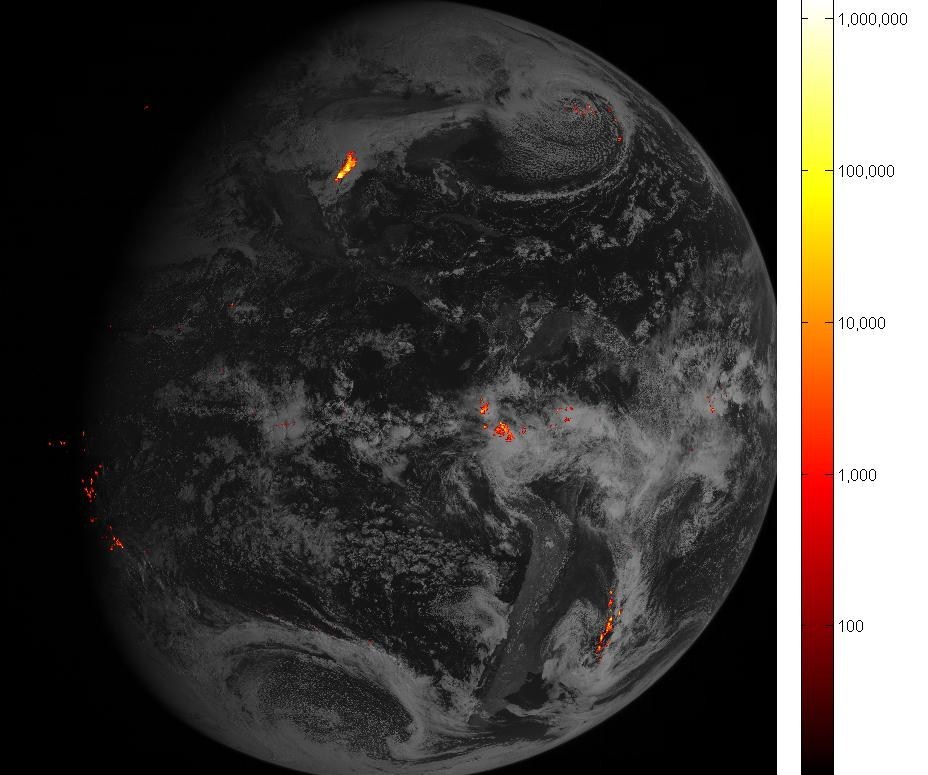
An early full disk image released by NASA and NOAA (source
of this image and the video below). Lighting locations are
superimposed on the ABI image (ABI = advanced baseline
imager). A short video showing lightning
events superimposed on the GOES-16 image (the green line shows the
SE Texas coastline, the faint green cross near the center and
about a third of the way down from the top of the image is
Houston).
A much larger collection of "GOES-16
Loop(s) of the Day" is available at a site operated by
Colorado State University.
Here's a list of some of the areas where regional or
global satellite observations of lightning might be of interest
(from Christian et al. (1989) and the GLM site above).
magnetospheric and ionospheric research
atmospheric chemistry
nitrogen fixation
ozone reactions and stratospheric chemistry
storm physics
lightning activity/storm intensity
ocean/land lightning ratio
hurricane electrification
lightning/tornado activity
lightning/precipitation
initial electrification
identifying and locating deep convection
initialization of weather forecast models
climate studies
ground and aviation hazard warning
from Christian et al. (1989)
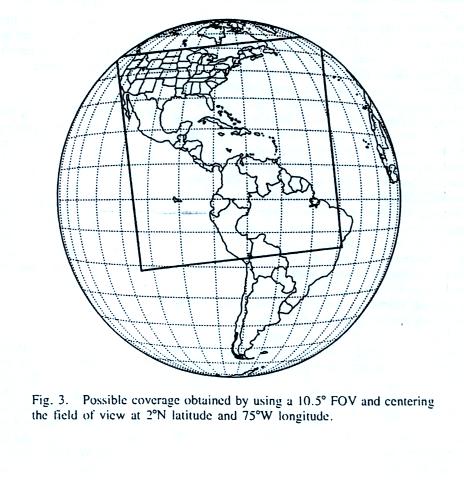
Combined field of view once GOES-16
and GOES-17 are operational. Source
of this image.
Christian et al. (1989) contains a detailed discussion of the
factors that must be considered in the design of a satellite
lightning sensor (and lists some of the earlier satellite
observations of lightning). Prior to designing the OTD and
LIS, the NASA Marshall group also made extensive measurements of
lightning optical emissions from a platform on high-altitude
aircraft flying well above the tops of thunderclouds (a U-2
aircraft flying at approximately 20 km altitude).
An example of a lightning spectrum recorded by the U-2 aircraft
is shown below (from Christian et al. (1989)).
The U-2 measurements did indeed show that both cloud to ground and
intracloud discharges could be detected from above cloud top
(determining the type of discharge process using the optical
signals is another problem and an area of current research).
The 777.4 nm and 886.3 nm features (OI and NI) highlighted above
each contain 5 to 10% of the optical energy in a lightning
flash. The 777.4 nm OI(1) line was ultimately chosen for the
satellite detectors.
Some of the early satellite observations of lightning were made
only at night. The OTD, LIS, and GLM will observe lightning
during the day and at night. Lightning occurs in clouds and
clouds are very good reflectors of the visible and near IR
wavelengths in sunlight. Steps must be taken to distinguish
or separate the relatively weak lightning signal from the brighter
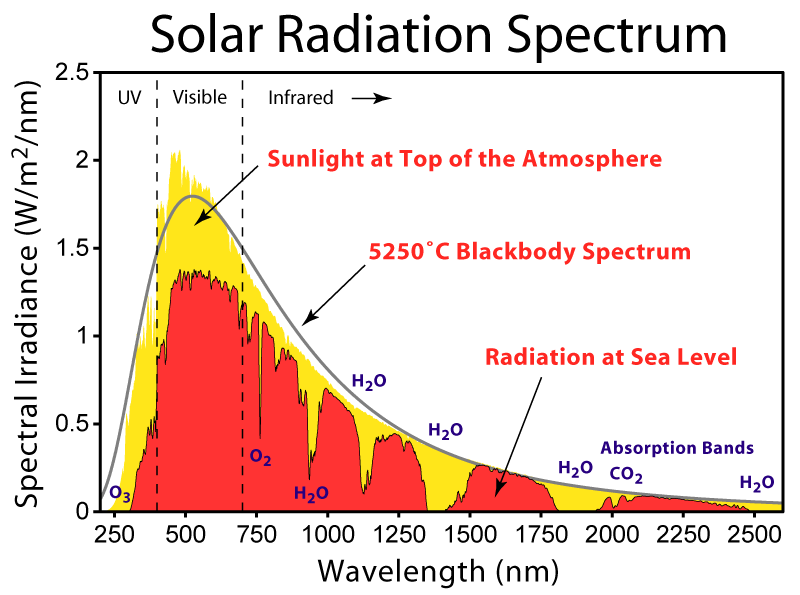
reflected sunlight. The solar spectrum as would be observed
at the top and bottom of the atmosphere is shown below (source).
The spectrum of reflected sunlight might
differ somewhat.
We should take a quick look at the shape of the optical signals
produced by lightning discharges. And because the lightning
will be viewed from above the thunderstorm top we need to look at
the effects that scattering by cloud particles will have on the
light impulses.
Examples of recorded fast electric fields (E, shaded blue) and
associated optical signals (O, highlighted in yellow) are shown
below (from Guo and Krider,
(1982)).
This was a
four stroke cloud-to-ground discharge that occurred at 13 km
range. The first return stroke is shown at the bottom of
the figure. The first 50 μs or so of the record is the
stepped leader. This is followed by an abrupt rise to
peak. Notice that the E field signal is still increasing
in amplitude at the end of the record. This indicates
some of the electrostatic field component is present which is
typical of a return stroke field recorded at a range of about
10 km. These waveforms were photographed on moving
film. The dark black timing marks were from an LED that
would flash on and off to code the absolute time onto the
film.
And a more recent example (Quick and Krider, (2013)), recorded
with modern waveform digitizing equipment is shown below
Signals from a first return stroke, subsequent return strokes
(NGC is a channel with a new ground contact point, PEC a
pre-existing channel), and a cloud discharge are shown. The
large divisions on the time scales range from 100 to 500
microseconds.
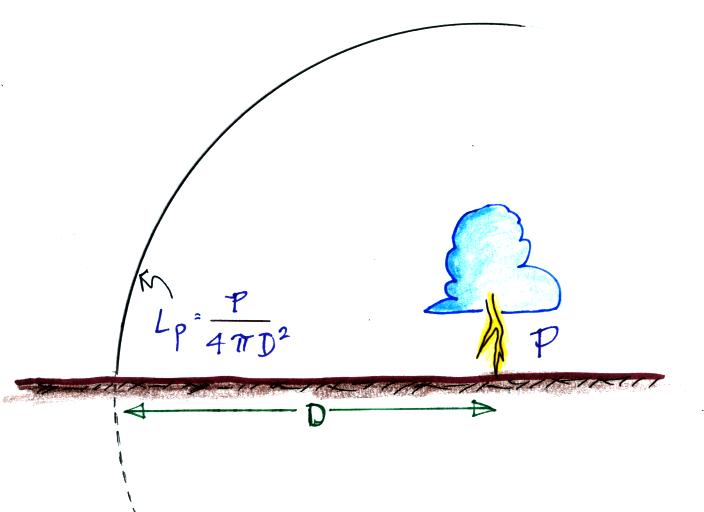
A typical return stroke optical signal. We can use a
measurement of the peak optical signal amplitude (in volts) to
determine the peak irradiance, Lp
(in W/m2). Then if the
range to the discharge is known we can estimate the peak optical
power output, P (in Watts) from the return stroke. This is a
variable that would be need to be known when designing a satellite
detector.
We treat the lightning discharge as a point source and assume the
optical power output during the strike will expand evenly outward
in a sphere. We measure the peak irradiance, Lp, a distance D from the source
(W/m2 on the surface of the
expanding sphere). So to estimate P we simply multiply the
measured values of Lp by the
area of the sphere.
Cumulative distribution of peak optical power estimates. 50%
of 1st return strokes have a peak optical power output of about 2
x 109 Watts or more.
Peak power emitted by subsequent strokes is almost a factor of 10
less.
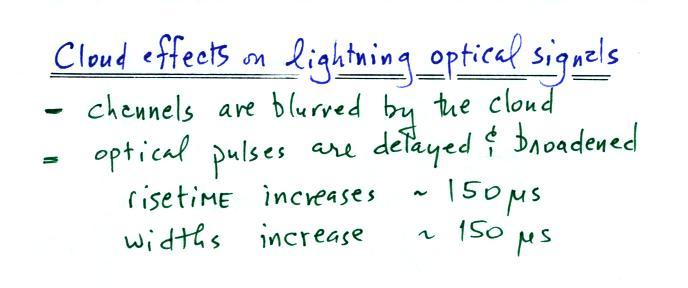
The relatively fast signals shown above will be broadened while
traveling upward through the thunderstorm cloud
Just like frosted glass, clouds will blur any image of the
lightning channel inside the cloud. The optical signal
risetime and pulse width are each increased by about 150
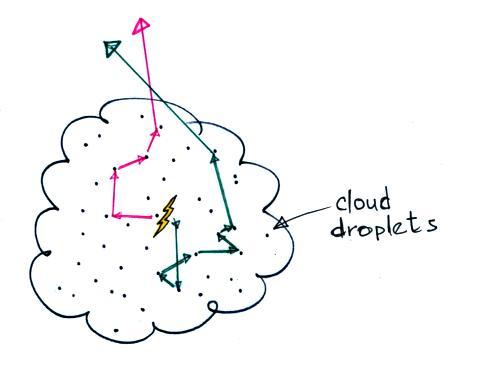
microseconds. The following figure helps to understand why
this is true.
Photons emitted by a lightning
channel are scattered (redirected) multiple times before
leaving the cloud. The path in pink undergoes a
relatively low number of scatters. The green path is
scattered more times and takes longer to escape from the
cloud. It is difficult to distinguish between
cloud-to-ground and intracloud discharges.
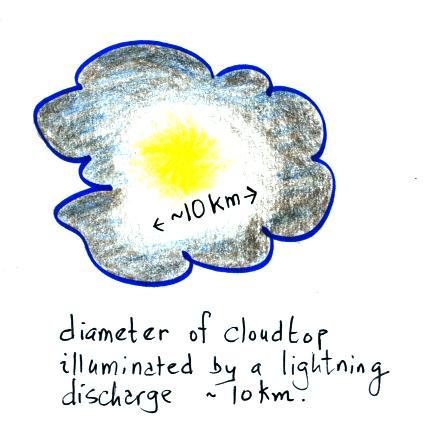
A lightning flash illuminates about 10 km diameter of the
cloud top. Ideally this would just fill a single pixel
on the CCD satellite detector, that would maximize the signal
to noise ratio.
We'll spent most of the remainder of our discussion on the
Optical Transient Detector (OTD). This is the first of two
satellite "lightning mappers" designed by the people at the NASA
Marshall Space Flight Center. You can read more about that
research group and some of the activities on the Global Hydrology and
Climate Center webpage.
The OTD was a prototype for the Lightning Imaging Sensor.
The OTD was launched on Apr. 3, 1995 and turned off in Mar. 2000,
having operated 2 years beyond its expected lifetime.
It was launched into a nearly circular orbit 740 km (~450 miles)
high. The orbit was inclined 70o (relative to the Equator) so the satellite
coverage extended from 75o S
to 75o N latitude.
For comparison the GOES GLM will be launched into geostationary
orbit and will have coverage extending from 52o S to 52o N latitude.
The OTD field of view was about 1300 km x 1300 km (about 1/300
th of the earth's surface) and was imaged onto a 128 pixel x 128
pixel CCD sensor array (thus about 10 km x 10 km per pixel which
is about the size of the cloud top illuminated by
lightning). The new GOES-16 GLM has a 1372 x 1300 CCD;
spatial resolution ranges from 8 km at the center of the field of
view to 14 km at the edge of the field of view.
The orbit precesses about 15 minutes (1/4 of a degree) per
day. It takes about 50 days for the satellite to review a
specific location on the earth's surface at the same time of
day. In a year the OTD images most locations for
a total time of > 14 hours (400 individual over passes).
The GOES GLM will view the same scene continuously.
The OTD and the new GLM detect lightning during the day and at
night. The typical daylight cloud background (sunlight
reflected off the cloud tops) is 50 to 100 times brighter than
lightning.
Several steps must be taken in order to detect lightning signals
superimposed on this bright background.
(i) The pixel size should correspond roughly to the
size of the cloud top illuminated by lightning (maximize the
signal to background noise)
(ii) A 1 nm narrow band interference filter centered on the
777.4 nm OI emission was used in both the OTD and the LISs.
Much of the reflected sunlight background falls at other
wavelengths and was blocked. The same feature will be used
in the GOES GLM
(iii) CCD signals were integrated for 2 ms - so that light from an
entire discharge is collected. The same integration time
will be used in the GLM.
(iv) Frame by frame subtraction is used. This removes much
of the slowly time varying background signal so that transient
events can be seen.
This last process is illustrated below
The leftmost image shows a hypothetical scene. The middle
two frames show the CCD data for two successive pictures taken of
the scene - one with and one without lightning. It's hard to
see the lightning until you difference these middle images.
The lightning appears in the 4th picture (the three pixels with
values of 1 in the middle of the scene).
As pixels are illuminated they are classified into groups and
flashs as illustrated below (I don't really know what the
constraints are, more
info).
There are still sources of noise such as sun glint that create
erroneous lightning counts. The South Atlantic Anamoly is
also a source of false triggers. This is a region where the
Van Allen Radiation Belts make their closest approach to the
earth's surface. The inner belt contains mainly high energy
protons. When the satellite passes through the belt, the
high energy particles strike the CCD array and produce anomalous
triggers.
Here are some images of lightning activity derived from OTD
data.
This image shows all of the lightning detected in 1999.
Most of the lightning detected is found over land affected by the
Intertropical Convergence Zone (ITCZ). This refers to a
feature in the 3-cell model of the earth's global
scale
circulation pattern.
The figure above shows most of the surface features (high and low
pressure belts and winds) predicted by the 3-cell model. The
ITCZ is nominally located near the Equator (also labelled the
equatorial low in the figure above). Surface winds converge
and produce rising air motions. Since
this equatorial air is often quite moist you can often see a
band of clouds at or near the equator on a satellite
photograph (if that link doesn't work try this
one or this
one). The ITCZ will
move north of the Equator in summer (northern hemisphere summer)
and south of the equator in the winter.
Here's the lightning detected during the months of December,
January, and February 1999. Note how the activity has
shifted into the southern hemisphere. The activity at higher
latitudes in the northern hemisphere might be associated with
storms forming along the polar front.
This is the June, July and August map for the same year.
Activity is now primarily in the northern hemisphere.
78% of the lightning detected (and remember the OTD doesn't
distinguish between cloud-to-ground and intracloud discharges) is
found between 30 S and 30 N latitude. 88% of the lightning
is found over continents, islands, and coastal regions.
There is much less activity over the oceans.
One interesting result from 5 years of OTD lightning data is a
new estimate for the global lightning flashing frequency:
44 flashes/sec
(plus or minus 5 flashes/sec)
This is about half of the 100
flashes/sec value that was long thought to be true. The
100 flashes/sec value dates back to about 1925.
You can view a more up to date global lightning image from
the Lightning Imaging Sensor (LIS) here.
This was the 2nd prototype sensor developed by the NASA
Marshall Space Flight Center group. The LIS
was launched in November, 1997, and detects and locates
lightning between 35o
S to 35o N.
The LIS mission ended in April 2015 (the TRMM satellite that
carried the LIS sensor rentered the atmosphere in June,
2015). A "spare" LIS sensor was placed aboard the
International Space Station in February, 2017 for a 2 - 4 year
mission.