Friday Mar. 23, 2012
click here
to download today's notes in a more printer friendly format
A song from the Cirque du Soleil
presentation of Alegria which I went to see a year or two ago. I
believe you heard "Icare",
but
it
might have been "Irna".
I handed out what I consider to be a fairly challenging
Optional Assignment. Students were free to turn it in at the
end of class but could also hang onto it, work out the questions over
the weekend, and turn it in at the start of class next Monday.
You can download the assignment here if your interested in doing the
same.
Occasionally you need to eat up all the left overs in your
refrigerator. In Atmo 170 we sometimes need to tie up a bunch of
loose
ends. That's what we did today.
The figure below is on p.
87 in the photocopied ClassNotes. It explains how you can dry
moist air.
At Point 1 we start with some 90 F air with a relative
humidity of 25%, fairly dry air. These are the same numbers in
Example Problem #4 last Wednesday. We imagine cooling this air to
the dew point temperature where the relative humidity would reach 100%
and a cloud would form (Pt. 2 in the figure above).
Then we continue to cool the air below the dew
point, to
30 F. Air that is cooled below the dew point finds itself with
more water vapor than it can contain. The excess moisture must
condense (we will assume it falls out of the air as rain or
snow). When air reaches 30 F it contains 3 g/kg, less than half
the
moisture that it originally did (7.5 g/kg). The air is being
warmed back up to 90 F along Path 4. As it warms the mixing ratio
remains constant. At Point 5, the air
now
has a RH of only 10%.
Drying moist air is very much like wringing moisture from a wet
sponge.
You start to
squeeze the sponge and it gets smaller. That's like cooling the
air and reducing the saturation mixing ratio, the air's capacity for
water vapor. At first squeezing the sponge doesn't cause anything
to happen (that's like cooling
the air, the mixing ratio stays constant as long as the air doesn't
lose any water vapor). Eventually water will start to drop from
the sponge (with air this is what happens when you reach the dew point
and continue to cool the air below the dew point). Then you let
go of the sponge and let it expand back
to its orignal shape and size (the air warms back to its original
temperature). The sponge (and the air) will be drier than when
you started.
This sort of process ("squeezing" water vapor out of moist air by
cooling the air below its dew point) happens all the time. Here
are a couple of examples (p. 87 again)
In the
winter cold air is brought inside your house or apartment and
warmed. Imagine 30 F air with a RH of 100% (this is a best case
scenario, the cold winter air usually has a lower dew point and is
drier). Bringing the air inside and warming it will cause the RH to
drop from 100% to 20%.. Air indoors during the winter is often
very dry. This can cause chapped skin, can irritate nasal
passages, and cause cat's fur to become charged with static electricity.
The air in an
airplane comes from outside the plane. The air outside the plane
can be very cold (-60 F perhaps) and contains very little water
vapor (even if the -60 F air is saturated it would contain essentially
no water vapor). When brought inside and warmed to a
comfortable
temperature, the RH of the air in the plane will be very close
0%.
Passengers often complain of dehydration
on
long
airplane
flights. The plane's ventilation system probably adds
moisture to
the
air so that it doesn't get that dry.
Next a much more important example of drying moist air (see p. 88
in the photocopied ClassNotes).
We start with some moist but unsaturated air (the RH is
about 50%) at Point 1 (the air and dew point temperatures would need to
be equal in
order for the air to be saturated).
As
it
is
moving
toward
the
right
the
air
runs
into
a mountain and
starts to rise. Rising air expands and
cools. Unsaturated air
cools 10 C for every kilometer of altitude gain.
This is known as the dry adiabatic lapse rate. So after rising 1
km
the air will cool to 10 C which is the dew point.
The air becomes saturated at Point 2 (the air temperature and the dew
point are both 10 C). Would you be able to
tell if you were outdoors looking at the mountain? Yes, you would
see a cloud
appear.
Now that the RH = 100%, the saturated air cools at a slower rate than
unsaturated air (condensation of water vapor releases latent heat
energy inside the rising volume of air, this warming partly offsets the
cooling caused by
expansion). We'll use a value of 6 C/km (an average
value). The air cools from 10 C to 4
C in next kilometer up to the top of the mountain. Because the
air is being cooled below its dew point at Point 3, some of the water
vapor will condense and fall to the ground as rain. Moisture is
being removed from the air and the value of the mixing ratio (and the
dew point temperature) decreases.
At Point 4 the air starts back down the right side of the
mountain. Sinking air is compressed and warms. As soon as
the air starts to
sink and warm, the relative humidity drops below 100% and the cloud
disappears. The sinking unsaturated air will warm at the 10 C/km
rate.
At Point 5 the air ends up warmer (24 C vs 20 C) and drier (Td =
4 C vs Td = 10 C) than when it started out. The downwind side of
the mountain is referred to as a "rain shadow" because rain is less
likely there than on the upwind side of the mountain. Rain is
less likely because the air is sinking and because the air on the
downwind side is drier than it was on the upslope side.
I went looking for some good specific illustrations of the
rainshadow effect.
We can see the effects of a rainshadow illustrated well in the
state of Oregon. The figure above at left shows the topography (here's
the
source
of that map). Winds generally blow from west to east
across the state.
Coming off the Pacific Ocean the winds first encounter a coastal range
of moutains. On the precipitation map above at right (source)
you
see
a
lot
of
greens and blue on the western sides of the coastal
range. These colors indicate yearly rainfall totals that range
from about 50 to more than 180 inches of rain per year. This is
where temperature rain forests are found.
That's the Willamette River, I think, in between the coastal range and
the Cascades. This valley is somewhat drier than the coast
because air moving off the Pacific has lost some of its moisture moving
over the coastal range.
What moisture does remain in the air is removed as the winds move up
and over the taller Cascades. Yearly rainfall is generally less
than 20 inches per year on the eastern side, the rainshadow side, of
the Cascades. That's not too much more than Tucson which averages
about 12 inches of rain a year.
Wikipedia considers the Tibetan Plateau one of the best examples of a
rain shadow.
(here's the source
of the
picture).
The Himalayan mountains stretch across the lower left 1/3 of the
picture. The land below and to the left of the mountains appears
somewhat green in the picture. This is because moist air moving
from lower
left toward the upper right leaves most of its moisture on this side of
the mountain range. The upper right 2/3rds of the picture, the
Tibetan plateau, is in the rain shadow and appears very dry and brown
in the
photograph.
Most of the year the air that arrives in Arizona comes from the west,
from the Pacific
Ocean (this changes in the summer). It
usually isn't very moist by the time it reaches Arizona because it has
travelled up and over the
Sierra Nevada mountains in
California and the Sierra Madre mountains further south in
Mexico. The air loses much of its moisture on the western slopes
of those mountains.
Next in
our mix of topics was measuring
humidity. One of the ways of measuring humidity is to use a sling
(swing might be more descriptive) psychrometer.
A sling
psychrometer consists of two thermometers mounted
side by side. One is an ordinary thermometer, the other is
covered with a wet piece of cloth. To
make a humidity measurement you swing the psychrometer around for a
minute or two and then read the temperatures from the two
thermometers. The difference between the dry and wet bulb
temperatures can be
used to determine relative humidity and dew point (you look up RH and
Td in a table, it's not something you can easily calculate).
You know I like to beat some concepts to death. But also
it's a pretty good example of where you can take some pretty basic
concepts that you understand and use them to really understand
something else.
The figure shows what
will happen as you start to swing the wet bulb thermometer. Water
will begin to evaporate from the wet piece of cloth. The
amount
or
rate
of
evaporation
will depend on the water temperature(the
80
F
value
was
just
made
up
in
this
example).
Warm
water
evaporates
at
a higher rate than cool water.
The evaporation is shown as blue arrows because this will cool the
thermometer. The same thing would happen if you were to step out
of a swimming pool on a warm dry day, you would feel cold. Swamp
coolers would work well (too well sometimes) on a day like this.
The figure at upper left also shows one arrow of condensation.
The
amount or rate of condensation
depends on how much water vapor is
in the air surrounding the thermometer. In this case (low
relative humidity) there isn't much water vapor. The
condensation arrow is orange because the condensation will release
latent heat and warm the thermometer.
Because
there is more evaporation (4 arrows) than condensation (1
arrow) the wet bulb thermometer will drop.
The wet thermometer will cool but it
won't cool indefinitely. We
imagine that the wet bulb thermometer
has cooled to 60 F. Because the wet piece of cloth is cooler,
there is less or slower evaporation. The wet bulb thermometer
has cooled to
a temperature where the evaporation and condensation are in
balance. The thermometer won't cool any further.
You
would measure a large difference (20 F) between the dry and wet bulb
thermometers on a day like this when the air is relatively dry.
Here's the situation on a
moister day. There's enough moisture in the
air to provide 3 arrows of condensation.You wouldn't feel as cold if you stepped
out of a pool on a warm humid
day like this. Swamp coolers wouldn't provide much cooling on a
day like this.
The wet thermometer only cools a little bit before the rates of
evaporation and condensation are equal.
Here's a summary
A large difference between the dry and wet bulb temperatures
means the relative humidity is low.
A small difference means the RH is higher.
No difference (the bottom figure) means the relative humidity is
100%. Any evaporation from the wet thermometer is balanced by an
equal amount of condensation from the surrounding air.
Evaporative
cooling will make you feel cold if
you get
out of a swimming pool on a warm dry day. You won't
feel as cold if the air is humid and the relative humidity is
high. This reminds me of something we covered earlier in the
semester.
We learned that a
40 F
day with 30 MPH winds will feel colder (because of
increased transport of energy away from your body by convection) than a
40 F
day
with no wind. The wind chill
temperature tells you how much colder it will feel ( a thermometer
would measure the same temperature on both the calm and the windy
day). If your
body isn't able to keep up with the heat loss, you can get hypothermia and
die.
Now something similar but new.
Your body tries to stay cool by perspiring. You
would feel
hot on
a dry 105 F day. You'll feel even hotter on a 105 F day with high
humidity; your sweat won't evaporate
as quickly. The heat index
measures how much hotter you'd feel. The
combination of heat and high humidity is a serious, potentially deadly,
weather hazard
because it can cause heatstroke
(hyperthermia).
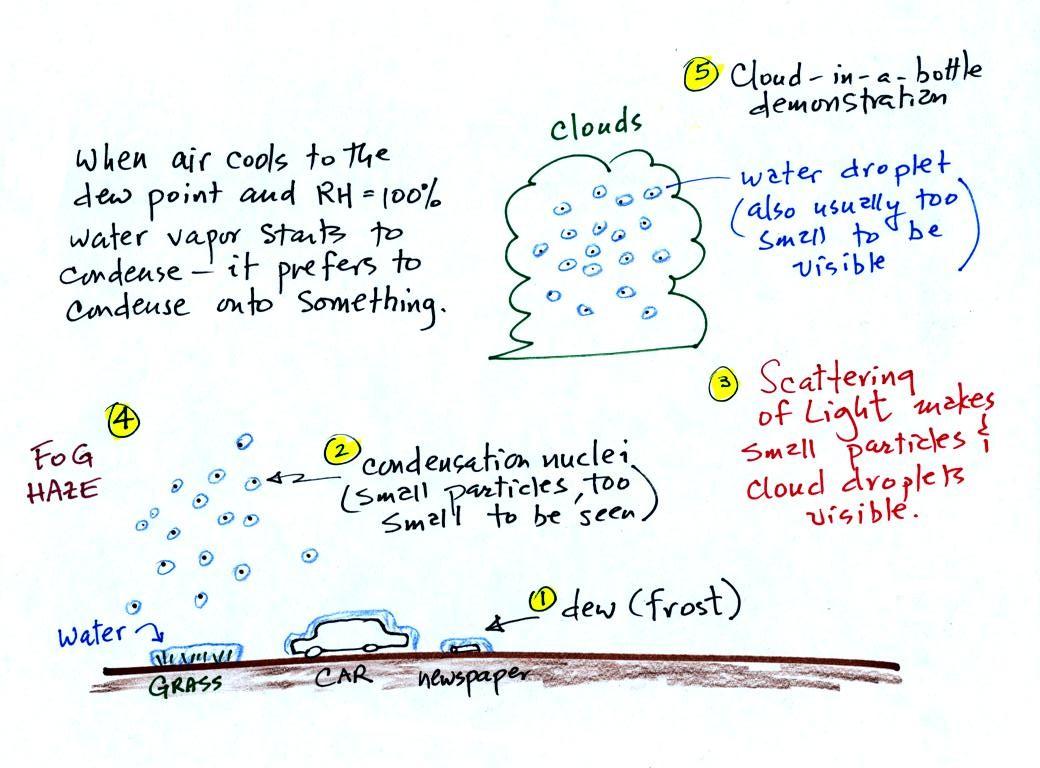
A variety of things can happen when you cool air
to the dew point and
the relative humidity increases to 100%. Point 1
shows that when moist air next to the ground is cooled to
and
below the
dew point, water vapor condenses onto (or is deposited onto) the ground
or objects on the ground. This forms dew, frozen dew, and
frost.
Air above the ground can also be cooled to the dew point. When
that happens (Point 2 above) it is much easier for water vapor to
condense
onto
something rather than just forming a small droplet of pure
water. In air above the
ground water vapor condenses onto small
particles in the air called condensation nuclei. Both the
condensation nuclei and the small water
droplets that form on them are usually too small to be seen with the
naked eye. We can tell they are present (Point 3) because they
either scatter (haze or fog) or reflect (clouds) sunlight.
We'll learn a little bit about the formation of dew and frost
today. We look at condensation nuclei and the role they play in
cloud formation on Friday.
The following confusing figures are found on p. 90 in the photocopied
ClassNotes.
It might be a little hard to figure out what is being
illustrated
here. Point 1 is sometime in the early evening when the
temperature of the air at ground level is 65. During the course
of the coming night the air will cool to 35 F. When the air
temperature reaches 40
F, the dew point, the relative humidity reaches 100% and water vapor
begins to condense
onto the ground. You would find your newspaper
and your car covered with dew (water) the next morning.
The next night is similar except that the nighttime
minimum
temperature drops below freezing. Dew forms (condensation) and first
covers
everything on the ground with water. Then the water freezes and
turns to ice. This isn't frost, rather
frozen dew. Frozen dew is often thicker and harder to scrape off
your car windshield than frost.
Now the dew point and the nighttime minimum temperature are both
below
freezing. When the RH reaches 100% water vapor turns directly to
ice (deposition).
This
is
frost.
What happens on this night? Because the nighttime minimum
temperature never reaches the dew point and the RH never reaches 100%,
nothing would happen.
I've seen some textbooks refer to this as black frost but I don't like
to use that term. You have probably heard of black ice.
Black ice does sometimes form on road surfaces and is a very dangerous
driving hazard. Because it's hard to see you can hit it with your
car and lose control.