Wednesday Apr. 18, 2012
click here to
download today's notes in a more printer friendly format
We'll
be
covering
tornadoes in class today and on Friday.
It's worth keeping in mind that while they are a fascinating phenomenon
and fun
to watch on video, tornadoes have brought sudden and complete
devestation to many parts of the country already this year. So a
little Irish music, which often deals with misfortune and sorrow,
seemed appropriate.
You heard "Black
is
the
Color" from Gaelic Storm.
Quiz #4 is Wednesday next week. Two weeks from today is the last
day of classes. Please check the following list of graded reports. Some
of these reports can be revised but the deadline is Wed., Apr. 25.
The Bonus 1S1P Assignment reports on Foucault's Pendulum and Regional
Winds were collected today. Several people are very close enough
to the maximum number of 1S1P pts allowed. Reports turned in
today will probably get them there. I'll have a quick look
through the reports and try to update the
list
of
people
having
earned
45 1S1P pts. soon.
The
United
States
has
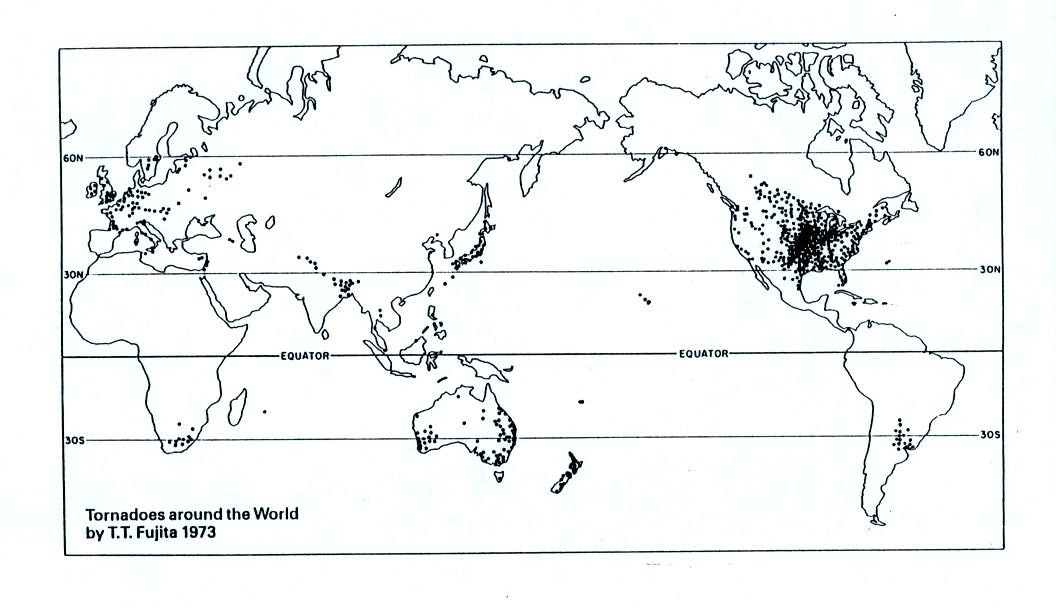
roughly 1000 tornadoes in an average year. That is more than
any
other country in the world .
Part
of
the
reason
why
is that the central
US
has
just
the
right
mix
of
meteorological
conditions.
Note
the
author
T.T.
Fujita
"Mr.
Tornado."

I got a little carried away with
the colored pencils on this picture. Without
any
mountains
in
the
way,
cold
dry
air
can
move
in the spring all the way
from
Canada to the Gulf Coast. There it collides with warm moist air
from the Gulf of Mexico to form strong cold fronts and
thunderstorms. There are some other meteorological conditions
that come into play that make these storms capable of producing
tornadoes.
Tornadoes
have
been
observed
in
every
state in the US, but tornadoes are most frequent in the Central
Plains, a region referred to as "Tornado Alley" (highlighted in red,
orange, and yellow above). You'll
find this map on p. 161 in the photocopied ClassNotes.
Here are some basic
tornado
characteristics (the figure above is also on p. 161)
1. About 2/3rds of tornadoes
are F0 or F1 tornadoes (we'll learn moare about the Fujita scale used
to rate
tornado intensity later today and on Friday) and have spinning
winds of
about 100 MPH or less. Microburst winds can also reach 100
MPH. Microbursts are much more common in Tucson in the summer
than tornadoes and can inflict
the same level of damage.
2. A very strong inwardly directed pressure
gradient force is needed to keep winds spinning in a circular
path. The pressure in the center core of a tornado can be 100 mb
less than
the pressure in the air outside the tornado. This is a very large
pressure difference in such a short distance. The
PGF
is
much
stronger
than
the
Coriolis
Force
(CF)
and
the
CF can be
neglected.
3. Because the Coriolis force doesn't play a
role, tornadoes can spin clockwise or
counterclockwise, though
counterclockwise rotation is more common. This might be because
larger scale motions in the cloud (where the CF is important, might
determine the direction of spin in a tornado).
4, 5, 6. Tornadoes usually last only a few
minutes, leave a path
on the ground that is a few miles
long, and move at a few 10s of MPH. There are exceptions, we'll
look at one shortly.
7, 8. Most tornadoes
move from the SW toward the NE. This is because tornado-producing
thunderstorms are often found just ahead of a cold front where winds
often blow from the SW. Most
tornadoes
have
diameters
of
tens
to
a
few
hundred
yards
but
tornadoes
with
diameters
over
a
mile
have
been
observed.
9, 10. Tornadoes
are
most
frequent
in
the
Spring.
The
strongest
tornadoes
also
occur
at
that
time
of
year.
Tornadoes
are
most
common
in the late
afternoon when the atmosphere is most unstable.
At the present time about 75 people
are
killed
every year in the
United States. This is about a factor of ten less than a century
ago due to improved methods of detecting tornadoes and severe
thunderstorms. Modern day communications also make easier to warm
people of dangerous weather situations. Lightning and flash
floods (floods are the most
serious
severe weather hazard) kill slightly more people than tornadoes.
Hurricanes kill
fewer people on average than tornadoes. The increase in the
number of tornadoes observed per year is probably more due to there
being more people in locations that are able to observe and report a
tornado rather than a true increase in tornado activity.

This
figure
traces
out
the
path of the 1925 "Tri-State
Tornado" . The
tornado path (note the SW to NE orientation) was 219 miles long, the
tornado lasted about 3.5 hours and
killed 695 people. The tornado was traveling over 60 MPH over
much of its path. It is still today the deadliest single tornado ever
in the United
States. The Joplin
Missouri tornado last year (May 22, 2011) killed 162 people making
it the deadliest
since 1947 and the 7th
deadliest tornado in US history.
Tornadoes often
occur
in
"outbreaks."
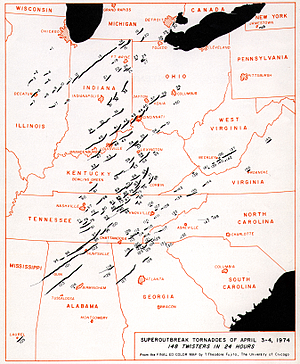
The paths of 148
tornadoes
during the April 3-4, 1974 "Jumbo Tornado
Outbreak" are shown above. Note the first tornadoes were
located
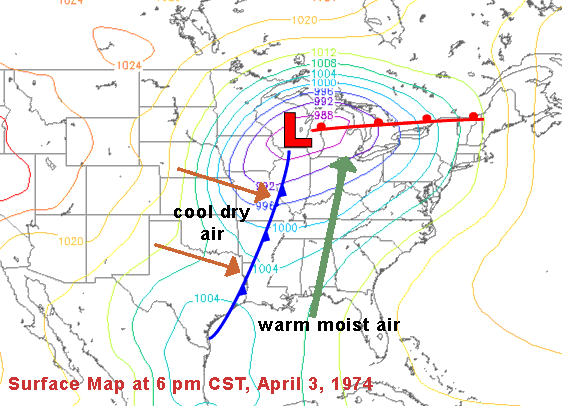
in the upper left corner of the map. The tornadoes were produced
by thunderstorms forming along a cold front (see the weather map
below). During this two day
period the front moved from the NW part toward the SE part of the
figure.
Note
that all the tornado paths have a
SE toward NE
orientation.
The April
25-28,
2011
outbreak is now apparently the largest tornado outbreak
in US history (358 tornadoes, 346 people killed)
As we learn more about tornadoes I'm
hoping you'll look at video with a more critical eye than you would
have otherwise. So we took a moment, at this point, to have
a look at some tornadoes caught on video. I have found the same
or similar video online for several of these.
54a
|
F3
|
Grand Isle, NE
|
Mar.
13,
1990
|
tornado
cloud is pretty
thick and vertical |
61f
|
F3
|
McConnell
AFB KS
|
Apr.
26,
1991
|
this
is about as close to a
tornado as you're ever likely to get. Try to judge the diameter
of the tornado cloud. What direction are the tornado winds
spinning?
|
52
|
F5
|
Hesston
KS
|
Mar.
13,
1990
|
Watch
closely,
you may see a tree or two uprooted by the tornado winds
|
51
|
F3
|
North
Platte NE
|
Jun.
25,
1989
|
Trees
uprooted
and buildings lifted by the tornado winds
|
65
|
F1
|
Brainard
MN
|
Jul.
5,
1991
|
It's
a good
thing this was only an F1 tornado
|
57
|
F2
|
Darlington
IN
|
Jun.
1,
1990
|
Tornado
cloud
without much dust
|
62b
|
F2
|
Kansas
Turnpike
|
Apr.
26,
1991
|
It's
sometimes
hard to run away from a tornado. Watch closely you'll see a van
blown off the road and rolled by the tornado. The driver of the
van was killed!
|
47
|
F2
|
Minneapolis
MN
|
Jul.
18,
1986
|
Tornado
cloud
appears and disappears. |
The Kansas
turnpike video also has a warning
that a highway underpass is actually a very dangerous place to take
shelter from a tornado. Here is some additional
information from the Norman OK office of the National Weather
Service. Slide 6 lists some of the reasons why underpasses are so
dangerous.
The figure
below (p. 162 in the ClassNotes) illustrates the life cycle of a
tornado. Have a close look at the next tornado you see on video
and see if you can determine whether it is in one of the early or late
stages of its development.

Tornadoes begin in and descend from
a
thunderstorm. You would usually see a funnel cloud dropping from
the base
of the thunderstorm. Spinning winds will probably be present
between the cloud and ground before the tornado cloud becomes
visible. The spinning winds can stir up dust at ground
level. The spinning winds might also be strong enough at this
point to produce some minor damage. Here is video of the Laverne
Oklahoma tornado that was shown in class and that shows the initial
dust swirl stage very well. We'll watch some more of this tape in
class on Friday because there are some good photos of a thunderstorm
wall cloud (beginning at about 1:07 and 1:46 minutes into the tape).
In Stage 2, moist air moves horizontally toward the low pressure
in the
core of the tornado. This sideways moving air will expand and
cool just as rising air does (see figure below). Once the air
cools enough (to the
dew point temperature) a cloud will form.
Tornadoes can go from Stage 2 to Stage 3 (this is what the
strongest
tornadoes do) or
directly from stage 2 to stage 5. Note a strong tornado is
usually vertical and thick as shown in Stage 3. "Wedge tornadoes"
actually appear wider than they are tall.
The thunderstorm and the top of the tornado will move faster than
the
surface winds and the bottom of the tornado. This will tilt and
stretch the tornado. The rope like appearance in Stage 5 is
usually a sign of a weakening (though still a dangerous) tornado.
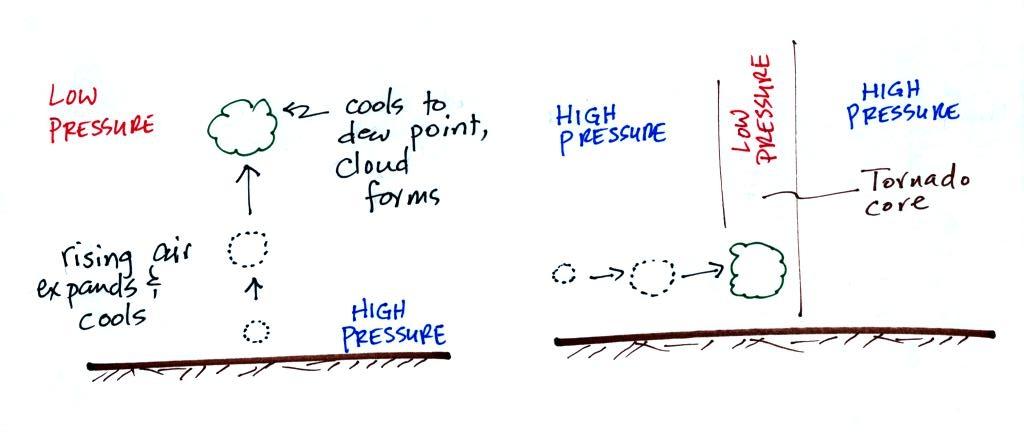
A tornado cloud forms is mostly the same way that
ordinary
clouds do. In an ordinary
cloud (left figure above) rising air moves into lower pressure
surroundings and expands. Expansion cools the air. When the
air cools to its dew point a cloud forms. In a tornado air moves
horizontally into lower pressure at the core of the tornado. The
air expands and cools just like rising air does. If the air cools
enough a true cloud apears.
Next we need to look at some
of the conditions that can lead to severe thunderstorm
formation and some of the characteristics of these storms. Severe
thunderstorms last
longer, grow bigger, and become stronger than ordinary air mass
thunderstorms. They can also produce tornadoes.
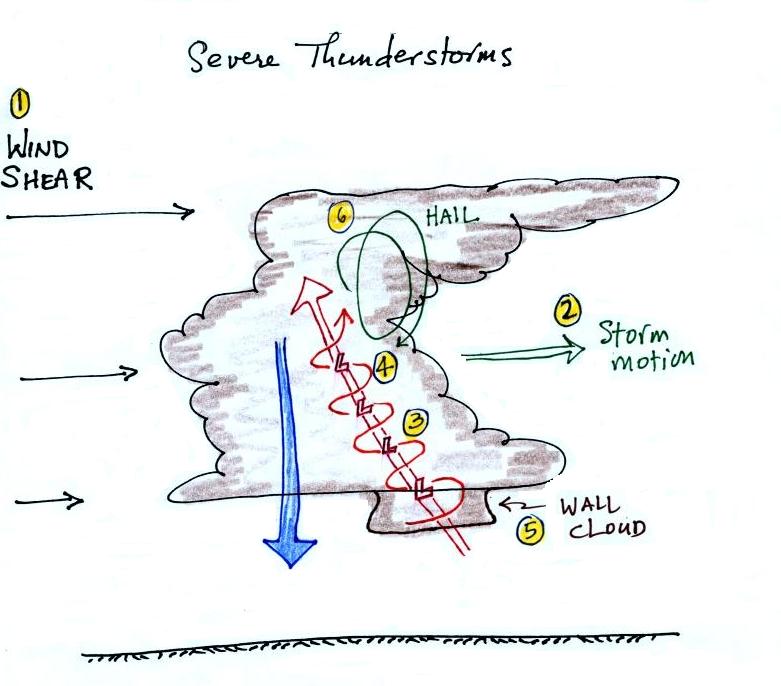
Severe
storms are more likely to form when there is vertical wind shear (the
picture above is on p. 154a in the ClassNotes).
Wind
shear (pt 1) is changing wind direction and/or wind speed with
distance. In
the case shown above, the wind speed is increasing with increasing
altitude, this
is vertical wind shear.
A thunderstorm that forms in this kind of an environment
will move at an average of the speeds at the top and bottom of the
cloud (pt.
2).
The thunderstorm will move to the right more rapidly than the air at
the ground
which is where the updraft begins. Rising air that is situated at
the
front bottom edge of the thunderstorm will find itself at the back edge
of the
storm when it reaches the top of the cloud.
This produces a
tilted
updraft (pt. 3). The downdraft is situated at the back of the
ground. The updraft is continually moving to the right and
staying away
from the downdraft. The updraft and downdraft coexist and do not
"get in each others way." If you remember in air mass
thunderstorms, the downdraft gets in the way of the updraft and leads
to dissipation of the storm.
Sometimes
the
tilted
updraft
will
begin
to
rotate.
A
rotating
updraft
is
called
a mesocyclone
(pt. 4). Meso refers to medium size
(thunderstorm size)
and cyclone
means winds spinning around low pressure (tornadoes are sometimes
called cyclones). Low pressure in the
core of the
mesocyclone creates an inward pointing
pressure
gradient force needed to keep the updraft winds spinning in circular
path.
The cloud that
extends
below the cloud base and surrounds the mesocyclone
is
called a wall cloud (pt.
5). The largest and strongest tornadoes
will
generally come from the wall cloud. We'll see some pretty
dramatic videos of wall clouds on Friday when we finish this section on
tornadoes.
Note (pt. 6) that a tilted updraft also provides a way of keeping
growing
hailstones
inside the cloud. Hailstones get carried up toward the top of the
cloud
where they begin to fall. But they then fall
back into
the strong core of the updraft and get carried back up toward the top
of the
cloud.

A wall cloud can form a little bit
below the rest of the base of the thunderstorm. Clouds normally
form when air
rises, expands, and cools as shown above at left. The rising air
expands because it is moving into lower pressure surroundings at higher
altitude.
At right the air doesn't have to rise to as high an altitude to
experience the same amount of expansion and cooling. This is
because it is moving into the core of the rotating updraft where the
pressure is a little lower than normal for this altitude. Cloud
forms a little bit closer to the ground.
Finally here's a photograph of the base of a thunderstorm
showing part of the
wall cloud
and what looks like a small and weak tornado. (from
the
University
Corporation
for
Atmospheric
Research).
On Friday we'll look at the structure of supercell thunderstorms and
watch a computer simulation of a supercell thunderstorm.
Thunderstorms with rotating updrafts and supercells produce a unique
signature on radar, a hook echo, that allows meteorologists to warn of
a thunderstorm that is capable of and might be producing
tornadoes. We'll also look at the Fujita Scale used to rate
tornado strength and intensity and look at some of the kinds of damage
that tornadoes can produce.
Then we'll just get started onlightning which is the last section
we cover before Quiz #4.