
Point 1 is the location of the
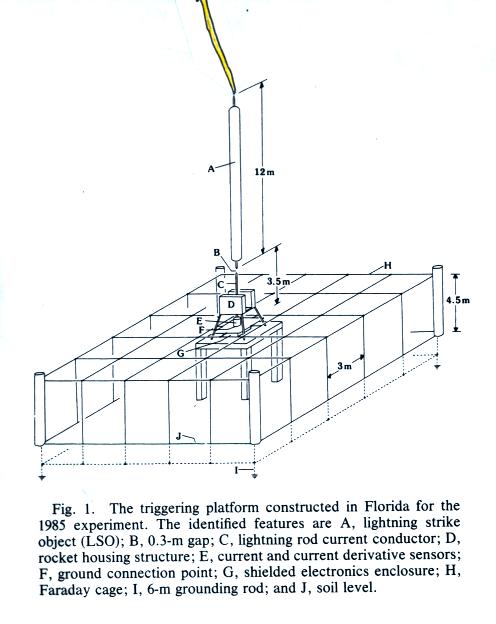
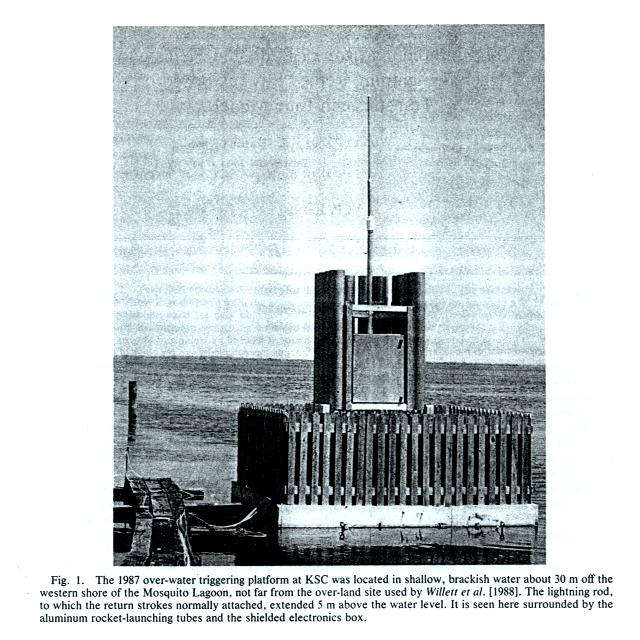
triggering site. A rather complicated set up was in place during
the 1985 experiments which may have affected the measurements and
interpretation of the results. A cleaner launch platform was used
in 1987 (the left figure below is from the Leteinturier et al. 1990, the right figure from
Willett et al. 1989, both
publications can be found the class articles folder). Neither of these
figures was shown in class.
E and dE/dt fields were recorded at Point 2, 5 km from the triggering site. At this range and at the time of peak E and peak dE/dt it is safe to assume the measured E fields were purely radiation fields. Water in the Mosquite Lagoon is a mixture of fresh water and salty ocean water.
E field derivative signals were also recorded at Point 4, 50 meters from the trigger point. At this close range the dE/dt signals probably did contain induction and electrostatic field components.
Finally return stroke velocity were measured at Point 5, 2 km from the triggering point.
You make simultaneous measurements of return stroke current (I) and the electric radiation field (Erad). If the transmission line model is valid, the two waveforms should have identical shapes. We plug in the measured peak values of E and I into the transmission line model relation. D, the distance at which the E field measurements were made, is known. We solve the transmission line model expression for velocity, vTLM
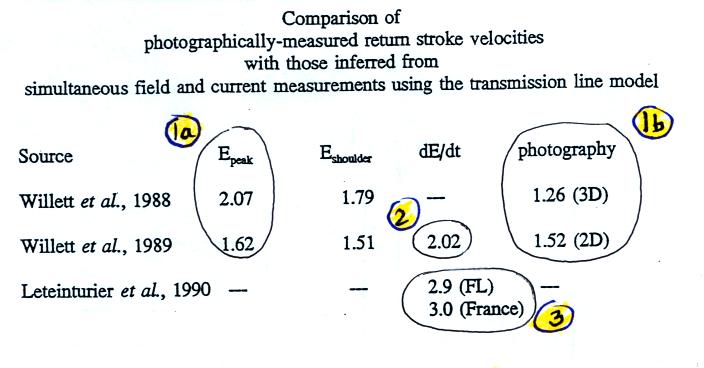
Then you compare vTLM with the velocity measured with the high-speed streaking camera. The next figure shows how things turned out. (the velocity values below should all be multiplied by 108 m/s)
 |
 |
E and dE/dt fields were recorded at Point 2, 5 km from the triggering site. At this range and at the time of peak E and peak dE/dt it is safe to assume the measured E fields were purely radiation fields. Water in the Mosquite Lagoon is a mixture of fresh water and salty ocean water.
E field derivative signals were also recorded at Point 4, 50 meters from the trigger point. At this close range the dE/dt signals probably did contain induction and electrostatic field components.
Finally return stroke velocity were measured at Point 5, 2 km from the triggering point.
Here's the basic idea behind the
experiment.

You make simultaneous measurements of return stroke current (I) and the electric radiation field (Erad). If the transmission line model is valid, the two waveforms should have identical shapes. We plug in the measured peak values of E and I into the transmission line model relation. D, the distance at which the E field measurements were made, is known. We solve the transmission line model expression for velocity, vTLM
Then you compare vTLM with the velocity measured with the high-speed streaking camera. The next figure shows how things turned out. (the velocity values below should all be multiplied by 108 m/s)
Let's first look at Points 1a and
1b. Point 1a shows vTLM
determined using the E and I measurements and the transmission line
model expression. Point 1b shows the measurements of return
stroke velocity. The agreement obtained for the 1985 experiment
2.07 does not agree very well with the measured value 1.26.
This may be due to the messy launch platform. Agreement was a
little better for the 1987 experiment.
At Point 2 we can see that vTLM using dE/dt and dI/dt is higher than the vTLM determined using E and I. This discrepancy has not been explained. The velocity values at Point 3 are appreciably higher than any of the other values. This estimate of vTLM was determined using dE/dt measured at 50 m distance from the triggering point. As we mentioned earlier, these fields probably contain induction and electrostatic field contributions and the transmission line model expression should probably not be used with them.
We haven't explained the Eshoulder column in the figure yet. A careful comparison of I and Erad signals (which the transmission line model predicts should be identical) shows some subtle differences between the two waveform shapes. Rather than just a single peak, the Erad signal often has a second somewhat smaller peak or shoulder as sketched below.

Much better agreement between vTLM and measured velocities was obtained when the Eshoulder amplitude was used with Ipeak in the transmission line expression when computing vTLM.
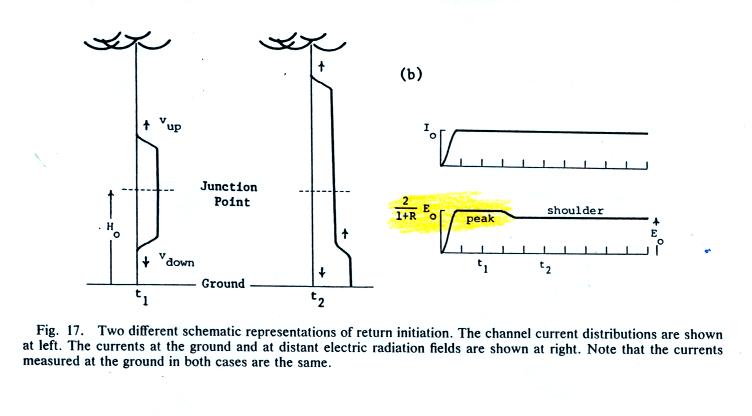
Here's one possible explanation of the Eshoulder business (the following figure was on a class handout).

We ordinarily think of the return stroke as being a single upward
propagating current that begins at the ground. This view is shown
at the top of the figure above. You measure a peak current of Io
at the ground and this produces a field with a peak value Eo at some
distance from the strike point.
It may be that the return stroke doesn't begin at the ground but a few 10s of meters above the ground. And there isn't just a single upward propagating current. Rather currents travel up and down from the junction point. The downward wave reaches the ground and is partially reflected. This kind of a situation, together with a few assumptions can produce an E field like sketched above. The E field signal has structure that resembles the peak and shoulder features seen in the triggered lightning data.
Here's some justification for starting the return stroke above the ground, i.e. at the junction point between the upward connecting discharge and the bottom of the stepped leader channel. Positive charge would tend to travel upward, negative charge downward. This would result effectively in two upward pointing current waves.

One of the assumptions we will make is that the current rises to peak value before the downward wave reaches the ground. The waves might travel at 1/3 the speed of light, 1 x 10⁸ m/s. If the current peaks in 0.1 microseconds, the junction point would need to be at least 10 m above the ground. If it takes 1 microsecond for the current to reach peak the junction point would need to be 100 m high (that seems a bit much).

A single upward propagating current with amplitutde Io will
produce a radiation field with amplitude Eo. What field will two
current waves each with amplitude Id produce? We need to find
some relation between Id and Io. To do that we need to look at
what happens when the downward traveling wave reaches the ground.
This is sketched in the figure below.

The top part of the figure shows the downward moving current wave
before it has reached the ground. At the bottom of the figure we
show what happens when the wave reaches the ground. A portion of
the downward wave is reflected (shown in blue). We will assume
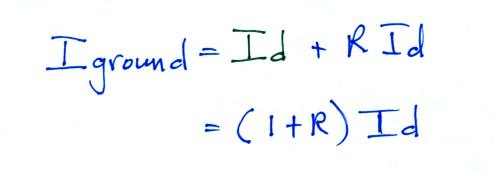
that the reflected current wave, which has amplitude R Id, and the
original wave, with amplitude Id, add. So the total current
measured at the ground would be
At Point 2 we can see that vTLM using dE/dt and dI/dt is higher than the vTLM determined using E and I. This discrepancy has not been explained. The velocity values at Point 3 are appreciably higher than any of the other values. This estimate of vTLM was determined using dE/dt measured at 50 m distance from the triggering point. As we mentioned earlier, these fields probably contain induction and electrostatic field contributions and the transmission line model expression should probably not be used with them.
We haven't explained the Eshoulder column in the figure yet. A careful comparison of I and Erad signals (which the transmission line model predicts should be identical) shows some subtle differences between the two waveform shapes. Rather than just a single peak, the Erad signal often has a second somewhat smaller peak or shoulder as sketched below.
Much better agreement between vTLM and measured velocities was obtained when the Eshoulder amplitude was used with Ipeak in the transmission line expression when computing vTLM.
Here's one possible explanation of the Eshoulder business (the following figure was on a class handout).
It may be that the return stroke doesn't begin at the ground but a few 10s of meters above the ground. And there isn't just a single upward propagating current. Rather currents travel up and down from the junction point. The downward wave reaches the ground and is partially reflected. This kind of a situation, together with a few assumptions can produce an E field like sketched above. The E field signal has structure that resembles the peak and shoulder features seen in the triggered lightning data.
Here's some justification for starting the return stroke above the ground, i.e. at the junction point between the upward connecting discharge and the bottom of the stepped leader channel. Positive charge would tend to travel upward, negative charge downward. This would result effectively in two upward pointing current waves.
One of the assumptions we will make is that the current rises to peak value before the downward wave reaches the ground. The waves might travel at 1/3 the speed of light, 1 x 10⁸ m/s. If the current peaks in 0.1 microseconds, the junction point would need to be at least 10 m above the ground. If it takes 1 microsecond for the current to reach peak the junction point would need to be 100 m high (that seems a bit much).
and we are going to force Iground
to be equal to Io

so that, in terms of the current
measured at the ground, the two versions of return stroke initiation (a
single upward propagating current wave that starts at the ground versus
upward and downward pointing current waves that start at a junction
point above the ground) are identical. The same current waveform
would be measured at the ground in both cases.
Now that we can relate Id and Io we can go back to our earlier figure

Now that we can relate Id and Io we can go back to our earlier figure
So we've explained the feature
below (highlighted yellow)
Now we need to explain why the
field decreases and forms a shoulder and why the shoulder amplitude is
Eo. To do that we need to consider the unreflected portion of the
current wave.
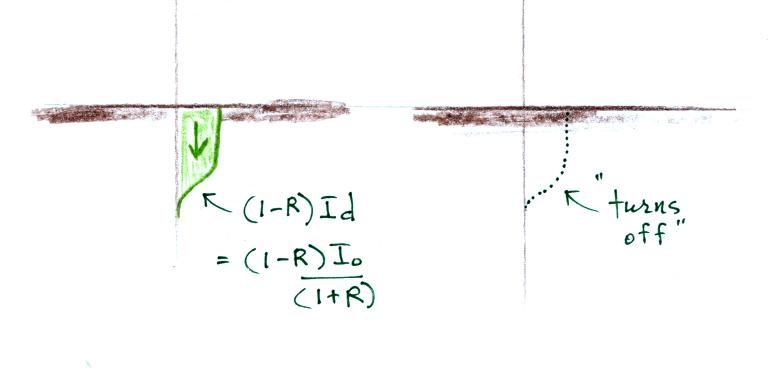
The unreflected current doesn't
just travel down into the ground as shown in the earlier figure.
It probably spreads out horizontally. In any event, from a field
production point of view, it "turns off" and stops radiating (it is
traveling into a conductor). So we need to subtract its
contribution to the total E field.

So the descent from peak field to a shoulder field occurs when the
downward current wave reaches the ground. A portion of the
downward current stops radiating field.
Back to the experimental test of the transmission line model.

Much better agreement between transmission line model derived velocities and measured velocities was obtained when the Eshoulder amplitude was used instead of Epeak in the transmission line model equation together with Ipeak. The current we measure at the ground begins only after the downward traveling wave has reached the ground. It seems reasonable that we should use the corresponding E field amplitutde, i.e. the shoulder ampltitude (the Epeak occurs before the downward current wave reaches the ground).
We should note that we still haven't explained why a different vTLM was obtained when using dE/dt and dI/dt data.
We ended the day with a look at some experimental measurements of distant electric radiation fields and estimates of peak I and peak dI/dt values that were derived from them. The measurements are described in the publication cited below.
"Submicrosecond fields radiated during the onset of first return strokes in cloud-to-ground lightning," E.P. Krider, C. Leteinturier, and J.C. Willett, J. Geophys. Res., 101, 1589-1597, 1996. (link to a PDF file)
Here are some important points regarding this experiment.
1. Electric fields from lightning first return strokes 25 to 45 km away was measured (purely radiation fields at these distances). Propagation between the strike point and the recording station was entirely over salt water so that high frequency signal content was preserved. The strokes in triggered lightning are representative of subsequent strokes in natural lightning.
2. The recording instumentation was triggered on an RF signal rather than on E or dE/dt to prevent trigger bias.

The plot above shows range normalized dE/dt data versus range. The trigger threshold on an oscilloscope or waveform recorder of some kind, a fixed voltage, corresponds to larger and larger dE/dt values with increasing range. Between about 40 and 80 km the distribution of measured dE/dt signals will be biased toward larger signal amplitudes (only the signals above the trigger threshold will be recorded). Beyond about 80 km it appears that very few of the dE/dt signals will be large enough to trigger the recording instrumentation.
The table below illustrates how measured dE/dt values can be range normalized.

Three typical peak dE/dt values from return strokes at ranges of
25, 35, and 65 km are shown in the left most column. We assume
the signal vary as 1/range. Data range normalized to 100 km are
shown in the right column. The three values here are highlighted
in the graph above.
3. Even though E field propagation was over salt water some high frequency attentuation was still present. An atttempt was made to correct for this.
The figure below shows the effects of propagation. The dI/dt waveform used in the calculations is shown at the top of the figure.

The three lower plots show the dE/dt signal at 10, 35, and 50 km
range. The signals are both attentuated and broadened (the
percentage refer to the pulse width at half maximum). The solid
line shows propagation over a perfectly conducting surface for
comparison.
And here are some results from the experiment. First estimates of peak I derived from measured E amplitudes using the transmission line model expression.

Note the value of the velocity used in the calculation is the best
fit between measured I and E values in the experimental test of the
transmission line discussed earlier in today's class.
Next the estimates of peak dI/dt

Again the velocity from the experimental test of the transmission
line model was used. Note the value used for dI/dt is different
from the value used to estimate peak I.
Back to the experimental test of the transmission line model.
Much better agreement between transmission line model derived velocities and measured velocities was obtained when the Eshoulder amplitude was used instead of Epeak in the transmission line model equation together with Ipeak. The current we measure at the ground begins only after the downward traveling wave has reached the ground. It seems reasonable that we should use the corresponding E field amplitutde, i.e. the shoulder ampltitude (the Epeak occurs before the downward current wave reaches the ground).
We should note that we still haven't explained why a different vTLM was obtained when using dE/dt and dI/dt data.
We ended the day with a look at some experimental measurements of distant electric radiation fields and estimates of peak I and peak dI/dt values that were derived from them. The measurements are described in the publication cited below.
"Submicrosecond fields radiated during the onset of first return strokes in cloud-to-ground lightning," E.P. Krider, C. Leteinturier, and J.C. Willett, J. Geophys. Res., 101, 1589-1597, 1996. (link to a PDF file)
Here are some important points regarding this experiment.
1. Electric fields from lightning first return strokes 25 to 45 km away was measured (purely radiation fields at these distances). Propagation between the strike point and the recording station was entirely over salt water so that high frequency signal content was preserved. The strokes in triggered lightning are representative of subsequent strokes in natural lightning.
2. The recording instumentation was triggered on an RF signal rather than on E or dE/dt to prevent trigger bias.
The plot above shows range normalized dE/dt data versus range. The trigger threshold on an oscilloscope or waveform recorder of some kind, a fixed voltage, corresponds to larger and larger dE/dt values with increasing range. Between about 40 and 80 km the distribution of measured dE/dt signals will be biased toward larger signal amplitudes (only the signals above the trigger threshold will be recorded). Beyond about 80 km it appears that very few of the dE/dt signals will be large enough to trigger the recording instrumentation.
The table below illustrates how measured dE/dt values can be range normalized.
3. Even though E field propagation was over salt water some high frequency attentuation was still present. An atttempt was made to correct for this.
The figure below shows the effects of propagation. The dI/dt waveform used in the calculations is shown at the top of the figure.
And here are some results from the experiment. First estimates of peak I derived from measured E amplitudes using the transmission line model expression.
Next the estimates of peak dI/dt