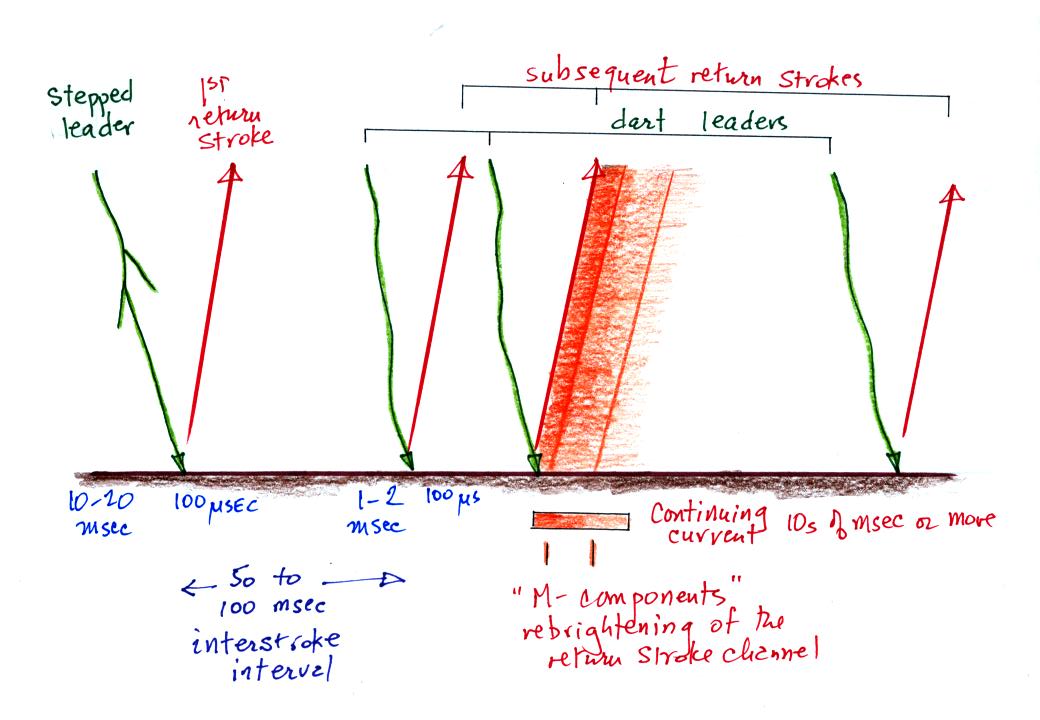
The discharge begins at left in the figure with a branched stepped leader that is followed by a 1st return stroke. The stepped leader takes a few 10s of milliseconds to travel from the main negative charge center in the cloud to the ground. The ensuing 1st return stroke travels back up the channel to the cloud is about 100 microseconds.
Then, with a few slight differences, the process repeats itself. Additional discharges occur typically at intervals of 50 to 100 ms and are usually preceded by a dart leader that travels, without stepping, down the existing channel. A short upward connecting discharge is initiated when the dart leader gets close to the ground and then a subsequent return stroke travels back up the channel to the cloud. We'll look at the dart leader and subsequent return stroke processes in a little more detail shortly.
The 3rd return stroke in the illustration above is following by a continuing current. This is a low amplitude (100s of Amperes) current that continues to flow for 10s of milliseconds, typically, which keeps the return stroke channel luminous. A short rebrightening of the channel sometimes occur during the continuing current, these are called M-components.
A couple of handouts were distributed at this point. The first was a short article "Panning for Lightning," by John Hendry Jr. that was published in Weatherwise (vol. 45, No. 6, pps 18-19, Dec. 1992/Jan 1993 issue). It was a photograph of a multiple stroke cloud-to-ground flash taken as the camera was deliberately moved back and forth. In this way the separate strokes in the flash were displaced on the image. The second was a short description of the Boys Camera that was used originally to photograph the sequences of processes in cloud-to-ground lightning with very fast time resolution.
Now some more information about dart leaders and subsequent return strokes.
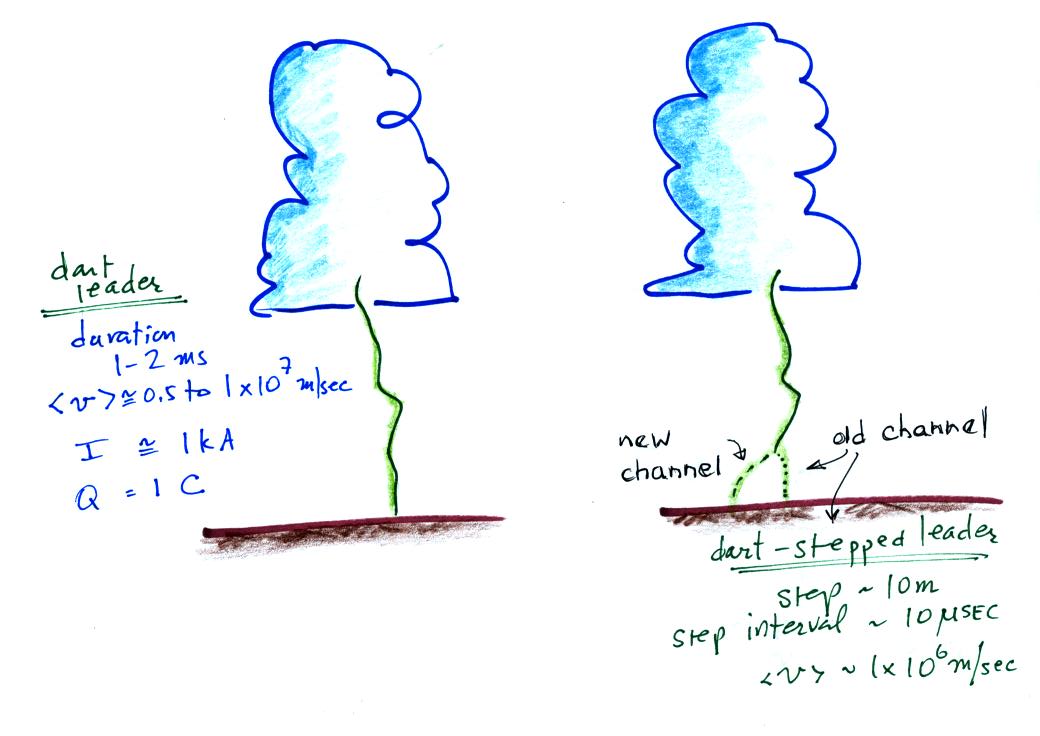
Because a dart leader is following
an existing channel it travels faster than a stepped leader.
Sometimes the dart leader will depart from the existing channel and
form a new channel to ground. Because it is traveling through
unionized air in this case the dart leader would turn into a stepped
leader .The dart leader would begin to step in this case.
Othertimes there is sufficient time between strokes that the existing
channell can begin to cool and become less conductive. In this
situation the dart leader becomes a dart stepped leader. A dart
leader takes shorter more frequent steps than a stepped leader.
Some subsequent return stroke characteristics are summarized in the table below
Statistics on the number of strokes per flash are shown in the following two histograms (this was on a class handout)

Many lightning parameters or characteristics are log-normally distributed. This appears to be the case with the interval time between return strokes distribution in the next figure.
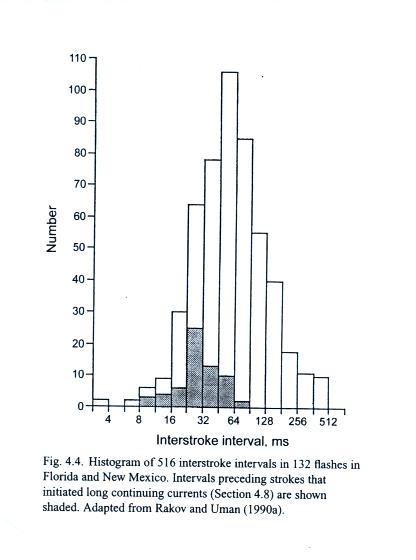
The two preceding figures are from Lightning: Physics and Effects,
V.A. Rakov, M.A. Uman, Cambridge Univ. Press, Cambridge, 2003.
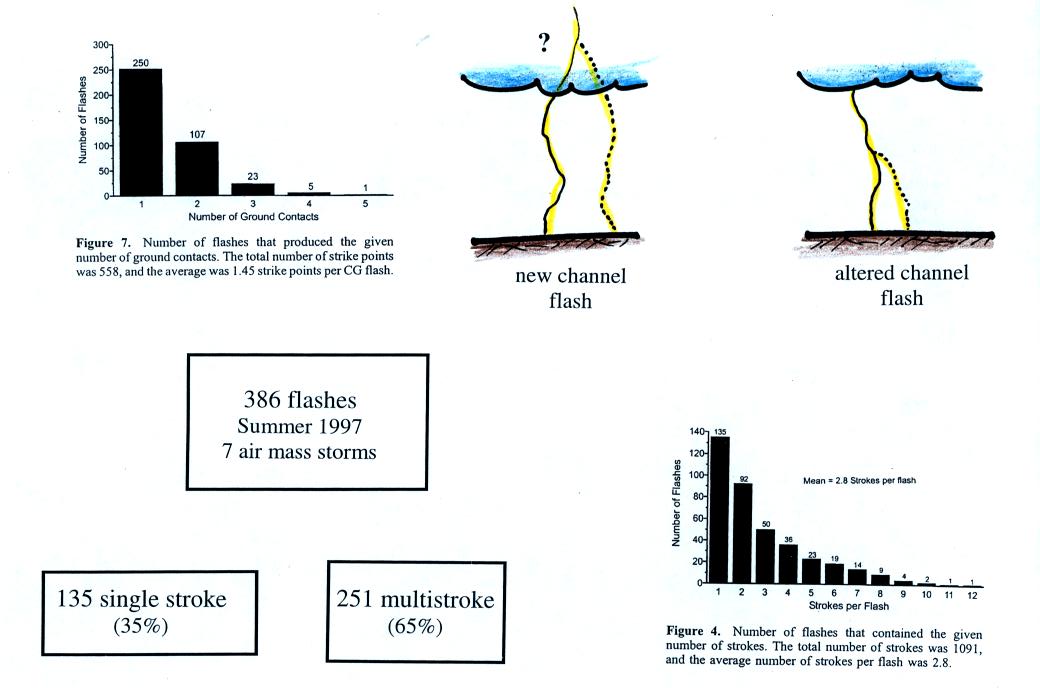
Return strokes in multi-stroke flash do not always strike the same point on the ground. This is illustrated in the following figure (source: "Statistics and characteristics of cloud-to-ground lightning with multiple ground contacts," W.C. Valine and E.P. Krider, J. Geophys. Res., 107(D20), 4441, doi:10.1029/2001JD001360, 2002)
Some subsequent return stroke characteristics are summarized in the table below
| peak current |
10 kA |
| peak current derivative |
100 kA/us |
| velocity |
1 x 10⁸ m/s |
Statistics on the number of strokes per flash are shown in the following two histograms (this was on a class handout)
Many lightning parameters or characteristics are log-normally distributed. This appears to be the case with the interval time between return strokes distribution in the next figure.
Return strokes in multi-stroke flash do not always strike the same point on the ground. This is illustrated in the following figure (source: "Statistics and characteristics of cloud-to-ground lightning with multiple ground contacts," W.C. Valine and E.P. Krider, J. Geophys. Res., 107(D20), 4441, doi:10.1029/2001JD001360, 2002)
Starting at lower left we see that
about 35% of the flashes studied contained just a single stroke.
A distribution of the number of strokes per flash is given in the
histogram at bottom right. Finally a distribution of the number
of ground contact points per flash is shown at upper right. On
average a flash has 1.45 strike points. We will make use of this
number later in the semester when we discuss lightning location
techniques and estimates of lightning flash densities, an important
parameter in lightning protection and lightning risk assessement.
Next we look at how a multi-stroke cloud-to-ground discharge might appear on slow and fast electric field antenna records. The next three figures were on a handout.
You've probably already got a copy of the 1st figure in your notes somewhere.

The high-speed photograph record of the discharge, at the top of the figure, should be familiar by now.
Point 1a on the slow E field record shows the field change produced by the stepped leader (the E field at the ground points upward toward the negative charge being lowered by the leader, so it looks like the atmospheric electricity convention for E field polarity is being used on this figure). The dart leader field changes are shown at Points 1b. They are smaller in amplitude (the dart leader doesn't lower as much charge as the stepped leader) and have shorter durations. The abrupt return stroke changes are shown at Points 2 on the slow E and the fast E records.
Points K on the fast E field record are "K changes." During the interval between return strokes, in-cloud leader processes seek out additional pockets of charge in the cloud. Occasionally, when the leader finds a concentration of charge, a rapid recoil streamer travels back along the in-cloud leader channel (in some ways like a return stroke propagates back along the leader in a cloud-to-ground strike). The K changes are probably produced by recoil streamers.
The preliminary discharge process that initiates cloud-to-ground discharges is not well understood. Sequences of bipolar waveforms like shown at Point 3 though are thought to be associated with the preliminary breakdown process.
Point 4 shows E field pulses thought to be produced by the last few steps of the stepped leader as it approaches the ground.
The fast E field waveforms produced by 1st and subsequent strokes are distinctly different. The 1st return stroke field variations following the peak are considerably noisier than is observed with subsequent strokes. Some of the "noisy" 1st return stroke E field record is probably produced by branches. Some of the structure on both the 1st and subsequent stroke waveforms is probably due to channel tortuosity.
Some of the modern lightning detection and location instrumentation is able to distinquish between return stroke waveforms and waveforms produced by leaders or discharges that occur during the preliminary breakdown activity.
The next figure is essentially the same except that some continuing current has been added following the second stroke.

A continuing current is a low level current (10s to 100s of
Amperes) that continues to flow after a return stroke for 10s to a few
100s of milliseconds. The continuing current can transport
signficant quantities of charge to the ground (100 ms x 250 Amps = 25 C
). Continuing currents can burn through metal sheets or metal
skins on aircraft bodies. A CG lightning discharge with
continuing current is sometimes referred to as "hot lightning" because
these discharges are more likely to cause a forest fire than a
discharge without continuing current. A field change associated
with the continuing current is visible on the slow E field
record. M components are a rebrightening of the lightning channel
that occurs during a continuing current. The K changes seen on
the fast E field trace may be associated with the M components.
This is an appropriate point to rexamine one of the slow motion lightning videos shown in class on Tuesday (the link is below). This is a 6 stroke flash. Continuing current follows the 6th stroke in the flash and extends until the end of the video. Here are a few thinks to look for during the flash
negative cloud-to-ground flash (7200 frame/sec capture rate)
The next figure illustrates a triggered lightning discharge

Next we look at how a multi-stroke cloud-to-ground discharge might appear on slow and fast electric field antenna records. The next three figures were on a handout.
You've probably already got a copy of the 1st figure in your notes somewhere.
The high-speed photograph record of the discharge, at the top of the figure, should be familiar by now.
Point 1a on the slow E field record shows the field change produced by the stepped leader (the E field at the ground points upward toward the negative charge being lowered by the leader, so it looks like the atmospheric electricity convention for E field polarity is being used on this figure). The dart leader field changes are shown at Points 1b. They are smaller in amplitude (the dart leader doesn't lower as much charge as the stepped leader) and have shorter durations. The abrupt return stroke changes are shown at Points 2 on the slow E and the fast E records.
Points K on the fast E field record are "K changes." During the interval between return strokes, in-cloud leader processes seek out additional pockets of charge in the cloud. Occasionally, when the leader finds a concentration of charge, a rapid recoil streamer travels back along the in-cloud leader channel (in some ways like a return stroke propagates back along the leader in a cloud-to-ground strike). The K changes are probably produced by recoil streamers.
The preliminary discharge process that initiates cloud-to-ground discharges is not well understood. Sequences of bipolar waveforms like shown at Point 3 though are thought to be associated with the preliminary breakdown process.
Point 4 shows E field pulses thought to be produced by the last few steps of the stepped leader as it approaches the ground.
The fast E field waveforms produced by 1st and subsequent strokes are distinctly different. The 1st return stroke field variations following the peak are considerably noisier than is observed with subsequent strokes. Some of the "noisy" 1st return stroke E field record is probably produced by branches. Some of the structure on both the 1st and subsequent stroke waveforms is probably due to channel tortuosity.
Some of the modern lightning detection and location instrumentation is able to distinquish between return stroke waveforms and waveforms produced by leaders or discharges that occur during the preliminary breakdown activity.
The next figure is essentially the same except that some continuing current has been added following the second stroke.
This is an appropriate point to rexamine one of the slow motion lightning videos shown in class on Tuesday (the link is below). This is a 6 stroke flash. Continuing current follows the 6th stroke in the flash and extends until the end of the video. Here are a few thinks to look for during the flash
| time |
comments |
| 0:05 |
1st stroke |
| 0:15 |
2nd stroke, upper part of the
channel is different from the 1st stroke |
| 0:21 |
3rd stroke, channel same as #2 |
| 0:27 |
4th stroke, back to channel in #1 |
| 0:32 |
5th stroke, channel #1 |
| 0:38 |
6th stroke with rebrightening ~1
sec after stroke, channel #1 continuing current following stroke |
| 0:44 0:45 |
channel rebrightening channell rebrightening |
| 1:03 |
weak rebrightening |
| 1:09 |
weak rebrightening |
negative cloud-to-ground flash (7200 frame/sec capture rate)
The next figure illustrates a triggered lightning discharge
Triggered discharges are initiated
by an upward propagating, positively charged leader which is followed
by a continuous current. This is followed by downward moving,
negatively charged dart leaders and subsequent return strokes.
The dart leaders and subsequent strokes are thought to be similar to
those that occur in natural CG discharges.
We watched a 10 minute video segment from a PBS program (NOVA?) that I'm not able to put online. However you can find some pretty good videos and still photographs at the following sites:
UF Florida site at Camp Blanding
Longer compilation from Florida (and Langmuir Lab in New Mexico?)
Lightning research group at the University of Florida
We watched a 10 minute video segment from a PBS program (NOVA?) that I'm not able to put online. However you can find some pretty good videos and still photographs at the following sites:
UF Florida site at Camp Blanding
Longer compilation from Florida (and Langmuir Lab in New Mexico?)
Lightning research group at the University of Florida