Thursday Feb. 24, 2011
click here to
download these notes in a more printer friendly format
Easily
the
worst
lecture
of
the
semester
so
far
(there's
still room
for more between now and early May). I probably should have just
canceled class and spent my furlough day planting my tomato seedlings
before the wind, dust, rain, and snow? that is forecast to arrive this
weekend.
Up to this point our study of thunderstorm electrical activity has
concentrated mainly on the electric fields and E field changes recorded
on the ground near thunderclouds. We have also looked at
some of the electrification processes that produce charge and at
the distribution of charge inside the cloud. Screening
layers that form at the edges of electrified clouds make it difficult
to determine
the true amount and distribution of charge inside the cloud but we can
use
field
change measurements to estimate amounts and locations of charge
neutralized by lightning.
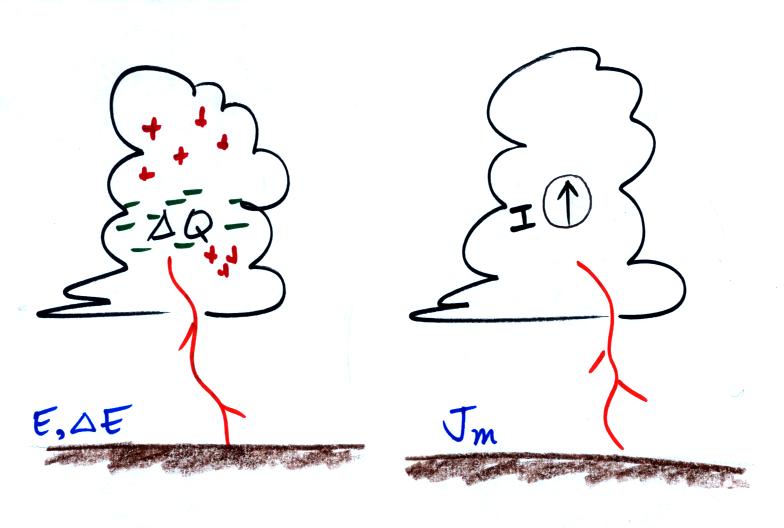
Today we will look at thunderstorms in a different way, as a
quasi-steady current source. We will look at how measurements of
"Maxwell current" at the ground (Jm
in the figure above) might allow us
to make a reasonable
lower limit estimate of the amplitude of the cloud current
source. We will also see that the Maxwell current varies
relatively slowly during a storm which suggests that cloud
electrification probably depends more on storm structure and storm
dynamics than the cloud electric field.
We can start with the continuity equation and derive an expression for
the Maxwell current:
The term in parenthesis appears in one of Maxwell's equations - that is
the origin of the name Maxwell current
A vector field with zero divergence is solenoidal
and the vector field lines must form closed loops (see Example 2.7.2 in
this
online reference). The following figure depicts the lines of
Jm surrounding a current source
in a thunderstorm (the current source
is highlighted yellow).

We will first look at how you might
measure Jm at a point (or at
multiple points) on the ground. With
measurements at multiple points it might be possible to produce a map
with contours of Jm (green in the
figure above). An area
integration of Jm
might then provide an estimate of the strength of the
current source in the cloud. Note however that, because some of
the lines of Jm do not reach the
ground (shaded pink in the figure), an
area integration will provide a lower limit estimate of the current
source strength.
The figure above looks simple enough. Once we start to see
what Jm includes,
it
becomes
a
little
harder
(for
me
at
least)
to
visualize
field
lines
of Jm .
In the figure above we
can see that Jm
includes lightning currents,
JL, and field
dependent conduction currents,
JE. There is a linear
contribution to JE
due to the drift of small ions
in an electric field (conductivity times E field) and a non-linear
component (corona discharge) that
occurs when fields at the tips of sharp pointed objects on
the ground exceed a certain
threshold and corona starts to "spray" charge into the air.
Charged precipitation and transport of charge by wind
motions are included in a convection current term, Jc. Finally
there is the displacement current term.
How do we determine Jm
at the ground?
1. You can measure it directly. The figure below shows what a "Jm sensor" might look like.

You basically dig up a piece of sod
about 1 meter square, place it in a metal pan, and isolate the pan from
ground. Currents flowing to or from the test patch of
soil (green) pass through an
operational amplifier which converts the small amplitude currents into
a measureable voltage. The pan and the measuring
electronics is positioned in a hole so that the top of the isolated
soil is flush with the surroundings (the surroundings are brown in the
figure above). Note that the op-amp will keep the potential of
the test pan at ground.
The figure below shows an example of simultaneous records of E
field and Maxwell current.
In the top figure you see 3 or 4 minutes of simultaneous recording
of Jm (top
trace)
and
E
field
(bottom
trace).
A
portion
of
the
record
is
shown on a faster time scale in the lower portion of the figure (Jm is the lower trace in
this case). Note that apart from the transient signals that occur
during lightning discharges, Jm is fairly steady with
time in these recordings (the green line). In the top example the
amplitude of Jm
does decrease slowly from about 10 nA/m2
at the start of the interval to
about 7 nA/m2 at the end of the
interval.
One important conclusion drawn from a plot like this is that,
because Jm
remains
relatively
constant
even
when
there
are
large
changes in E
field amplitude and polarity, the cloud electrication process must be
independent of the E field.
2. There may be situations where Jm is dominated
by the displacement current term. In that case you
can
determine Jm from
E
field
recordings.
We'll
write
down
the
expression
for
Jm
again.
We'll determine Jm
at a time when E is about zero (when E crosses zero
following a lightning discharge as shown below).
Then the field dependent conduction term will be zero. We'll
determine Jm
in between lightning discharges so that we won't have to include a
lightning current term. And we'll assume (for the time being
anyway) that the convection current term is much smaller than the
displacement current.
When all these conditions are true we'll be able to approximate
Jm by computing the
displacement current.
The next figure gives us some idea how well this approach works:
The top curve (highlighted yellow) shows direct measurements of
Jm made
using the Jm
sensor (the soil-filled pan) described in (1) above.
The blue shaded curve is an estimate of Jm made using measurements
of the displacement current term (at times when E is zero) using field
measurements made at the same site as the Jm sensor. For
the
pink
curve,
measurements
of
the
displacement
current
were
made
using field mills at nearby sites (field mills in the Kennedy Space
Center network). Estimates of Jm could be made using
measurements of displacement current at field mill sites east and west
of the sensor site for example. The value of Jm at the Jm sensor site could then
be made by interpolating between the two nearby sites. Lightning
activity (number of discharges per 5 minute period) is plotted in the
histogram at the bottom of the figure.
The direct measurements of are consistently 15% to 20% higher
than the estimates derived from measurements of the displacement
current. The authors of the study state "this discrepancy is not
large and probably due to a systematic error in the absolute
calibration of the different sensors".
Next we'll look at one of the first attempts to map out values of Jm over a large area.
The assumption is that Jm
is dominated by the displacement current term. Estimates of Jm were then made at
multiple sites by measuring dE/dt at field mill sites in the KSC
network. The figure below (I can see a very
reasonable mid-term exam question
coming from this figure or a figure like this) shows an
example of fields recorded at
6 of the sites .
A cloud-to-ground discharge was observed striking the ground at
16:57:23 and produced the field change near the start of each
record. A vertical arrow indicates where E crossed zero on each
waveform. This is the time at which dE/dt is measured and the
displacement current term is computed. The discharge at 16:58:39
(near
the end of each record) was apparently an intracloud discharge.
The next figure is a contour map of E field change values for the
16:57:23 cloud-to-ground discharge.
The field change values were computed after locating the charge
neutralized during the CG flash using the chi-squared minimization
procedure discussed in class last Tuesday. Approximately 46 C of
negative charge located at an altitude of 8.1 km was neutralized during
the flash. The preceding figure and the figure to
come are also from the reference cited in this figure.
The next figure shows contours of Jm determined just after
the
16:57:23 CG flash (i.e. at the time E was crossing zero).
Note that the center of the Jm
pattern is near the center of the field change pattern. The units
of Jm
in
the
figure
above
are
nA/m2.
An integration of Jm
over area will provide
an estimate of the strength of the current source in the cloud.
The next figure shows just such an estimate.
The two peaks in the plot of total current is explained by the
fact that there were two storms cells active over the KSC field network
during the time these data were collected. Note the very
reasonable (lower limit) estimate of 0.45 A peak total current.
We looked at one more surprising result that can be obtained from
estimates of Jm
and displacement current.
We'll look at the field recovery following a lightning discharge and
estimate Jm
at time to (when E crosses zero)
and a time t that can be before or
after to
(i.e. it could be t1, t2, or t3
in the figure above). Jm
at both to and t are
shown above. Now since Jm
is relatively steady we can set Jm at times to and t equal
to each other.
This leads to

We eliminate the convection current
terms because they would be hard to measure or determine. We're
left with a way of estimating the conduction current term at times
during the field recovery following a lightning flash. Note that
for each t in the figure below (t1, t2,
or
t3) our estimate of
JE is
associated with a different value of E.
I.e. To estimate JE(t1) you would
compute dE/dt at to and t1 and use
the formula above. JE(t1) would be associated with E1.
JE(t2) would be associated with E2.
If you plot all these pairs of JE
and E on a graph you find they fall in
a straight line.
You have a linear relationship between J and
E. The slope of the straight line is conductivity. Thus you
have a means of estimating conductivity.
Here's an example using actual data

Estimates of conductivity ranged
from 2 to 6 x 10-13 mhos/m.
Actual measurements of conductivity
ranged from 0.4 to 1.8 x 10⁻¹⁴ mhos/m. The
agreement is not very
good. The authors of the study (Blakeslee & Krider, 1992; see
the articles folder)
conclude the estimates of conductivity "will be
extremely sensitive to small time variations in the local Maxwell
current density and must be modified to include these terms".


