Tuesday Apr. 27, 2010
click here to download today's notes in a more
printer friendly format
Three songs ("Under My Thumb", "19th Nervous Breakdown", and
"Paint It, Black") from the Rolling Stones
before class today.
An In-class Optional Assignment was distributed in class today. Answers to
the assignment are online.
Lightning kills just bit fewer than 100 people every year in the United
States (more than tornadoes or hurricanes but less than flooding,
summer heat and winter cold) and is the cause of about 30% of all power
outages. In
the western United States, lightning starts about half of all forest
fires. Lightning caused fires are a particular problem at the
beginning of the thunderstorm season in Arizona. At this time the
air underneath thunderstorms is still relatively dry. Rain
falling from a thunderstorm will often evaporate before reaching the
ground. Lightning then strikes dry ground, starts a fire, and
there isn't any rain to put out or at least slow the spread of the
fire. This is so called dry lightning. Here's a short
story I used to read
before starting the section on lightning.
Lighning is most commonly produced by thunderstorms (it has also
be observed in dust storms and volcanic eruptions such as the one
erupting at present in Iceland).
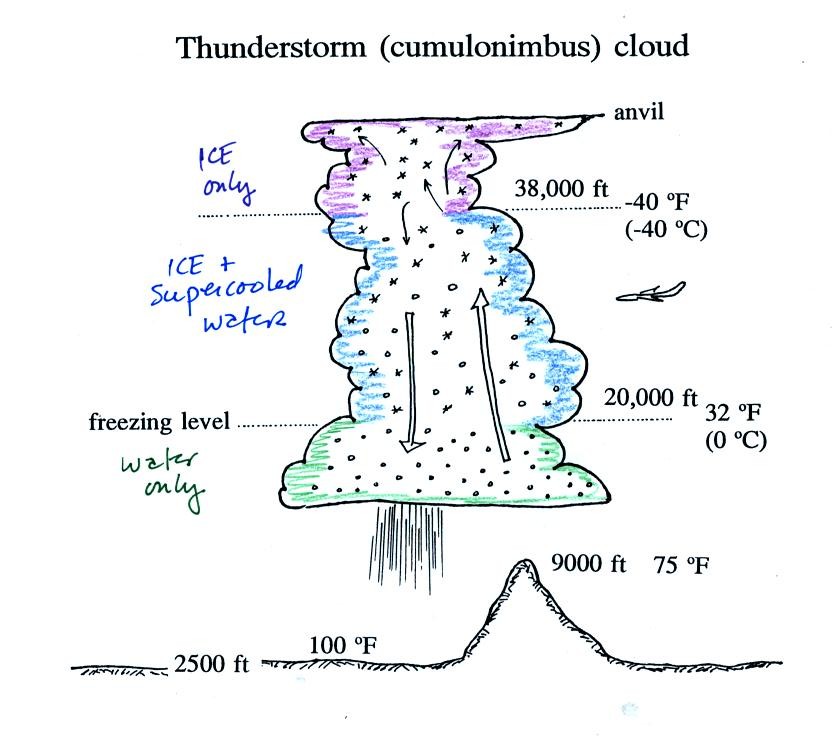
A typical summer thunderstorm in Tucson (found on p. 165 in the
photocopied Classnotes). Remember that
even in the summer
a large part of the middle of the middle of the cloud is found at below
freezing temperatures and contains a mixture of super cooled water
droplets and ice crystals. This is where the ice crystal process
of precipitation formation operatures and is also where electrical
charge is created. Doesn't it seem a little unusual that
static electricity can be created in such a cold and wet environment?
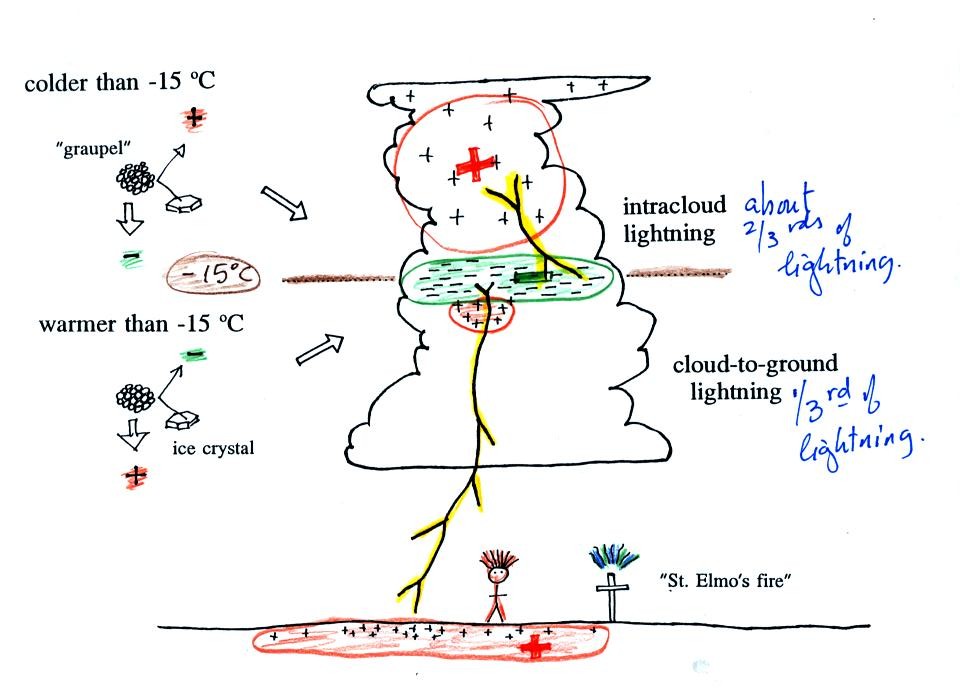
A couple of interesting things that can happen at the ground when
the
electrical forces get high enough. Attraction between positive
charge in the ground and the layer of negative charge in the cloud can
become strong enough that a person's hair will literally stand on
end. This is a potentially deadly situation to be in as lightning
might be about to
strike (don't hang around and have your picture taken as the people
below were doing). St.
Elmo's
fire
is a faint
electrical discharge that sometimes develops at the tops of elevated
objects during thundestorms. It was first observed coming from
the tall masts of sailing ships at sea (St. Elmo is the patron saint of
sailors).
The
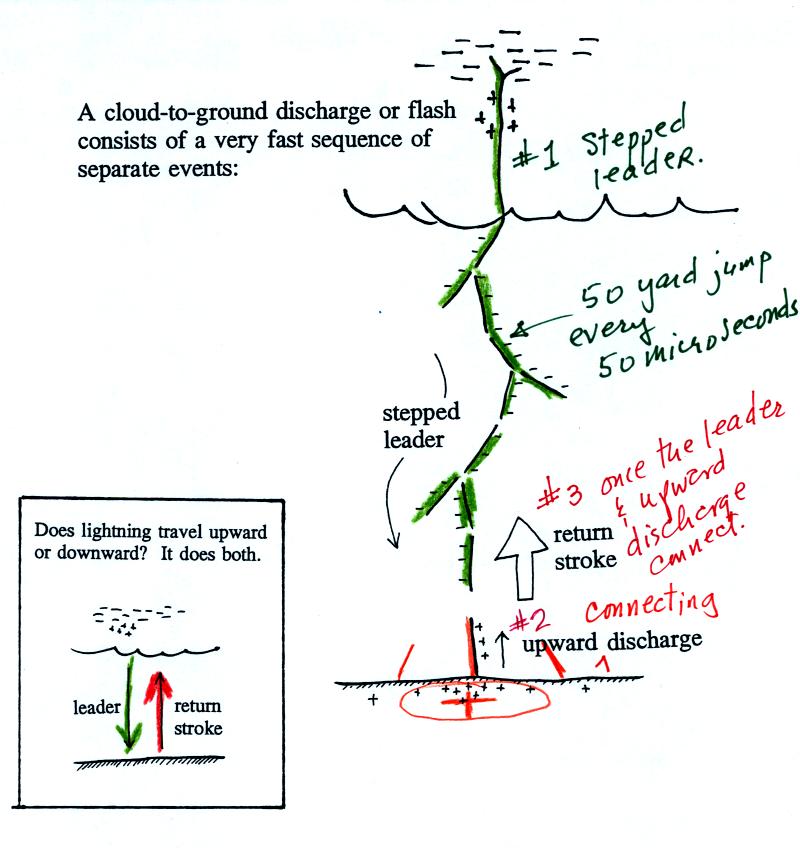
following figure is on p. 166 in the photocopied ClassNotes.
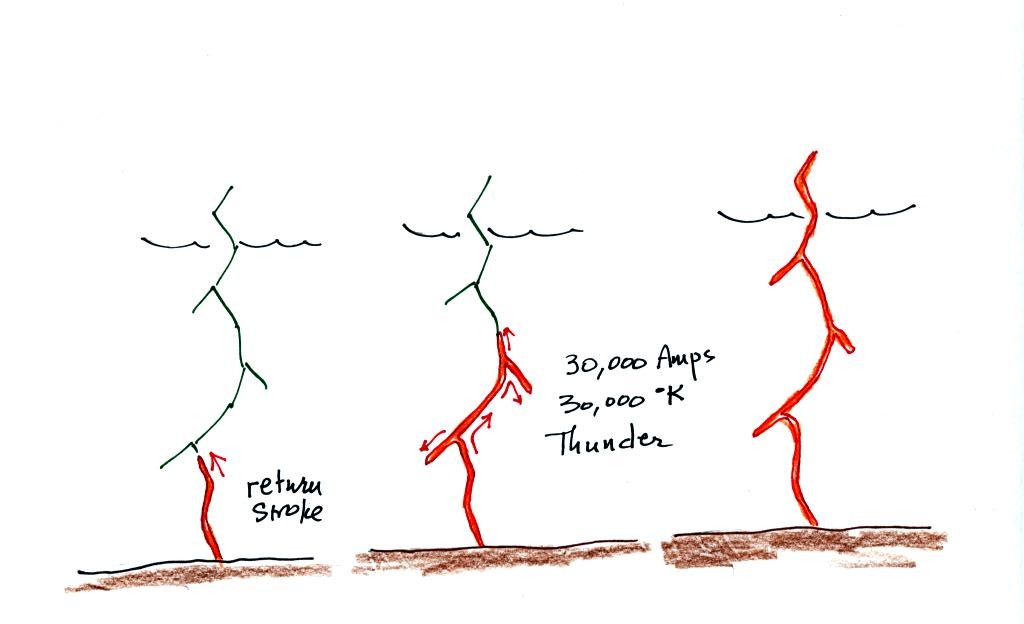
Most cloud to ground discharges begin with a negatively-charged
downward-moving stepped leader. It makes its way down toward the
cloud in 50 m jumps that occur every 50 millionths of a second or
so. Every jump produces a short flash of light. An upward
discharge is initiated when the stepped leader nears the ground.
A powerful return stroke travels back up the channel (and out into all
the branches) once the upward discharge and the stepped leader
meet. These three steps are shown in additional detail below.
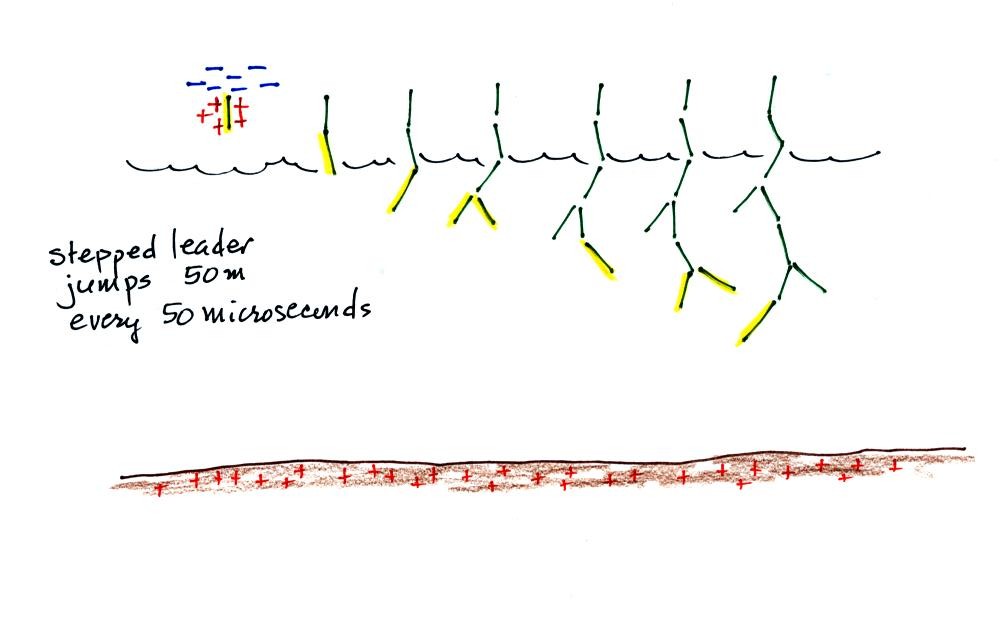
A sequence of stepped leader steps. Each of the
channels in the drawing should actualy be superimposed on each
other. This is what you would see if the film were moving so that
each new step was photographed in a slightly different position on the
film
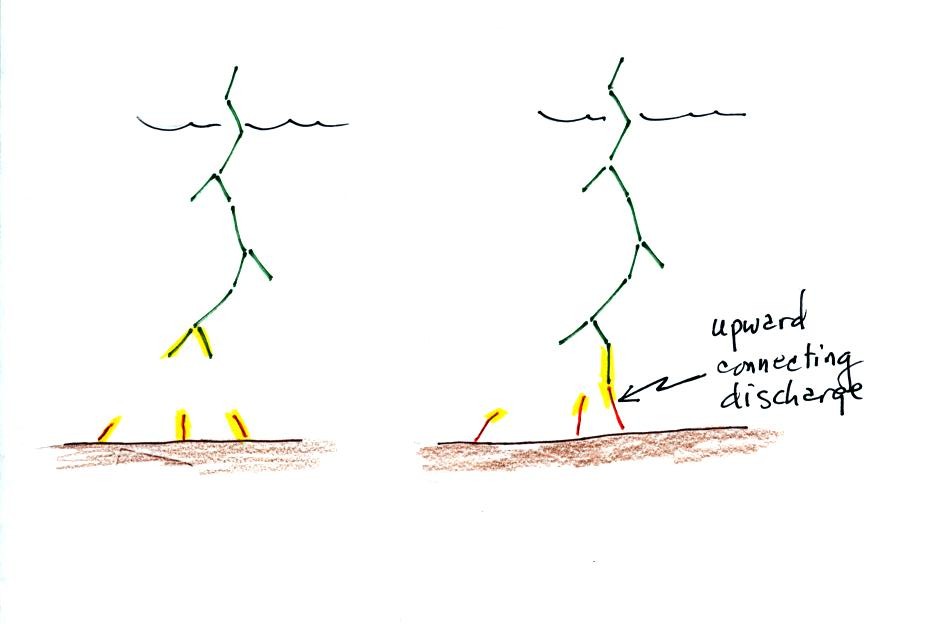
Several
positively charged upward discharges begin to travel upward from the
ground. One
of these will eventually intercept the stepped leader. This
is what determines what will be struck by the lightning. Lightning
doesn't really know what it will strike until it gets close
to the ground.
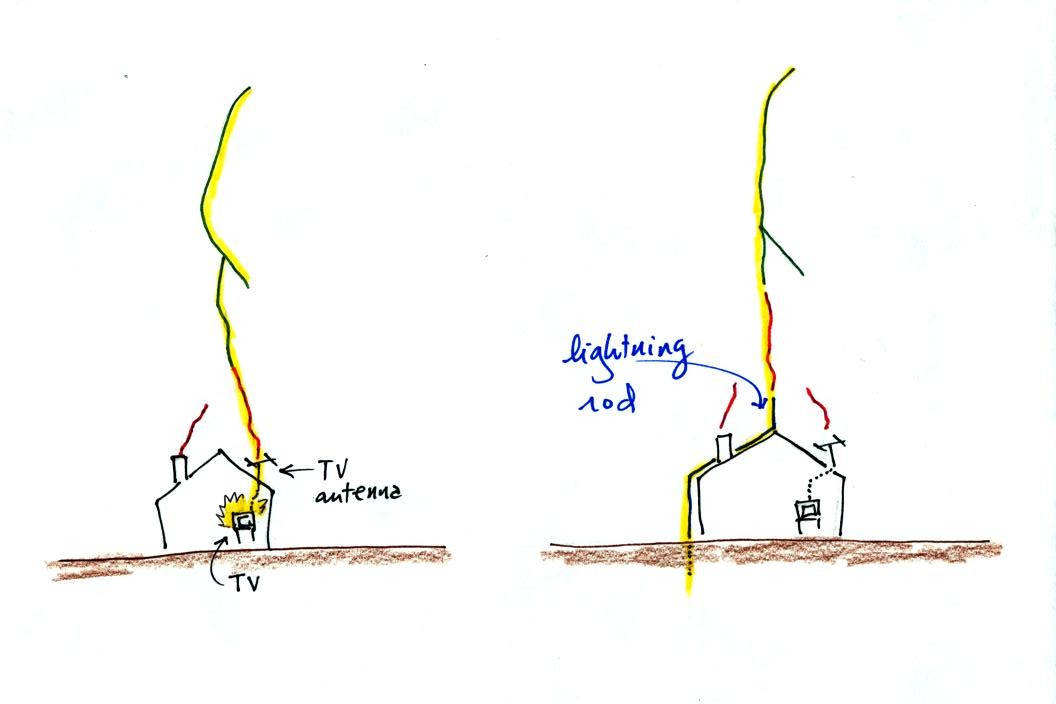
Lightning rods take advantage of this principle.
Houses with and without lightning rods
are
shown
above. When lightning strikes the house without a lightning rod
the powerful return stroke travels into the house destroying the TV and
possibly starting the house on fire.
A lightning rod is supposed to intercept the stepped leader and safely
carry the lightning current around the house and into the ground.
The
connection between the stepped leader and the upward discharge creates
a "short circuit" between the charge in the cloud and the charge in the
ground. A powerful current travels back up the channel from the
ground toward the cloud. This is the return stroke. Large
currents (typically 30,000 amps in the
first return stroke)
heat the
air to around 30,000K (5 times hotter than the
surface of the sun) which causes the air to explode. When you
hear thunder, you are hearing the sound produced by this explosion.
Here's a stepped
leader-upward connecting discharge-return
stroke computer
animation
We also watched a fast time resolved film of an actual
stepped leader (which I can't unfortunately put online). Here's a
pretty good
substitute that is on YouTube.
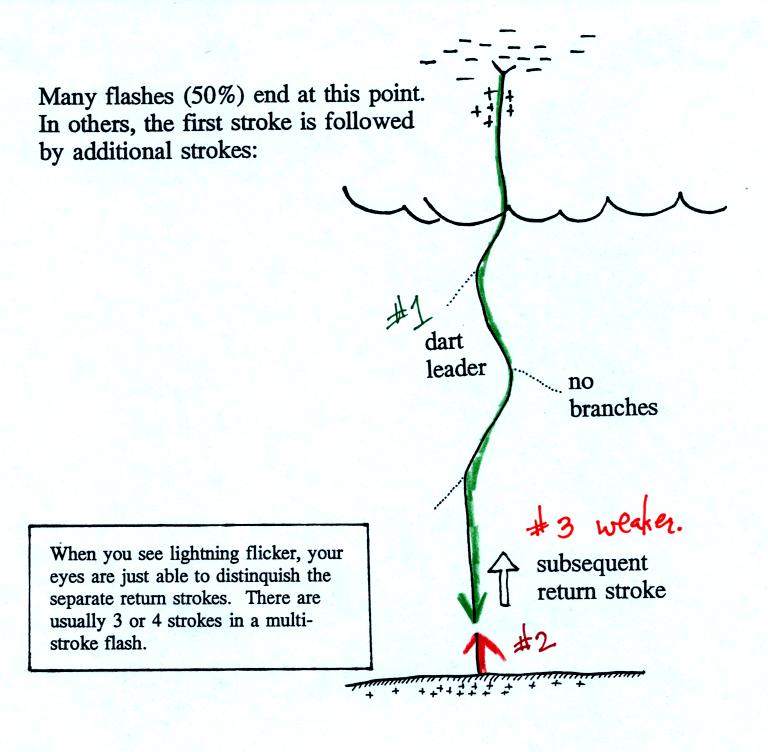
Many cloud-to-ground flashes end at this point. In
about 50% of cloud to ground discharges,
the stepped leader-upward
discharge-return stroke sequence repeats itself with a few subtle
differences.
A downward dart leader travels from the cloud to the
ground. The dart leader doesn't step but travels smoothly and follows
the channel created by the stepped leader (avoiding the
branches). It is followed by a slightly less powerful subsequent
return stroke that travels back up the channel to the cloud.
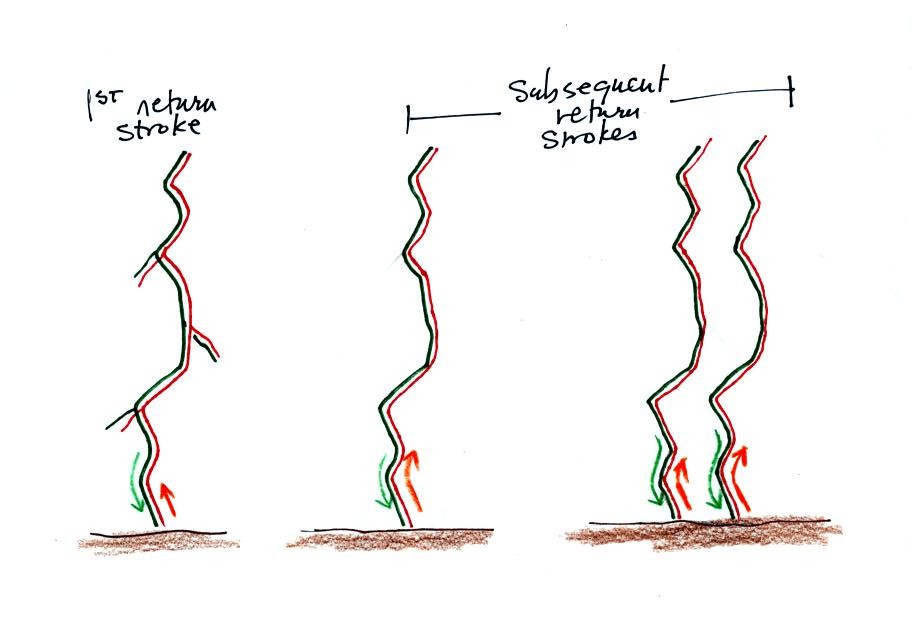
A normal still photograph would capture the
separate
return strokes
superimposed on each other. If you bumped or moved the camera
during the photograph the separate return strokes would be spread out
on the image.
The image above shows a multiple stroke flash consisting of 4 separate
return strokes. There is usually enough time between separate
return strokes (around 1/10 th
second) that your eye can
separate the individual flashes of light. When lightning appears
to flicker you are seeing the separate return strokes in a multiple
stroke flash. The whole flash usually lasts 0.5 to 1 second.
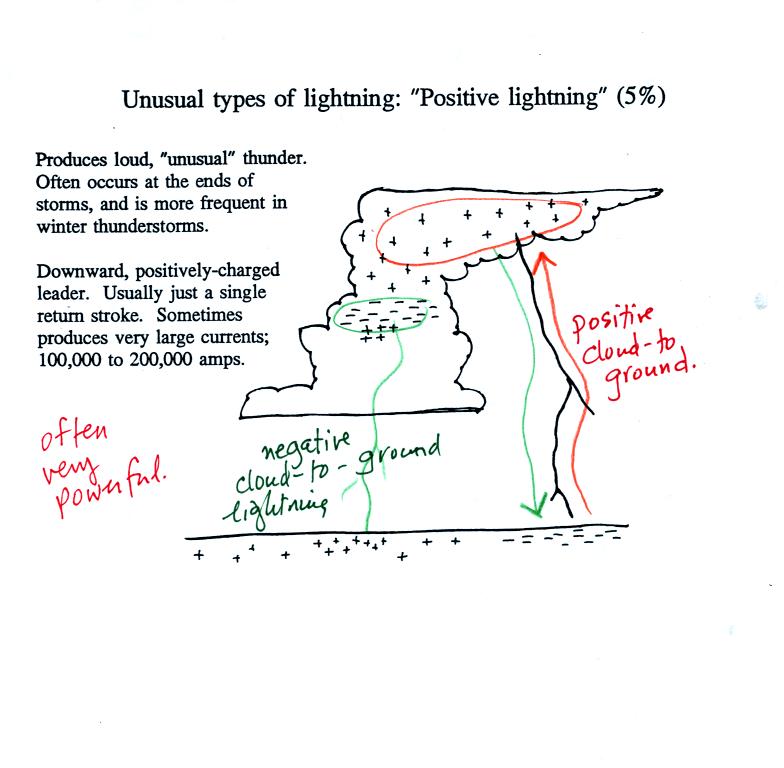
Here are
some unusual types of lightning.
Occasionally a lightning stroke will travel from the
positive charge
region in the top of the thunderstorm cloud to ground. These
types of strikes are more common at the ends of storms and in winter
storms. This is probably because the top part of the cloud gets
pushed sideways away from the middle and bottom portions of the
cloud. Positive strokes are very powerful. They sometimes
produce an unusually loud and long lasting clap of thunder.
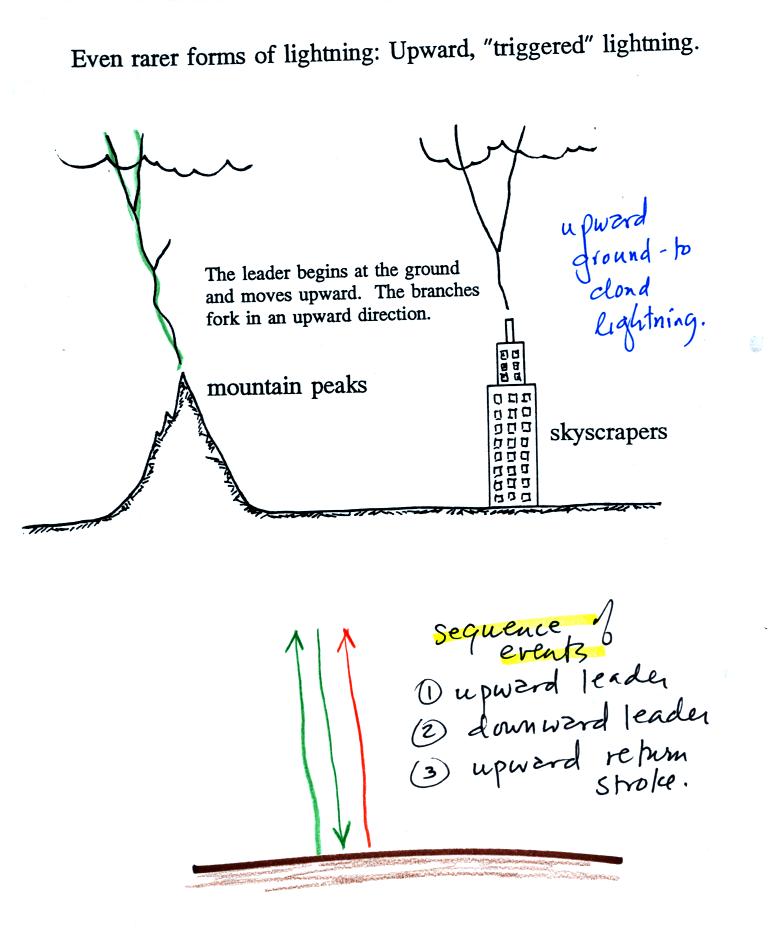
Here's an even rarer form of lightning. Lightning
sometimes starts at the ground and travels
upward.
Upward lightning is generally only initiated by mountains and tall
objects such as a skyscraper or a tower of some kind. Note the
discharge is different in a couple of other ways also. These
discharges are initiated by an upward leader. This is followed by
not by a return stroke but by a more normal downward leader. Once
the 2nd leader reaches the ground, an upward return stroke travels back
up the channel to the cloud. And because the initial
leader propagated upward, the branches on the channel point upward.
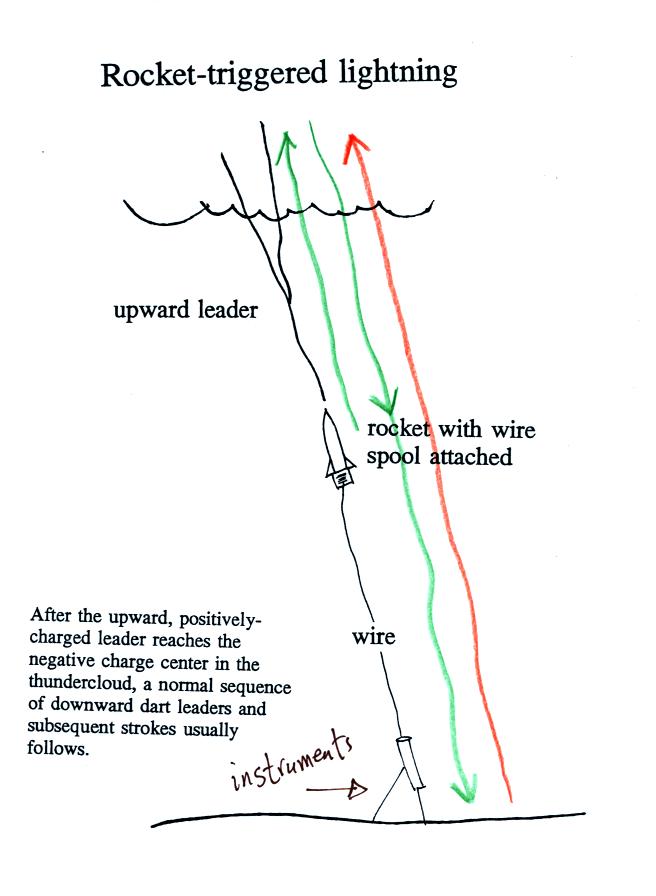
The fact that lightning could begin with an upward discharge that
begins at the ground lead scientists to develop a technique to trigger
lightning by firing a small
rocket up
toward a thunderstorm. The rocket is connected by a thin wire to
the ground. When the rocket gets 50 to 100 m above the ground
upward lightning will develop off of the top of the wire.
Scientists are able to take closeup photographs and make measurements
of lightning currents using triggered lightning. Triggered
lightning can also be used to test the operation of lightning
protection devices. A short video showing rocket triggered
lightning experiments being conducted in northern Florida was shown in
class.
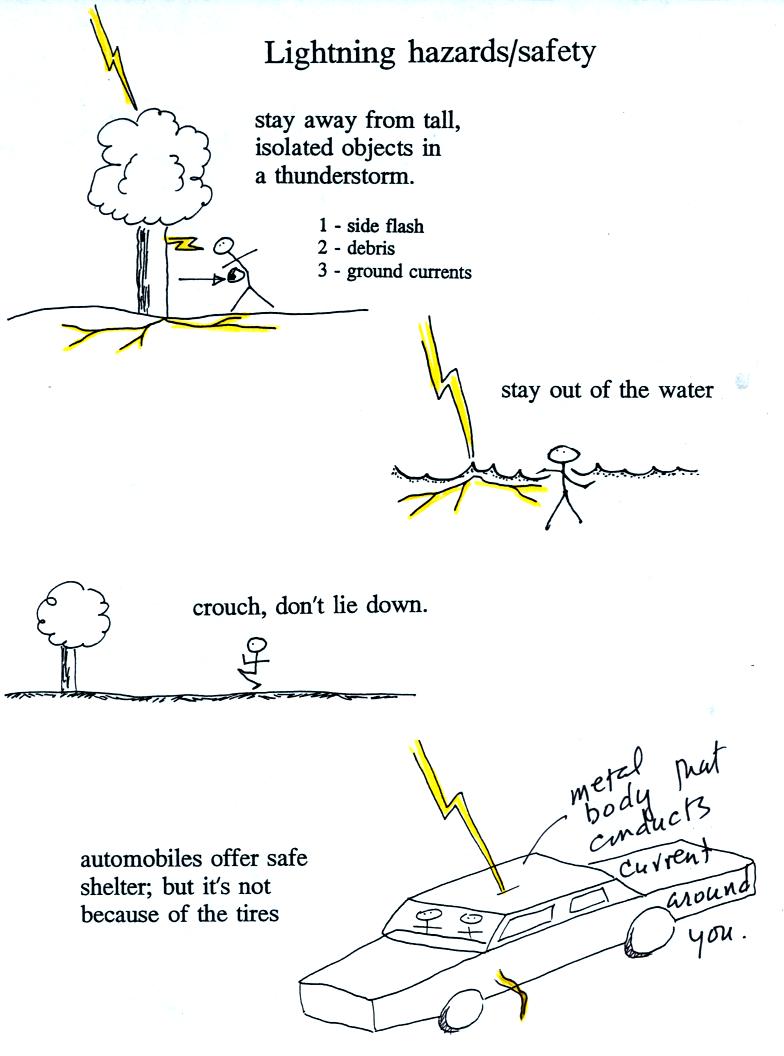
Lightning is a serious weather hazard and kills just under 100
people every year in the United States. We discussed some
lightning safety rules that you should keep in mind during
thundery weather.
Stay
away
from
tall
isolated
objects
during
a
lightning
storm.
You can be hurt or killed just by being close to a lightning strike
even if you're
not struck directly.
An
automobile
with
a
metal
roof and body provides good
protection from
lightning. The lightning current will travel through the metal
and around the passengers inside. The rubber tires really don't
play any role at all. The people in Florida that were
triggering lightning were inside a metal trailer and were perfectly
safe. All of the connections made to equipment outside the
trailer were done using fiber optics, there were no metal wires
entering
or leaving the trailer.
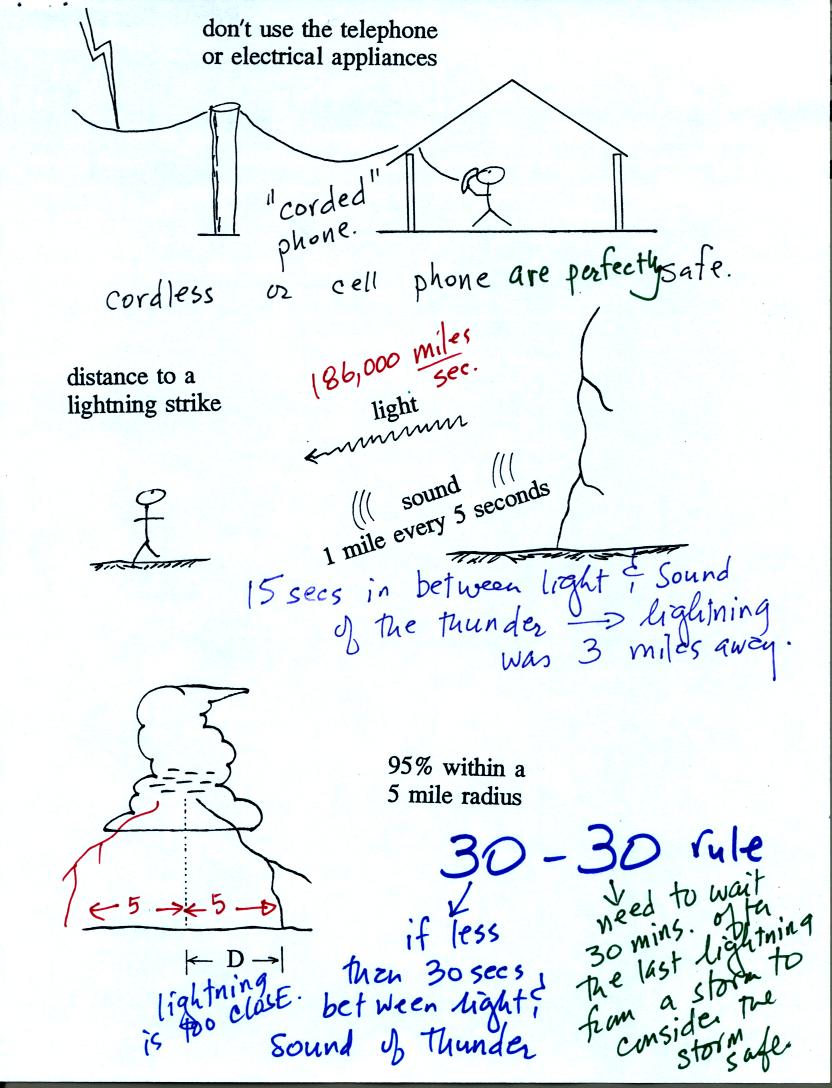
You shouldn't use a corded phone or electrical
appliances
during a lightning storm because lightning currents can follow wires
into your home. Cordless phones and cell phones are safe.
It is also a good idea to stay away from plumbing as much as possible
(don't take a shower during a lightning storm, for example). Vent
pipes that are connected to the plumbing go up to the roof of the
house which puts them in a perfect location to be struck.
To
estimate the distance to a lightning strike
count the
number of
seconds between the flash of light and when you first hear the
thunder. Divide this by 5 to get the distance in miles.
For example, a delay of 15 seconds between the flash of light and
the sound of thunder would mean the discharge was 3 miles away.
The latest lightning safety recommendation is the
30/30 Rule.
The 30/30 rule
People should seek shelter if the delay between
a lightning flash and its
thunder is 30 seconds or less.
People should remain under cover until
30 minutes after the final clap
of thunder.