Monday, Mar. 1, 2010
click here to download today's notes in a more printer friendly format

A couple of songs from Robert Plant and Alison Krauss before class today ("Sister Rosetta Goes Before Us" and "The Fortune Teller" from their Raising Sand CD).

The 1S1P Bonus Assignments (Surface Weather Map Analysis) were returned today.  The reports were in my backpack Sunday morning while I was riding my bike out to Sabino Canyon and some of them got pretty wet.  And my cat tore a few small pieces of paper from a few of them while they were drying in my house.  Sorry about that.  The average grade was 3.6 out of 5 pts.

The Experiment #2 reports were collected today.  It takes about a week to grade them. 

I plan to hand out the Expt. 3 materials this week.

Note the due date for the 1S1P Assignment #1 Topic #1 reports has been extended until next Monday, Mar. 8.  This is because I have been very slow about getting the report writing guidelines online.

By the time you see these online lecture notes, a preliminary version of the Quiz #2 Study Guide should be online. 


The sun emits electromagnetic radiation. That shouldn't come as a surprise since you can see it and feel it.  The earth also emits electromagnetic radiation.  It is much weaker and invisible.  The kind and amount of EM radiation emitted by the earth and sun depend on their respective temperatures.


The curve on the left is for the sun.  We first used Wien's law and a temperature of 6000 K to calculate  lambda max and got 0.5 micrometers.  This is green light; the sun emits more green light than any other kind of light.  The sun doesn't appear green because it is also emitting lesser amounts of violet, blue, yellow, orange, and red - together this mix of colors appears white.  44% of the radiation emitted by the sun is visible light,  49% is IR light (37% near IR + 12% far IR), and 7% is ultraviolet light.  More than half of the light emitted by the sun is invisible.

100% of the light emitted by the earth (temperature = 300 K) is invisible IR light.  The wavelength of peak emission for the earth is 10 micrometers. 

Because the sun (surface of the sun) is 20 times hotter than the earth a square foot of the sun's surface emits energy at a rate that is 160,000 times higher than a square foot on the earth.  Note the vertical scale on the earth curve is different than on the sun graph.  If both the earth and sun were plotted with the same vertical scale, the earth curve would be too small to be seen.

This seemed like an appropriate point for a demonstration - one that might save students some money (ones that live off campus and pay electric bills).

Last Friday we learned that ordinary tungsten bulbs (incandescent bulbs) produce a lot of wasted energy.  They emit a lot of infrared light that is wasted because it doesn't light up a room (it will heat up a room but there are better ways of doing that).  The light that they do produce is a warm white color (tungsten bulbs emit lots of orange, red, and yellow light and not as much blues, greens and violets). 
Energy efficient compact fluorescent lamps (CFLs) are being touted as an ecological alternative to tungsten bulbs because they use substantially less electricity, don't emit a  lot of wasted infrared light, and also last longer.  CFLs come with different color temperature ratings.


The bulb with the hottest temperature rating (5500 K ) in the figure above is meant to mimic or simulate sunlight.  The temperature of the sun is 6000 K and lambda max is 0.5 micrometers.  The spectrum of the 5500 K bulb is similar.

The tungsten bulb (3000 K) and the CFLs with temperature ratings of 3500 K and 2700 K produce a warmer white. 

Three CFLs with the temperature ratings above were set up in class so that you could see the difference between warm and cool white light.  Personally I find the 2700 K bulb "too warm," it makes a room seem gloomy and depressing.  The 5500 K bulb is "too cool" and creates a stark sterile atmosphere like you might see in a hospital.  I prefer the 3500 K bulb in the middle.

This figure below is from an article on compact fluorescent lamps in Wikipedia for those of you that weren't in class and didn't see the bulb display..  You can see a clear difference between the cool white bulb on the left in the figure below and the warm white light produced by a tungsten bulb (2nd from the left) and 2 CFCs with low temperature ratings (3rd and 4th from the left).


There is one downside to these energy efficient CFLs.  The bulbs shouldn't just be discarded in your ordinary household trash because they contain mercury.  They should be disposed of properly (at a hazardous materials collection site or perhaps at the store where they were purchased).


We now have most of the tools we will need to begin to study energy balance on the earth.  It will be a balance  between incoming sunlight energy and outgoing energy emitted by the earth.  We will look at the simplest case first, the earth without an atmosphere (or at least an atmosphere without greenhouse gases) found on p. 68 in the photocopied Classnotes.


You might first wonder how, with the sun emitting so much more energy than the earth, it is possible for the earth (with a temperature of around 300 K) to be in energy balance with the sun (6000 K).  At the top right of the figure you can see that the earth is located about 90 million miles from the sun and therefore only absorbs a very small fraction of the total energy emitted by the sun.

To understand how energy balance occurs we start, in Step #1, by imagining that the earth starts out very cold (0 K) and is not emitting any EM radiation at all.  It is absorbing sunlight however so it will begin to warm.  This is like opening a bank account, the balance will be zero.  But then you start making deposits and the balance starts to grow.

Once the earth starts to warm it will also begin to emit EM radiation, though not as much as it is getting from the sun (the slightly warmer earth in the middle picture is now colored blue).  Once you find money in your bank account you start to spend it.  Because the earth is still gaining more energy than it is losing the earth will warm some more.

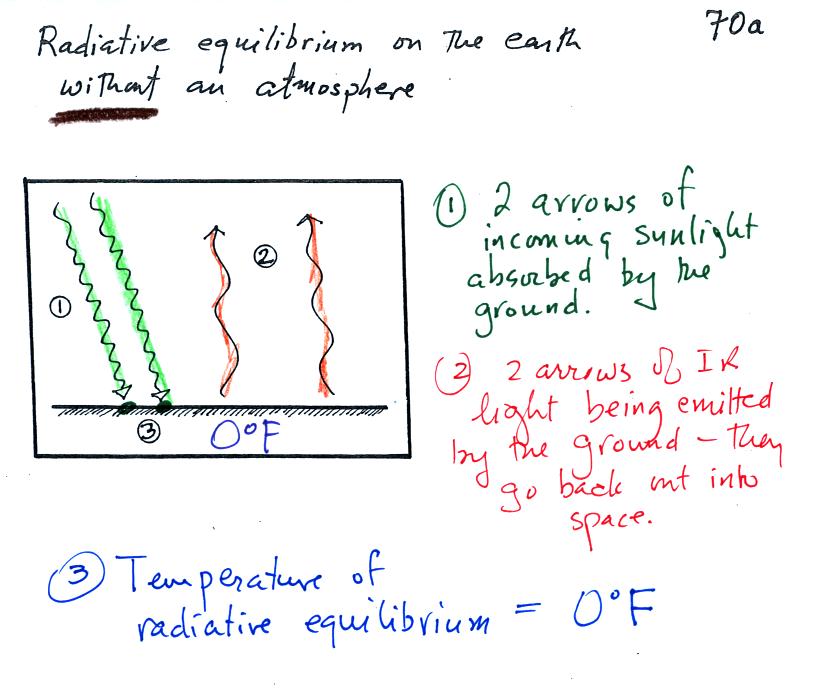
Eventually it will warm enough that the earth (now shaded green) will emit the same amount of energy (though not the same wavelength energy) as it absorbs from the sun.  This is radiative equilibrium, energy balance.  The temperature at which this occurs is about 0 F.  That is called the temperature of radiative equilibrium.  You might remember this is the figure for global annual average surface temperature on the earth without the greenhouse effect.


Before we start to look at radiant energy balance on the earth with an atmosphere we need to learn about filters.  The atmosphere will filter sunlight as it passes through the atmosphere toward the ground.  The atmosphere will also filter IR radiation emitted by the earth as it trys to travel into space.

We will first look at the effects simple blue, green, and red glass filters have on visible light.  This is just to become familiar with filter absorption graphs.


If you try to shine white light (a mixture of all the colors) through a blue filter, only the blue light passes through.  The filter absorption curve shows 100% absorption at all but a narrow range of wavelengths that correspond to blue light.  Similarly the green and red filters only let through green and red light.

The following figure is a simplified, easier to remember, representation of the filtering effect of the atmosphere on UV, VIS, and IR light (found on p. 69 in the photocopied notes).  The figure was redrawn after class.


You can use your own eyes to tell you what the filtering effect of the atmosphere is on visible light.  Air is clear, it is transparent.  The atmosphere transmits visible light.

In our simplified representation oxygen and ozone make the atmosphere pretty nearly completely opaque to UV light .  We assume that the atmosphere absorbs all incoming UV light, none of it makes it to the ground.  This is of course not entirely realistic.

Greenhouse gases make the atmosphere a selective absorber of IR light - the air absorbs certain IR wavelengths and transmits others.  It is the atmosphere's ability to absorb (and also emit) certain wavelengths of infrared light that produces the greenhouse effect and warms the surface of the earth.

Note "The atmospheric window" centered at 10 micrometers.  Light emitted by the earth at this wavelength (and remember 10 um is the wavelength of peak emission for the earth) will pass through the atmosphere.  Another transparent region, another window, is found in the visible part of the spectrum.

You'll find a more realistic picture of the atmospheric absorption curve on p. 70 in the photocopied Classnotes, but the simplified version above will work fine for us.


Here's the outer space view of radiative equilibrium on the earth without an atmosphere.  The important thing to note is that the earth is absorbing and emitting the same amount of energy (4 arrows absorbed balanced by 4 arrows emitted).


We will be moving from an outer space vantage point of radiative equilibrium (figure above) to the earth's surface (figure below).

Don't let the fact that there are
4 arrows are being absorbed and emitted in the top figure and
2 arrows absorbed and emitted in the bottom figure
bother you.  The important thing is that there are equal amounts being absorbed and emitted in both cases.


The next step is to add the atmosphere.
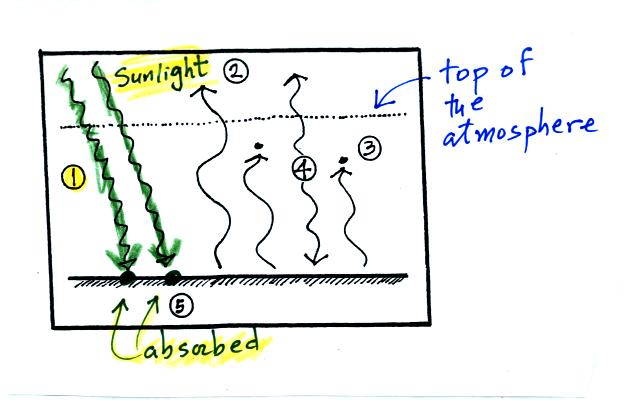
We will study a simplified version of radiative equilibrium just so you can identify and understand the various parts of the picture.  Keep an eye out for the greenhouse effect.  Here's something close to what we ended up with in class


It would be hard to sort through all of this if you weren't in class (and maybe even if you were) to see how it developed.  So below we will go through it again step by step (which you are free to skip over if you wish).  Caution: some of the colors below are different from used in class.


1.   The figure shows two rays of incoming sunlight that pass through the atmosphere, reach the ground, and are absorbed.  100% of the incoming sunlight is transmitted by the atmosphere.  This wouldn't be too bad of an assumption if sunlight were just visible light.  But it is not it is about half IR light and some of that is going to be absorbed.

The ground is emitting 3 rays of IR radiation.

2.   One of these (pink arrow above) is emitted by the ground at a wavelength that is NOT absorbed by greenhouse gases in the atmosphere.  This radiation passes through the atmosphere and goes out into space.

3.  The other 2 units of IR radiation emitted by the ground are absorbed by greenhouse gases is the atmosphere.


4.   The atmosphere is absorbing 2 units of radiation.   In order to be in radiative equilibrium,the atmosphere must also emit 2 units of radiation.  1 unit of IR radiation is sent upward into space, 1 unit is sent downward to the ground where it is absorbed.


Before we go any further we will check to be sure that every part of this picture is in energy balance.

The ground is absorbing 3 units of energy (2 green arrows of sunlight and one bluish arrow coming from the atmosphere) and emitting 3 units of energy (one pink and two red arrows)

The atmosphere is absorbing 2 units of energy and emitting 2 units of energy

2 units of energy arrive at the earth from outer space, 2 units of energy leave the earth and head back out into space.


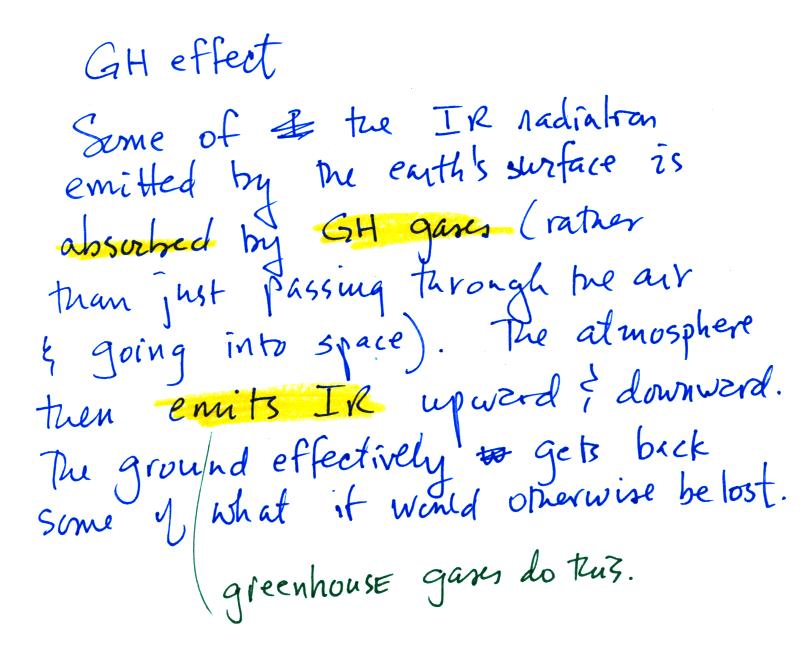
The greenhouse effect is found in the absorption and emission of IR radiation by the atmosphere.  Here's how you might put it into words: