Monday Feb. 8, 2010
click here to download today's notes in a more
printer friendly format
A couple of songs ("Resistance" and "Undisclosed Desires") from Muse before class today.
The In-class Optional Assignment from last Friday was returned
today. Here are answers to
the two questions.
The 1S1P Bonus Assignment and Experiment
#1 reports were collected in class today. It will take about
a week to grade the experiment reports, a little bit longer for the
1S1P reports perhaps.
Experiment #2 materials will be
distributed on Wednesday or Friday this week. If you haven't yet
returned Expt. #1 materials please do so as soon as you can, the
graduated cylinders are needed for Expt. #2.
Because we rushed through it at the end of class last Friday, we
reviewed how pressure data is coded and decoded on surface weather
maps. You'll find that near the end of the Fri.,
Feb.
05 online notes.
Another
important piece of information that we didn't cover last Friday and
that is included on a surface weather
map is the time the observations were collected. Time on a
surface map is converted to a universally agreed upon time zone called
Universal Time (or Greenwich Mean Time, or Zulu time).
That is the time at 0 degrees longitude. There is a 7 hour time
zone difference between Tucson (Tucson stays on Mountain
Standard Time year round) and Universal Time. You must add 7
hours to the time in Tucson to obtain Universal Time.
Here are some examples
2:45 pm MST:
first convert 2:45 pm to the 24
hour clock format 2:45 + 12:00 = 14:45 MST
then add the 7 hour time zone correction ---> 14:45
+ 7:00 = 21:45 UT (9:45 pm in Greenwich)
9:05 am MST:
add the 7 hour time zone
correction ---> 9:05 + 7:00 = 16:05 UT (4:05 pm in England)
18Z:
subtract the 7 hour time zone
correction ---> 18:00 - 7:00 = 11:00 am MST
02Z:
if we subtract the 7 hour time
zone correction we will get a negative
number.
We will add 24:00 to 02:00 UT then subtract 7 hours
02:00 + 24:00 = 26:00
26:00 - 7:00 = 19:00 MST on the previous day
2 hours past midnight in Greenwich is 7 pm the previous day in
Tucson
We spend most of the period learning about some of the analyses of
weather data that are done on surface weather maps.
A bunch of weather data has been
plotted (using the station model notation) on a surface weather map in
the figure
below (p. 38 in the ClassNotes). 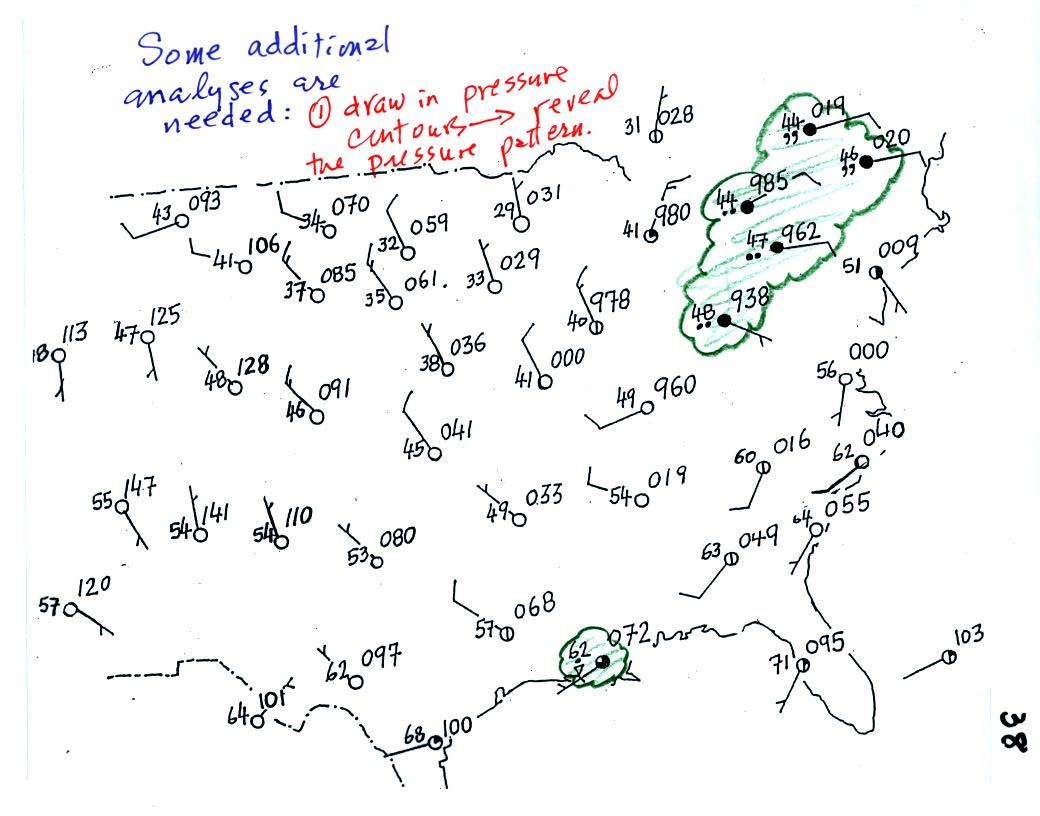
Plotting the surface weather
data
on a map is
just the
beginning.
For example you really can't tell what is causing the cloudy weather
with rain (the dot symbols are rain) and drizzle (the comma symbols) in
the NE portion of the map above or the rain
shower along the Gulf Coast. Some additional
analysis is needed. A meteorologist would usually begin by
drawing some contour lines of pressure to map out the large scale
pressure pattern. We will look first at contour lines of
temperature, they are a little easier to understand (easier to decode
the plotted data and temperature varies across the country in a fairly
predictable way).
I told you I would finish coloring
the map when I got back to my office (actually this is from a previous
semester)
Isotherms, temperature
contour lines, are usually drawn at 10 F
intervals.
They do two things: (1) connect points on the map that all
have the same temperature, and (2) separate regions that are warmer
than a particular temperature from regions that are colder. The
40o F isotherm highlighted in yellow above passes through
a city which is reporting a temperature of exactly 40o.
Mostly
it
goes
between pairs of
cities: one with a temperature warmer than 40o and the other
colder
than 40o. Temperatures
generally decrease with
increasing
latitude: warmest temperatures are usually in the south, colder
temperatures in the north.
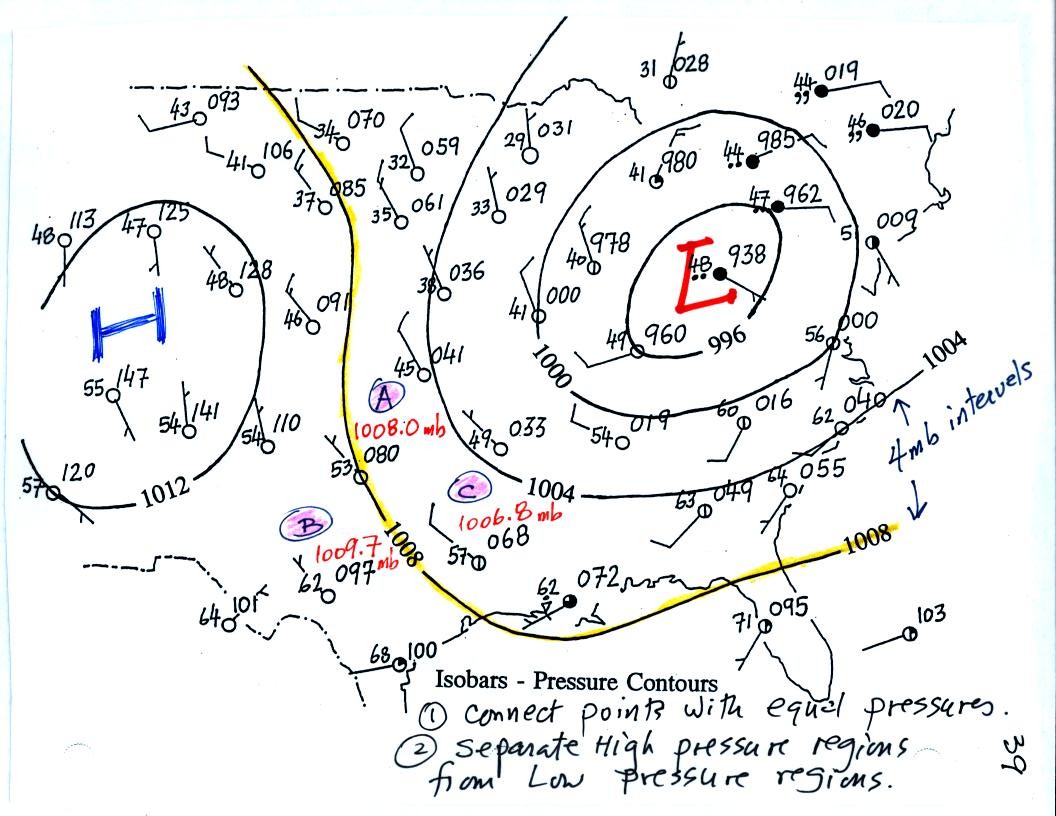
Now the same data with isobars
drawn in. Again they
separate
regions with pressure higher than a particular value from regions with
pressures lower than that value.
Isobars are generally drawn at 4 mb intervals. Isobars also connect points on the map
with the same pressure. The 1008 mb isobar (highlighted in
yellow) passes through a city at Point
A where the pressure is exactly
1008.0 mb. Most of the time the isobar
will pass between two
cities. The 1008 mb isobar passes between cities with
pressures
of 1009.7 mb at Point B and
1006.8 mb at Point C.
You would
expect to find 1008 mb somewhere in between
those two cites, that is where the 1008 mb isobar goes.
The pattern on this map is very different from the
pattern
of
isotherms. On this map the main features are the circular low and
high pressure centers.
Just locating closed centers of high and low pressure will already
tell you a lot about the weather that is occurring in their vicinity.
1.
We'll start with the large nearly circular centers of High and Low
pressure. Low pressure is drawn below. These figures are
more neatly drawn versions of what we did in class.
Air will start moving
toward low
pressure (like a rock sitting on a hillside that starts to roll
downhill), then something called the Coriolis force will cause
the
wind to start to spin (we'll learn more about the Coriolis force later
in the semester). In the northern hemisphere winds spin in a
counterclockwise (CCW) direction
around surface
low pressure
centers. The winds also spiral inward toward the center of the
low, this is called convergence. [winds spin clockwise around low
pressure centers in the southern hemisphere but still spiral inward,
don't worry about the southern hemisphere until later in the semester]
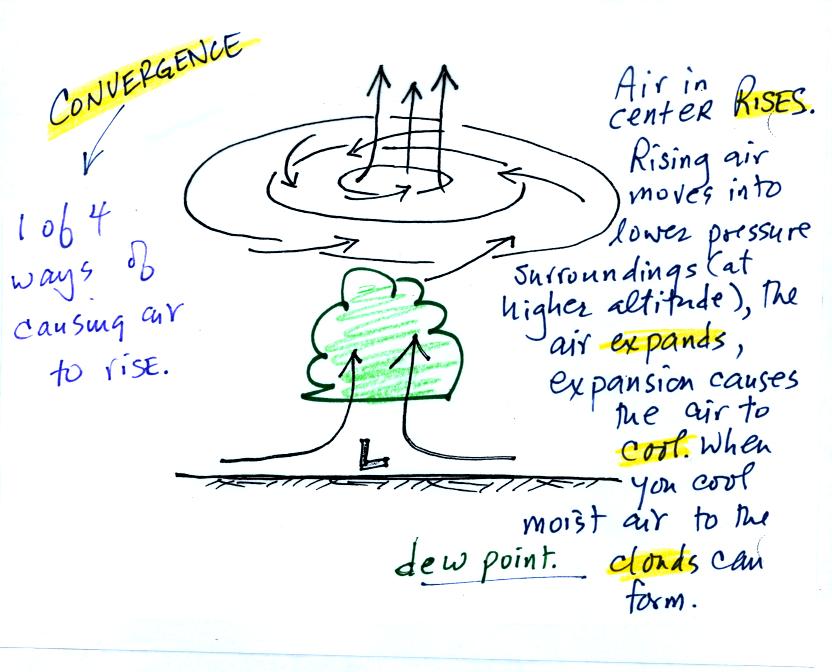
When the converging air reaches the
center of the low it starts to rise.
Rising air expands (because it is moving into lower pressure
surroundings at higher altitude), the expansion causes it to
cool. If the air is moist
and it is cooled enough (to or below the dew point temperature) clouds
will form and may then begin to rain or snow. Convergence is 1 of 4 ways of causing air
to rise. You often
see
cloudy skies and stormy weather associated with surface low pressure.
Surface high pressure
centers are pretty much just the opposite situation. Winds
spin
clockwise
(counterclockwise
in the southern hemisphere) and spiral outward.
The
outward motion is called divergence.
Air sinks in the center of
surface high pressure to
replace the diverging air. The sinking air is compressed and
warms. This keeps clouds from forming so clear
skies are normally found with high pressure (clear skies but not
necessarily warm weather, strong surface high pressure often forms when
the air is very cold).