Wednesday, Feb. 27, 2019

Haelos "Earth Not Above"(4:51), "Dust"(5:00), "Pray" (5:30)

We'll be using page 71, page 72, page 72a and page 72b from the ClassNotes today.

Experiment #3 materials will be distributed in class today

An Optional In-class Assignment was handed out today and collected at the end of class.
  If you weren't in class you can download the assignment, answer the questions, turn it in at the start of class on Mon., Mar. 11 and receive at least partial credit.

How much of the sunlight arriving at the top of the atmosphere actually makes it to the ground?

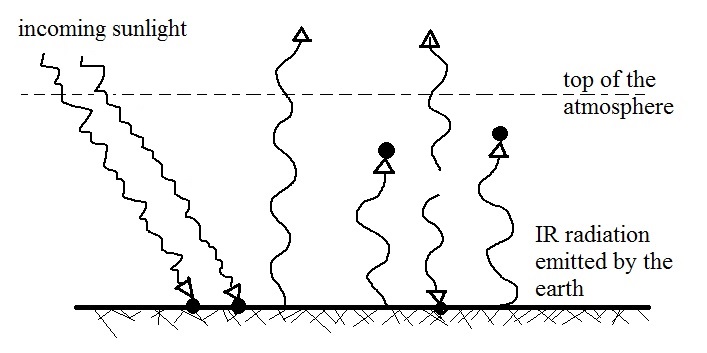
In the simplified explanation of the greenhouse effect last week we assumed that 100% of the sunlight arriving at the top of the earth's atmosphere passed through the atmosphere and got absorbed at the ground (the upper portion of the figure below). That would be a reasonable assumption if sunlight were just visible light, but it's not.  We will get a better idea now of what actually happens to the incoming sunlight.


The bottom portion of the figure above shows that on average (averaged over the year and over the globe) about half  (50%) of the incoming sunlight makes it through the atmosphere and gets absorbed at the ground.  This is the only number in the figure you should try to remember.

About 20% of the incoming sunlight is absorbed by gases in the atmosphere.  Sunlight is a mixture of mostly visible and near IR light.  There are smaller amounts of far IR and UV light.  Ozone and oxygen will absorb most of the UV (UV makes up only 7% of sunlight).  Roughly half (49%) of sunlight is IR light and greenhouse gases will absorb some of that.

The remaining 30% of the incoming sunlight is reflected or scattered back into space (by the ground, clouds, even air molecules).

Expt. #3 students take note.  The object of Expt. #3 is to measure the energy in the sunlight arriving at the ground here in Tucson.  About 2 calories of sunlight energy pass through a one square centimeter area every minute at the top of the atmosphere.  Since about 50% of that will reach the ground, you should get a value of about 1 calorie/(cm2  min).


Here is our simplified version of the greenhouse effect
from last week.  This figure is in energy balance

We'll make our simplified version more realistic by allowing only half of the incoming sunlight to reach the ground.  The other half is absorbed by the atmosphere. 


As shown here the figure is incomplete because it is not in energy balance. 
The atmosphere is absorbing 3 units of energy but not emitting any.  
We need to add 3 arrows of emitted energy.  The question is what direction
to send them, up or down. 

The ground is emitting 3 units of energy and getting 1 from the sun.  It needs two additional units to be in energy balance.  At the top of the picture we need 1 more unit of outgoing energy.
We send 1 of the 3 units of energy emitted by the atmosphere upward.  We send the two remaining units downward.  Now all three parts of the figure are in energy balance.


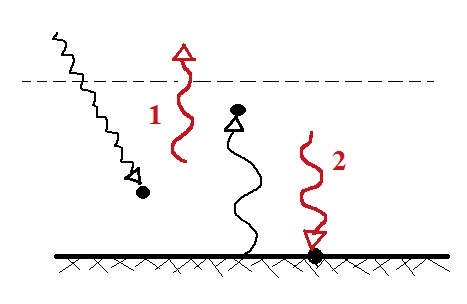
Here's another example to try to balance on your own.   You'll find the answer at the end of today's notes


A more realistic picture of energy balance on the earth

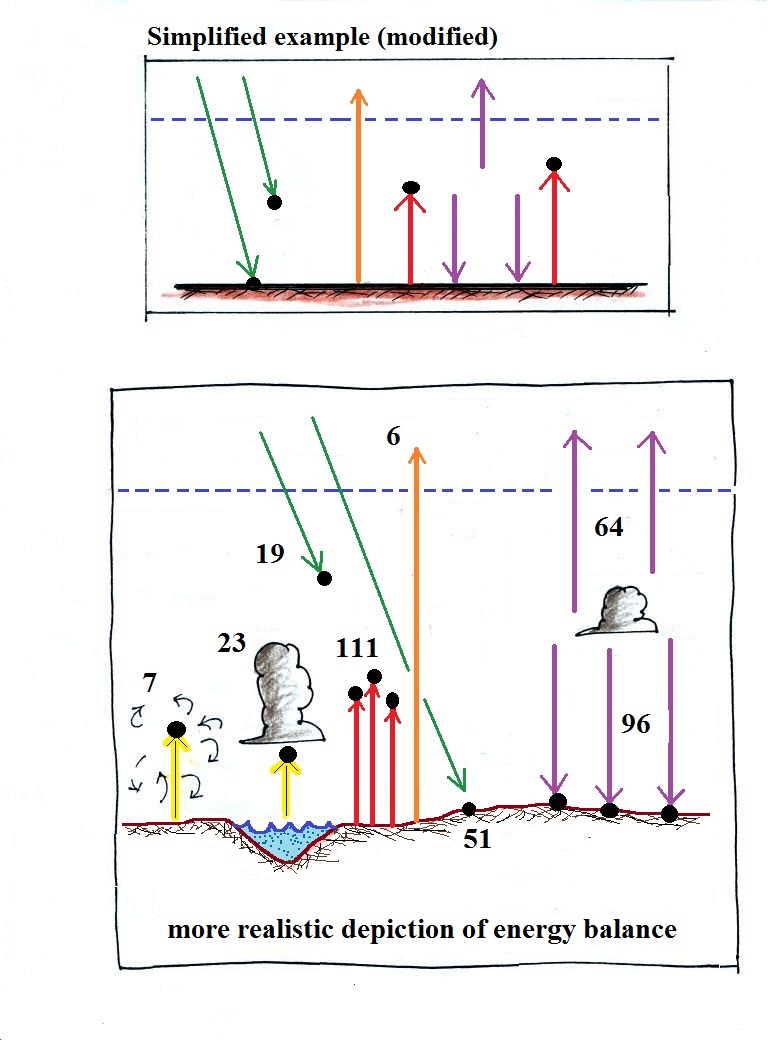
The top part of the figure below is our new and improved but still simplified representation of energy balance and the greenhouse effect.  


In the top figure you should recognize the incoming sunlight (green), IR emitted by the ground that passes through the atmosphere (orange), IR radiation emitted by the ground that is absorbed by greenhouse gases in the atmosphere (red) and IR radiation emitted by the atmosphere (violet). 

The lower part of the figure is pretty complicated.  It would be difficult to start with this figure and find the greenhouse effect in it.  That's why we used a simplified version.  Once you understand the upper figure, you should be able to find and understand the corresponding parts in the lower figure (I've tried to use the same colors for each of the corresponding parts).

The figure assumes that 100 units of sunlight energy are arriving at the top of the atmosphere.  About half of the incoming sunlight (51 units in green) reaches the ground and is absorbed.  19 units of sunlight (green) are absorbed by gases in the atmosphere.  The 30 units of reflected sunlight weren't included in the figure.

The ground emits a total of 117 units of IR light.  Only 6 shine through the atmosphere and go into space.  The remaining 111 units are absorbed by greenhouse gases. 

There were 3 somewhat surprising things to notice in the figure.

(1).  How can the ground be emitting more energy (117 units) than it gets from the sun (51 units ) and still be in energy balance?

The answer is that the ground isn't just receiving sunlight energy.  It is also getting energy from the atmosphere.  That's thanks to the greenhouse effect.  Most of the energy emitted by the ground is absorbed by greenhouse gases in the atmosphere.  The atmosphere then emits some of this energy downwards.  The ground gets back some of what it would otherwise have lost.

If you're really paying attention you would notice that 117 units emitted doesn't balance 96 + 51 = 147 units absorbed.  The surface is emitting 117 units but an additional 30 units are being carried from the ground to the atmosphere by conduction, convection, and latent heat (at the far left of the figure).  That brings everything into balance (117 + 30 = 147). 
Note how much smaller the energy transport by conduction, convection, and latent heat are compared to radiant energy transport.

(2).  Why are the amounts of energy emitted upward (64 units) and downward (96 units) different? 

One reason might be that the lower atmosphere is warmer than the upper atmosphere (warm objects emit more energy than cold objects).  But I think a better explanation is that there is more air in the bottom of the atmosphere (the air is denser) than near the top of the atmosphere.  It is the air in the atmosphere that is emitting radiation.  More air =  more emission.

Note that the atmosphere is also emitting more energy downward than upward in our simplified version of the greenhouse effect.

(3)
At the ground we are actually getting more radiant energy from the atmosphere (96 units) than we get from the sun (51 units)!

Doesn't that seem surprising?  I think the main reason for this is that the sun just shines for part of the day (half the day on average over the course of a year).  We receive energy from the atmosphere 24 hours per day, 365 days per year.

A common misconception about the cause of global warming.


Many people know that sunlight contains UV light and that the ozone layer absorbs much of this dangerous type of high energy radiation.  People also know that release of chemicals such as CFCs are destroying stratospheric ozone and letting some of this UV light reach the ground.  That is all correct. 

But then they conclude that it is this additional UV energy reaching the ground that is causing the globe to warm.  This is not correct.  There isn't enough additional UV light to cause significant warming.  The additional UV light will cause cataracts and skin cancer and those kinds of problems but not global warming.

If all 7% of the UV light in sunlight were to reach the ground it probably would cause some warming.  But it probably wouldn't matter because some of the shortest wavelength and most energetic forms of UV light would probably kill us and most other forms of life on earth.  We wouldn't be around long enough to have to worry about climate change.

Enhancement of the greenhouse effect and global warming

Here's the real cause of global warming and the reason for concern (this is also the last time you'll see these energy balance pictures)


On the left side of this figure (page 72b in the ClassNotes)  shows energy balance on the earth without an atmosphere (or with an atmosphere that doesn't contain greenhouse gases).  The ground achieves energy balance by emitting only 2 units of energy to balance out what it is getting from the sun.  The ground wouldn't need to be very warm to do this, only 0 F.


If you add an atmosphere and greenhouse gases, the atmosphere will begin to absorb some of the outgoing IR radiation.  The atmosphere will also begin to emit IR radiation, upward into space and downward toward the ground.  After a period of adjustment you end up with a new energy balance.  The ground is warmer and is now emitting 3 units of energy even though it is only getting 2 units from the sun.  It can do this because it gets a unit of energy from the atmosphere.  This is what I refer to as the beneficial greenhouse effect.  It makes the earth more habitable by raising the average surface temperature to 60 F.

In the right part of the figure the concentration of greenhouse gases has increased even more (due to human activities).  The earth might find a new energy balance.  In this case the ground would be warmer and could be emitting 4 units of energy, but still only getting 2 units from the sun.  With more greenhouse gases, the atmosphere is now able to absorb 3 units of the IR emitted by the ground.  The atmosphere sends 2 back to the ground and 1 up into space.  A new balance is achieved but the earth's surface is warmer.  How much warmer?  That's the big question.  An even bigger question is what effects that warming will have.

Don't worry about all the details in this figure, just notice the trend.  As greenhouse gas concentrations increase, the earth warms.

The effects of clouds on daytime high and nighttime low temperatures

This is a topic that I often "beat to death."  I want to keep it as short and simple as I can this semester.


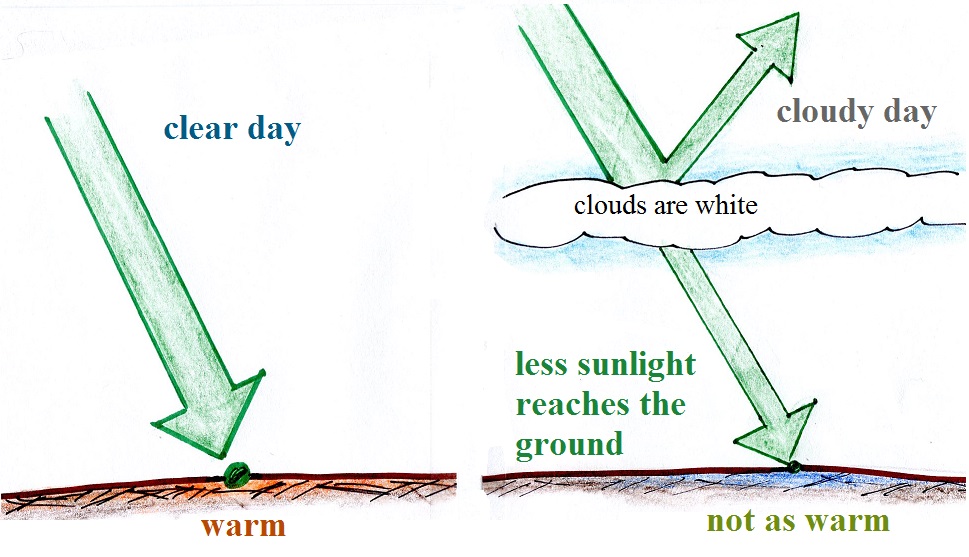
Here are some pretty typical high and low temperatures for this time of year in Tucson.  Notice the effects that clouds have: they generally lower the daytime high temperature (it doesn't get quite as hot on a cloudy day as it would on a clear day) and raise the nighttime low temperature (it doesn't get quite as cold on a cloudy night as it would on a clear night). 


Sunlight is what warms the earth during the day.  Sunlight is mostly visible and near-IR light.  Clouds are good reflectors of visible and near IR light (clouds appear white).  A smaller fraction of the incoming sunlight will reach the ground on a cloudy and it won't get as warm.


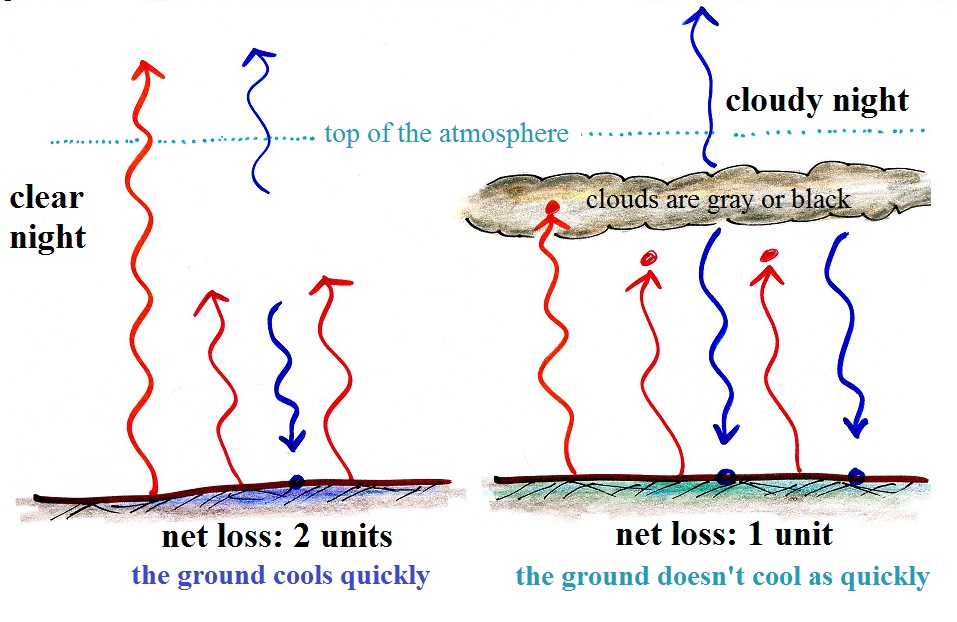
The situation is different at night.  The sun is no longer in the picture.  The ground cools by emitting far-IR light.  Without an atmosphere at all this IR energy would travel out to space and the ground would cool very quickly and get very cold.  Greenhouse gases absorb some of this IR light emitted by the ground and re emit a portion of it back to the ground.

It turns out that clouds are good absorbers of far-IR light too (they absorb some of the wavelengths that greenhouse gases do not).  I've colored the cloud layer grey in the right picture above.  If our eyes were sensitive to far IR instead of visible clouds would appear gray or black.  I've also added some orange to the gray cloud because clouds also emit far IR light.   Some of this emitted IR light is downward to the ground and reduces the rate at which the ground cools.  It doesn't get as cold on a cloudy night as it would on a clear night.


Here's the answer to the question embedded early in today's notes.


The atmosphere is absorbing two units of energy so it needs to also emit 2 units.  We'll send 1 upward and 1 downward. 

At the top of the picture we now have equal amounts of incoming and outgoing energy.  Down at the ground the 1 unit being emitted is balanced by 1 unit of absorbed energy.