Quiz #1 Study Guide

Composition of the atmosphere (15 pts). The five most abundant gases in the atmosphere (listed here in alphabetical order): argon (Ar), carbon dioxide (CO2), nitrogen (N2), oxygen (O2), and water vapor (H2O) (you should be able to list them in order from most to least abundant and know the approximate concentrations of oxygen and water vapor).  Water vapor (H2O) and carbon dioxide (CO2) are greenhouse gases. What does the greenhouse effect do?  What weather variable is commonly used to measure atmospheric water vapor content?   Typical values of that variable in Tucson during the year.
Atmospheric evolution (EC pts only).  About how old is the earth? What were the two main gases in the earth's first atmosphere?  Plants and photosynthesis are the source of most of what constituent in our present day atmosphere?

Sample questions (from the online example quizzes)
Practice Quiz: 1, 5a, 7b, 13, 17     Quiz #1: 1, 11, 23, EC2     Final Exam: 10?, 22, 49

Air pollution (0 pts).   Air Quality Index (AQI). Would an AQI value of 0 mean the air was healthy (clean) or very unhealthy (polluted)?

Carbon monoxide (CO) (15 pts). Toxic, colorless, odorless.  Produced during incomplete combustion.  What would complete combustion produce?  Oxygenated fuels and catalytic converters.  Early morning wintertime pollutant. What is a surface inversion layer, when do they form? Stable and unstable atmospheric conditions.  Would a surface inversion layer act to concentrate or disperse CO?  CO is a serious indoor hazard.

Scattering of Light (0 pts)  Water droplets and ice crystals in clouds, microscopic particles, and even air molecules all scatter ("splatter") light.  Are we able to see sunlight being scattered by air?

Tropospheric ozone and Stratospheric Ozone (O3) (20 pts). Ozone aggravates existing respiratory diseases, is harmful to plant life, and damages materials such as rubber. Ozone is a secondary pollutant and is a key component of photochemical smog (also known as Los Angeles-type smog). To produce smog, ozone reacts with hydrocarbons. The gaseous product of that reaction condenses and forms a smog cloud that we can see.  Peak ozone and photochemical smog concentrations occur on summer afternoons.

Ozone layer.  What beneficial role does it play?  Natural formation of stratospheric ozone.  The chlorine in chlorofluorocarbons (CFCs) destroys stratospheric ozone.

Sulfur dioxide (SO
2) (10 pts).
Toxic and aggravates existing respiratory diseases. The first pollutant that people were aware of.  Natural and man made sources. Involved in some of the world's worst air pollution disasters such as the Great London Smog of 1952. The word smog was first used to describe the combination of sulfurous smoke + fog; the term London-type smog is now used. 
SO2 reacts with water in clouds to form acid rain. 

Particulate Matter (PM) (5 pts).  Small particles (generally less than 10 micrometers across) that are inhaled into the lungs and sometimes even enter the bloodstream.  Sources of PM.  PM is a year round pollutant, a health concern, and also affects visibility.  How are PM and gaseous pollutants most effectively removed from the atmosphere?

Sample questions
Practice Quiz: 2, 3, 7a, 8, 10-12, 15, 18, 19, 21, EC 1, 3      Quiz #1: 2, 8, 12, 13, 15, 20, 22      Final Exam: 1, 26, 30, 40, 44

Mass, weight, density, and pressure (25 pts).  Mass is the amount of a particular substance. On the earth gravity pulls downward on a mass producing weight. Pressure at any level in the atmosphere is determined by the weight of the air above (this is a large scale way of thinking about and understanding pressure).   Pressure is defined as force (weight) divided by area and acts like a force (a force that pushes upward, downward, and sideways). Common pressure units and typical sea level pressure values.     Pressure and density decrease with increasing altitude (you should be able to explain why). 

Sample questions
Practice Quiz: 6, 9, 14, 16, 20     Quiz #1: 5, 9     Final Exam: 16, 34
You can also use this semester's Practice Quiz to review all of the material above.

Ideal Gas Law (15 pts).  This is a microscopic explanation of air pressure.  Two equations

P = N k T / V     &     P = ρ R T


N is the number of air molecules in a volume V, T is temperature and
ρ is density.  R and k are both constants.  You should be able to determine what will happen to the pressure in a rigid container or something flexible like a balloon if you change one or more of the variables in the equations above.  What variables could you change together in such a way that the pressure would stay constant?  Volumes of atmospheric air obey Charles' Law, what is Charles' Law?   In the atmosphere why is warm air normally low density air and cold air normally high density air?

Vertical forces acting on parcels (small volumes) of air (15 pts).   There are two forces, one points upward, the other downward.  The strength of one of the forces depends on the air inside the parcel, the other on the air outside (surrounding) the parcel. These two forces are usually in balance (they point in opposite directions and cancel each other out). What happens to the balance when you warm or cool a parcel of air (the strength of which of the two forces changes)?  Basically you should be able to explain why a balloon of hot low density air rises and a balloon of cold high density air sinks.

Archimedes principle states than an object immersed in a fluid (this can be a liquid like water or a gas like air) experiences an upward buoyant force that is equal to the weight of the fluid displaced by the object.  Basically objects that are less dense than the fluid surrounding them float, objects that are denser sink.  What causes the upward buoyant force?

Sample questions
Quiz #1: 3, 6, 14     Final Exam: 45, 55

Station model notation (20 pts)How and where are the following weather variables plotted on a surface map (using the station model notation): cloud cover, temperature, dew point temperature, wind direction and speed, common weather symbols (rain, snow, fog, rain shower, thunderstorm, tropical storm and hurricane), pressure.  Units.   What important adjustment is made to the measured station pressure before the pressure is plotted on the surface map? Why is that necessary? Average and typical range of sea-level pressure values.

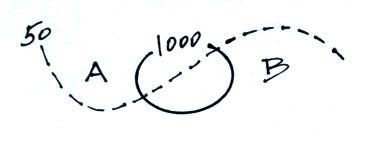
Surface weather maps (30 pts).  Isobars and isotherms (one of each is shown in the figure below). Small horizontal differences in pressure cause the wind to blow. Air motions around high and low pressure centers (northern hemisphere).  Does the figure below show a center of  high or low pressure?  Points A and B are at the same latitude, would you expect the air at Pt. A to be warmer,  colder, or the same temperature than(as) at Pt. B?


Convergence and divergence.  Rising air motions, what can cause air to rise and why is rising air important?  Sinking air.  Strong and weak pressure gradients and their effects.

Sample questions
Quiz #1: 4, 7, 16, 21, 24, EC 1       Final Exam:
2
, 6, 41, 47a&c


Fronts (20 pts).
  Cross-sectional structure of cold and warm fronts (such as shown in the 1st and 3rd figures below). 
You should be able to identify the warm and cold air and be able to determine which direction the cold air mass is moving.  Symbols used on surface maps, where is the warm & cold air, what direction are the fronts moving.  Weather changes (temperature, moisture/dew point, wind) that precede and follow passage of warm and cold fronts.  You will not have to locate a front on a surface map like was done in class, though I might draw a front and ask you what type it is.


Sample Questions
Quiz #1: 10, 19     Final Exam: 56


Reviews

Tue., Sep. 24
4 - 4:50 pm
ECE 102
Wed., Sep. 25
4 - 4:50 pm
MLNG 310
 ECE is Electrical and Computer Engineering, MLNG is Modern Languages
