Wednesday Jan. 24, 2018
Nicole Atkins "A Little
Crazy" (4:20), "Goodnight
Rhonda Lee" (2:39), "Listen Up"
(4:07), "Promised
Land" (3:41), "Girl You Look
Amazing" (3:56)
Acid Rain Demonstration (sort of)
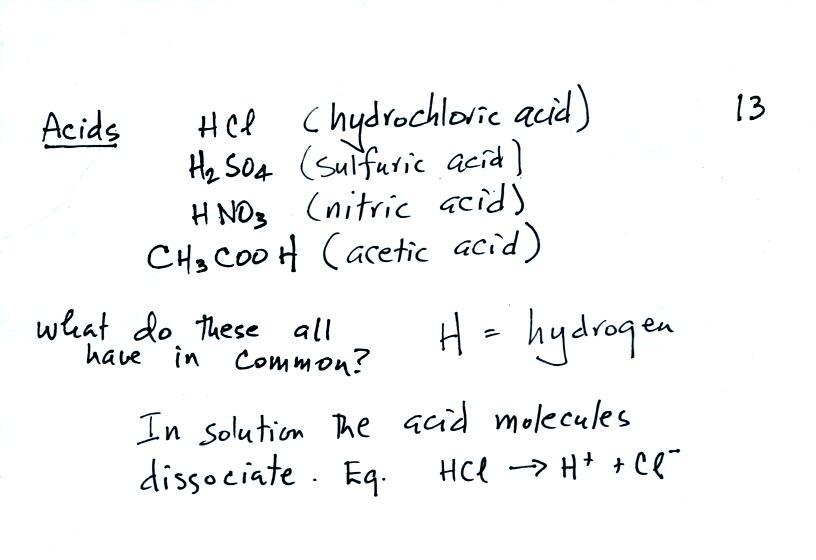
Some common acids are listed below. In
solution the acid molecules dissociate (split) into pieces.
The presence of H+ ions is what makes these materials
acids.
And
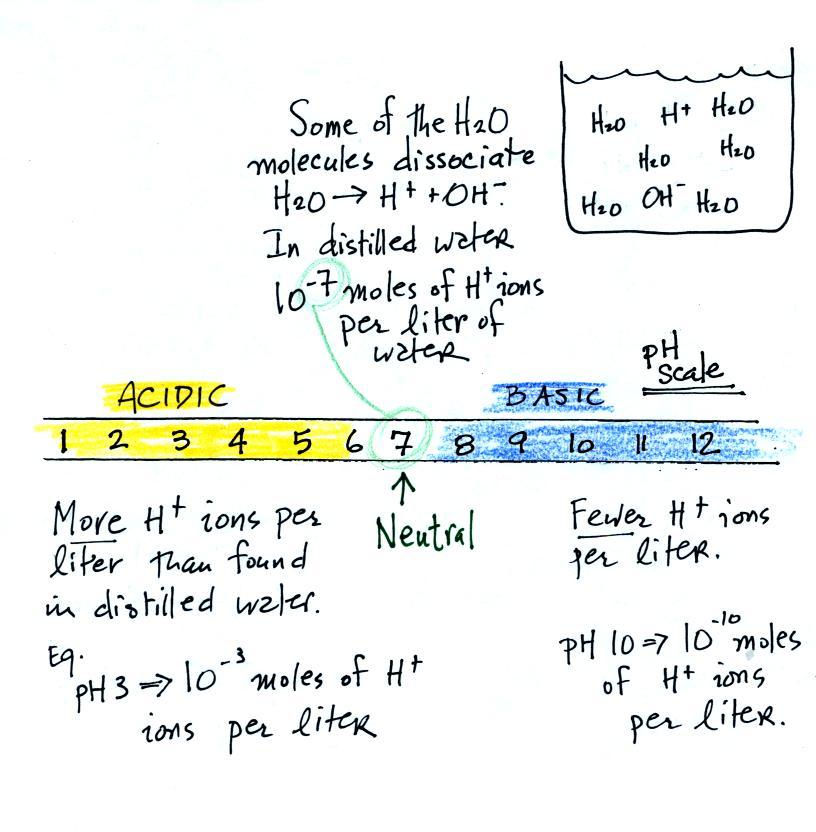
actually it isn't enough to just have H+ ions for
something to be an acid. There are H+
ions in pure distilled water and it's not an acid. To be an
acid the H+ ion concentration must be
greater than is found in distilled water. The H+
ion concentration in distilled water is 10-7 moles
of H+ ions per liter of
water. A mole is
just a number, a very large number (6 x 10²³).
It's the same idea as dozen. A dozen means you've got 12 of
something. 10-7 moles
of H+ ions per liter is
10-7 times
6 x 1023 = 6 x 10¹⁶
H+ ions per liter of water.
The pH scale
We often use the pH scale to measure acid concentration. An
H+ ion concentration of 10-7 moles/liter corresponds to
pH 7 (the pH value is computed by taking the -log10
of the H+
ion concentration). Other than remembering the pH
value of distilled water is pH7, these are all details
you don't need to worry about.
It is also possible to have fewer H+
ions in a solution than would be found in distilled water. A
solution like this is basic.
Pouring some acid into water would increase the H+ ion concentration (from 10-7moles/liter to 10-3moles/liter, perhaps as shown
in the example above). Adding a base to water will decrease
the H+ ion
concentration (from 10-7moles/liter
to 10-10moles/liter,
perhaps).
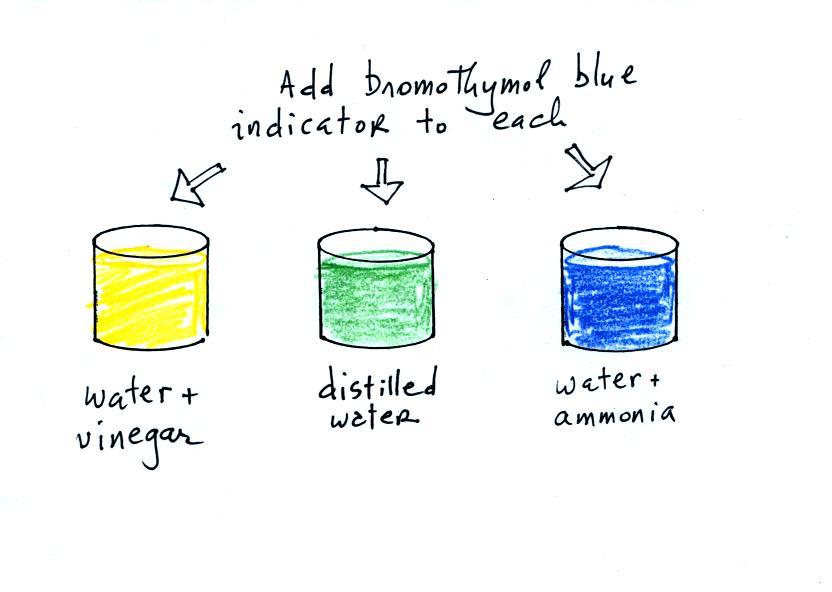
Now we can proceed with the demonstration. We will start
with three 1000 mL beakers each filled with distilled water.
Some vinegar (contains acetic acid) was added to the left beaker.
Some ammonia (a base) was added to the right beaker.
Acid/Base indicator solution
Then we added some bromothymol blue,
a color indicator solution, to all three beakers.
Bromothymol blue has the amazing property of changing color
depending on whether it is mixed with an acid (golden yellow) or a
base (deep blue).
So far we have just reviewed the pH scale and introduced
acid/base indicator solutions.
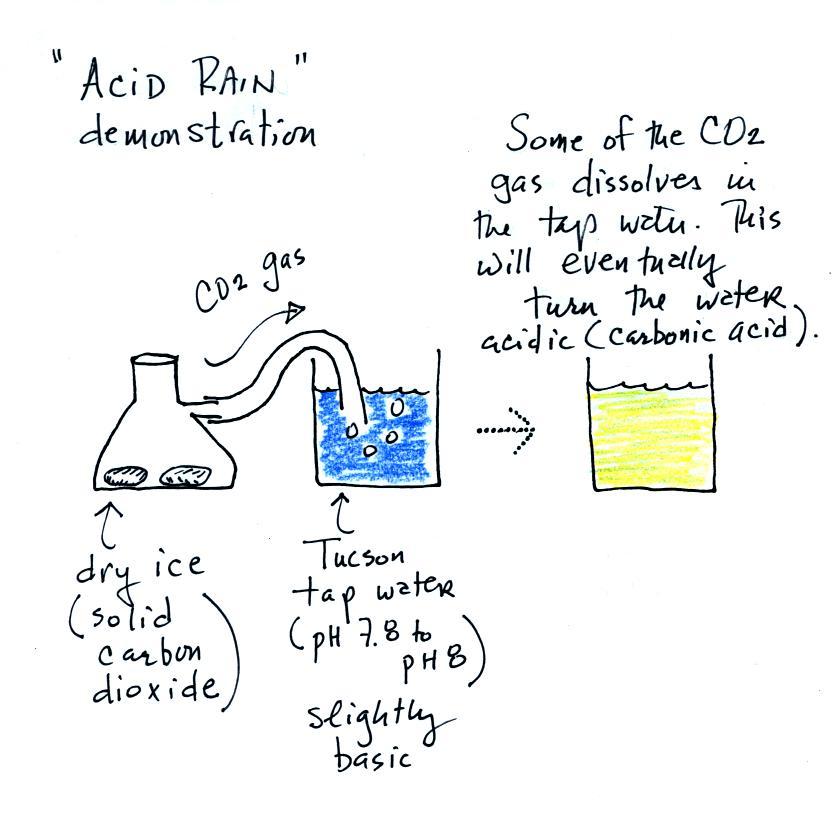
When sulfur dioxide is released into the air it reacts with the
water in clouds to produce acid rain. I really can't use SO2
in class because it's poisonous. I'll use carbon dioxide, CO2,
instead.
We added some Tucson tap water to a large 2000 mL beaker.
This represents a cloud. We added some bromothymol
blue to the tap water and it turned blue. So we know that
Tucson tap water is basic.
A few small pieces of dry ice are put into a flask. We close
the flask with a stopper. The end of a piece of tubing
connected to the flask is immersed in the tap water.
Dry ice sublimes. It turns directly from solid to ice
(ordinary ice melts and turns from solid to liquid). The
gaseous CO2 is invisible but
you can tell it is there because of the bubbles in the tap
water. Some of the CO2
dissolves as it bubbles through the water and slowly turns the
water acidic. You can tell that this is occurring because
the bromothymol blue indicator turns from deep blue to green and
eventually to yellow.
I call this a "sort of" acid rain demonstration.
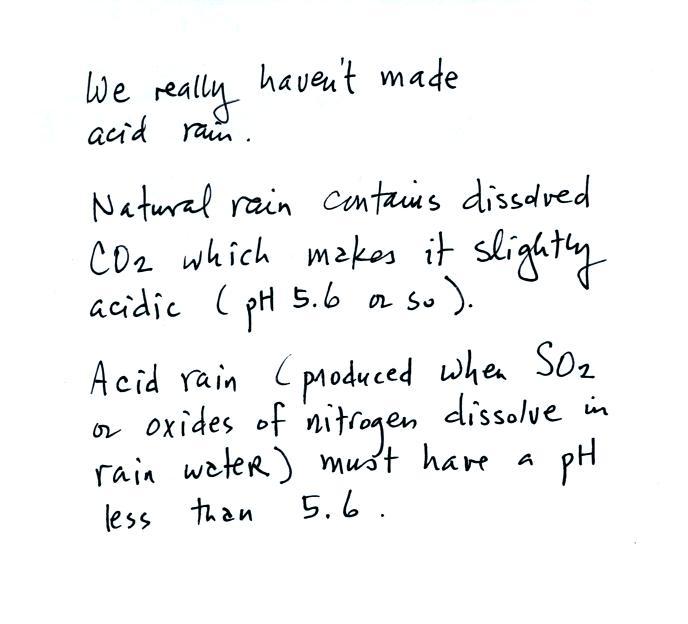
That's because we haven't really produced acid rain. Air
contains carbon dioxide and the CO2 makes natural rain slightly
acidic (pH5.6 or so). To make true acid rain we would need a
different gas, something other than carbon dioxide, something that
would lower the pH below 5.6.
While we didn't actually produce acid rain, there is concern
that increasing atmospheric concentrations of carbon dioxide will
dissolve in ocean water and lower the pH of the world's
oceans. This could in turn affect organisms in the ocean
especially those that make shells.
We'll finish by mentioning carbonated beverages which contain
dissolved carbon dioxide and are acidic. Soft drinks also
contain phosphoric acid which makes them even more acidic than the
dissolved carbon dioxide would do. With time the acidity of
soft drinks can damage tooth enamel.
Sources of particulate matter
Particulate matter can be produced naturally (wind blown dust,
clouds above volcanic eruptions, smoke from lightning-caused
forest and brush fires). Many human activities also produce
particulates (automobile exhaust for example). Gases
sometimes react in the atmosphere to make small drops or particles
(this is what happened in the photochemical smog
demonstration). Just the smallest, weakest gust of wind is
enough to keep these small particles suspended in the atmosphere.
A recent study estimates that more than 3.2 million people die
each year across the globe because of exposure to unhealthy levels
of PM25 (click here
to see a summary and some discussion of the study and here
to see the study itself). The study also attempted to
determine the sources of the PM25 pollution. The figure
below summarizes their findings.
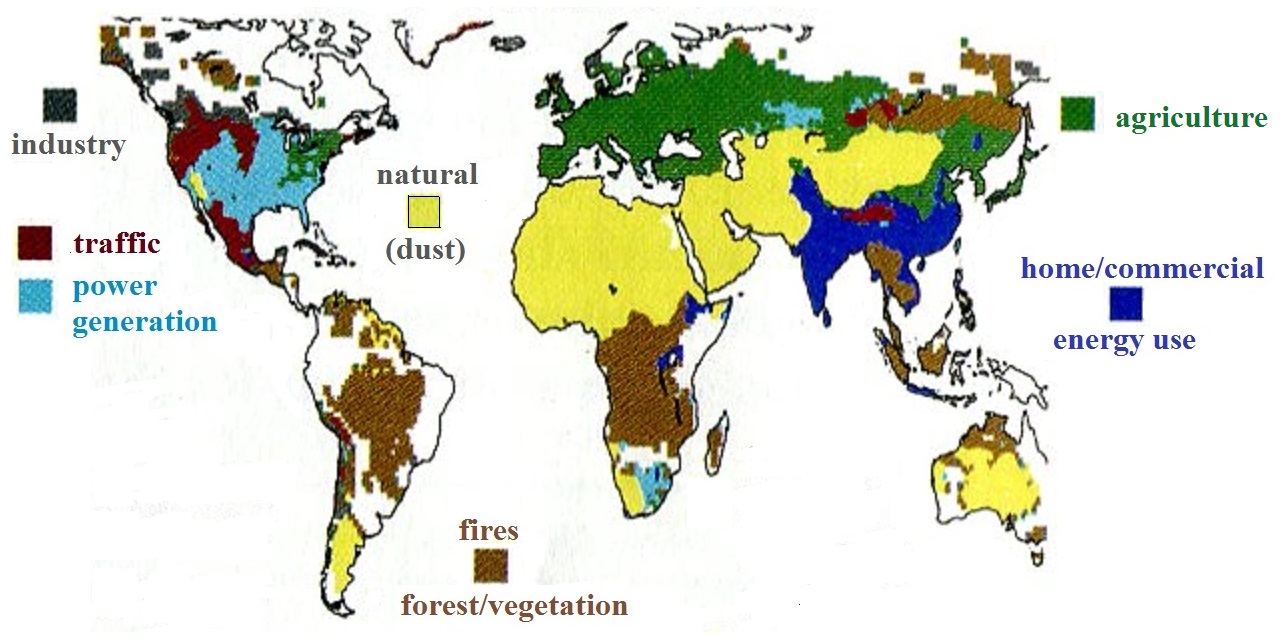
Information like this is important because you need
to know what is adding particulate matter to the air if you
want to try and reduce emissions.
Note
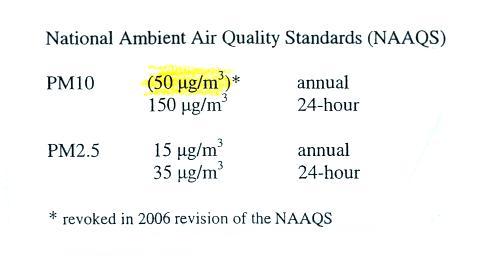
the PM10 annual National Ambient Air Quality
Standard (NAAQS) value of 50 micrograms/cubic
meter (µg/m3)
at the bottom of p. 13c in the photocopied
ClassNotes.
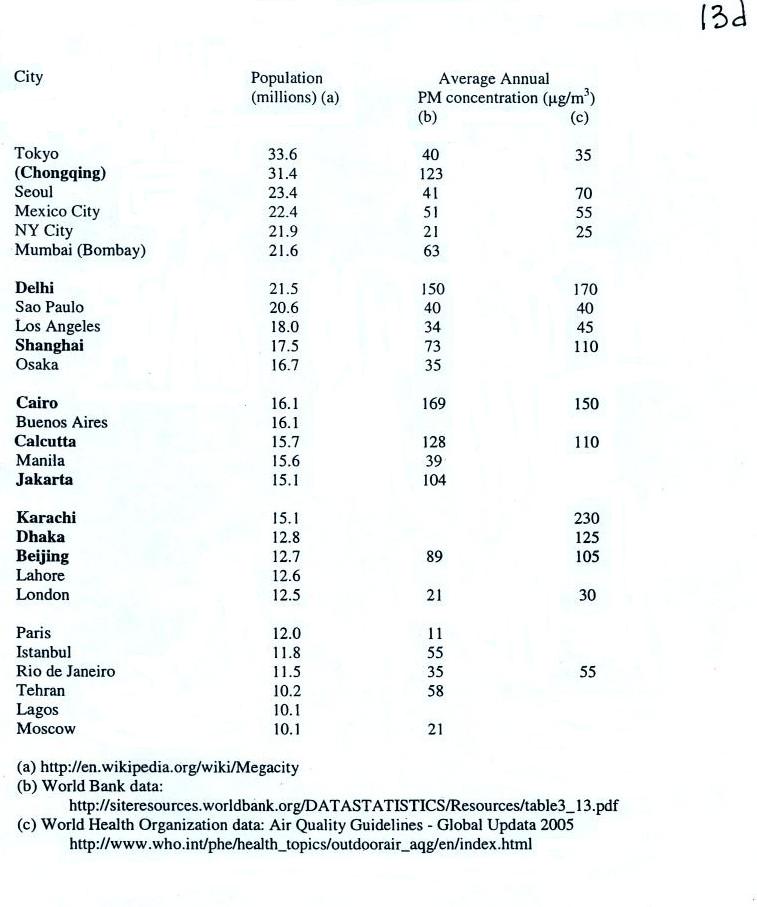
The following list (p. 13d in the ClassNotes) shows that there are
several cities (in bold font) around the world where PM
concentrations are 2 or 3 times higher than the NAAQS value.
Effects of PM on health
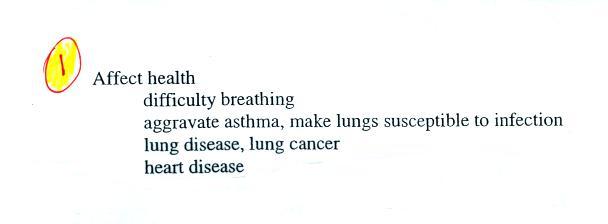
One of the main concerns with particulate pollution is that the
small particles might be a health hazard ( a health advisory is
sometimes issued during windy and dusty conditions in Tucson).
Here's a link to a timely
article on air pollution that appeared yesterday on the
HuffingtonPost web site.
Particles with dimensions of 10 µm
and less can be inhaled into the lungs (larger particles get
caught in the nasal passages). These inhaled particles
may be poisonous, might cause cancer, damage lung tissue, or
aggravate existing respiratory diseases. The smallest
particles can pass through the lungs and get into the blood
stream (just as oxygen does) and damage other organs in the
body.
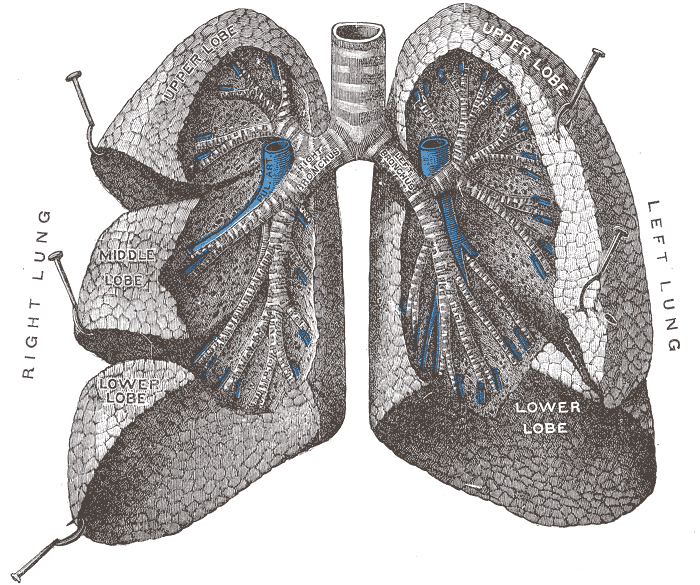
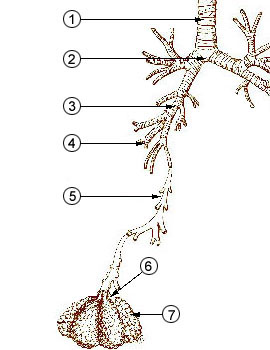
The figure below identifies some of the parts of the human
lung mentioned above. The key point is that
the passageways get smaller and smaller the deeper you move
into the lungs. The smallest particles are the most
dangerous because they can penetrate furthest into the lungs.
The 2008 Summer
Olympics were held in Beijing and there was some concern
that the polluted air would affect the athletes
performance. Chinese authorities restricted
transportation and industrial activities before and during
the games in an attempt to reduce pollutant
concentrations. Rainy weather during the games may
have done the greatest amount of good.
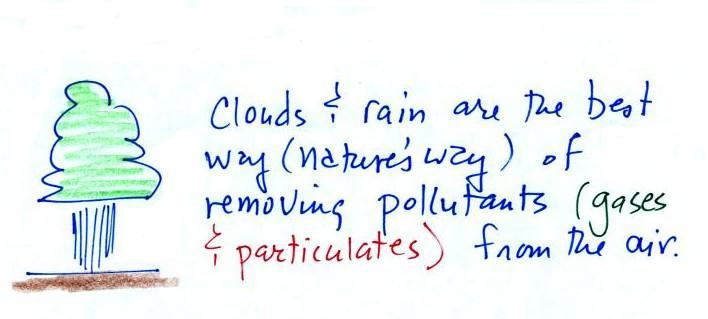
Clouds and precipitation are the best way of cleaning
pollutants from the air. We'll learn later in the semester
that cloud droplets form on small particles in the air called
condensation nuclei. The cloud droplets then form raindrops
and fall to the ground carrying the particles with them.
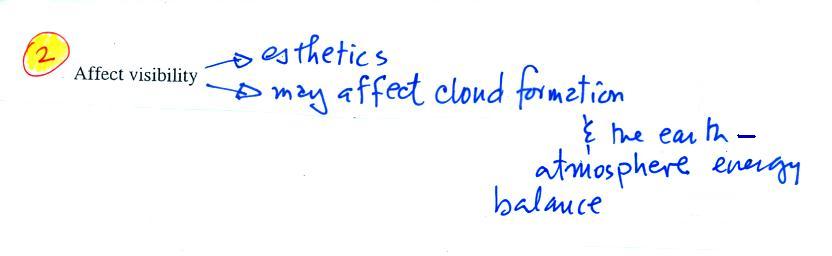
The second main concern with particulates is the
effect they may have on visibility (esthetics below should
actually be spelled aesthetics - i.e. qualities that might
make something appear beautiful or not).
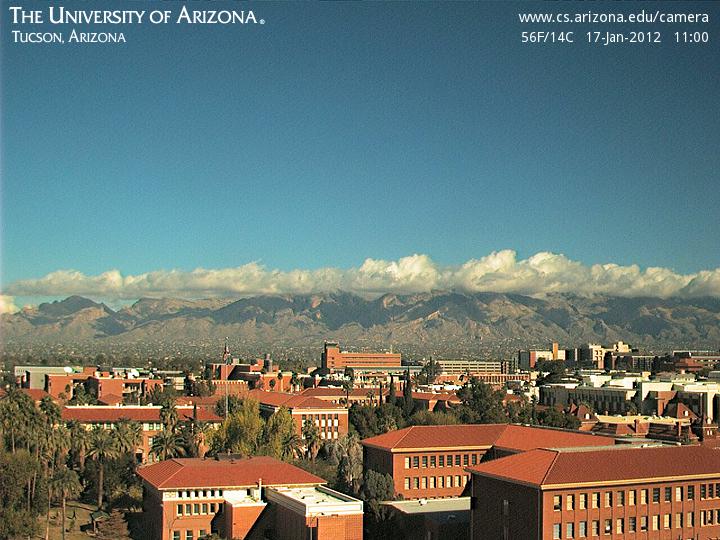
Here's a view of the Catalina mountains taken from the Gould
Simpson Building on the south side of campus.
Some rainy weather had occurred just a day to two earlier, cleaned
the air, and the visibility was very good. Clouds and rain
have done a really good job of cleaning the air.
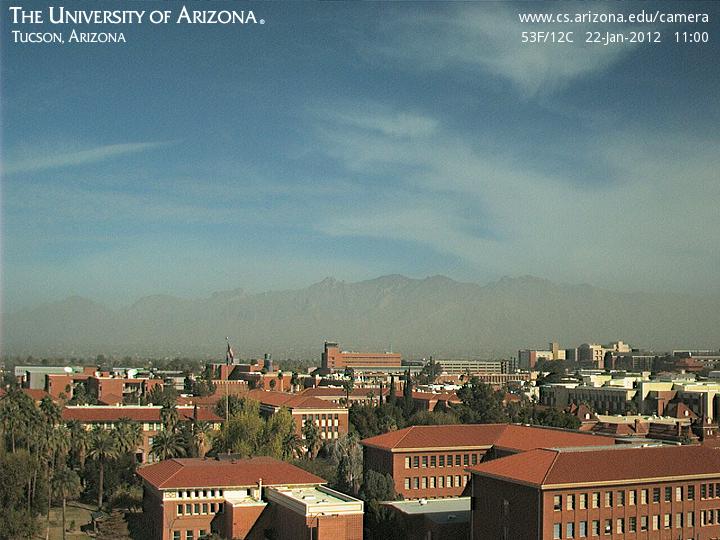
Windy weather a few days later
stirred up a lot of dust that was carried into town.
This picture was taken the day after the windy weather.
There is still a lot of fine dust particles in the air and the
visibility is pretty bad.
We looked at some photographs from Beijing
(January, 2013) where particulate pollution can be quite
severe. Here are some pictures from Harbin,
China (October, 2013). That's about as bad as visibility can
get, visibility in some cases is just a few 10s of feet. The
problem is limited to China, here's a picture from Paris
(March, 2014) and India
(November, 2017).
_____
Satellite photograph taken early in the Fall 2017 semester
(with the new GOES16 satellite) showing smoke from wildfires
burning in Washington, Oregon, Idaho and Montana being carried
across much of the continental US. Smoke from
these fires made it into southern Arizona where, at times, it had
a noticeable effect on visibility.

|

|
Photograph taken last Saturday (Aug. 26)
when the air was free of smoke and visibility was pretty
good.
|
Photograph taken Tuesday this week (Aug.
29) when smoke from the fires in the NW was present.
There has been a noticeable drop in visibility.The camera
was tilted down slightly in this picture but the field of
view is the same as the other photograph.
|
I
suspect we'll have a little extra time and
will able to start a new topic:
Mass, weight, density, and pressure.
Pressure,
especially, is a pretty important concept.
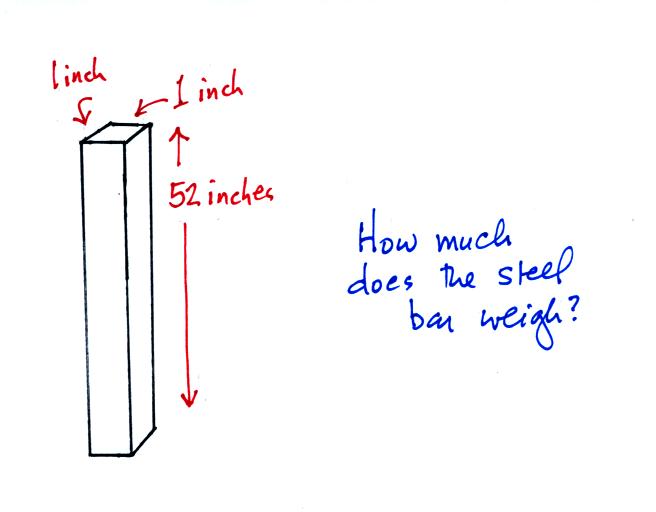
Weight is something you can feel. At
some point, probably on Friday, I'll pass an
iron bar around in class (it's sketched below)
- lift it and try to guess or estimate it's
weight. The fact that it is a 1" by 1"
is significant.
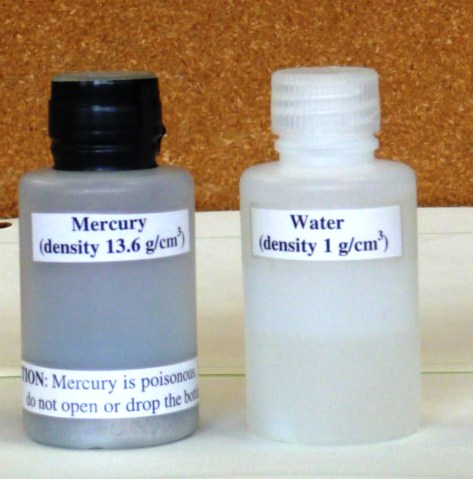
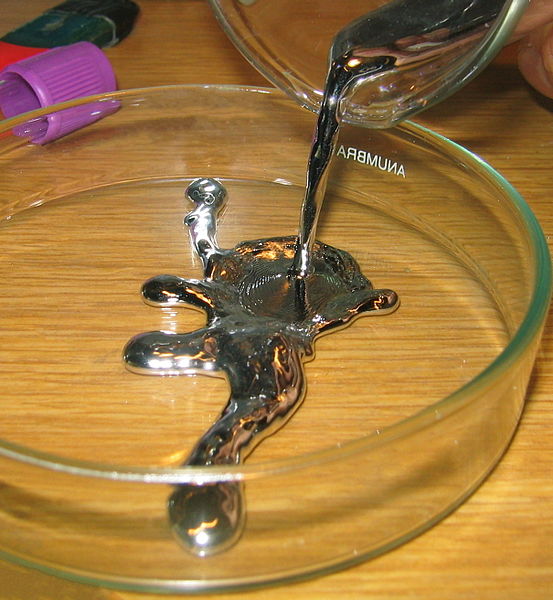
I used to
pass around a couple of small plastic bottles (see
below). One contained some water, the other an equal
volume of mercury (here's the source
of the nice photo of liquid mercury below at
right). I wanted you to appreciate how much
heavier and denser mercury is compared to
water.
But the plastic bottles have a way of getting brittle with
time and if the mercury were to spill in the classroom the
hazardous material people would need to come in and clean it
up. That would probably take a lot of time and would be
very expensive. So this semester I'll pass around a
smaller, much safer, sample of mercury (again I may wait until
Friday) so that you can at least see what mercury it looks
like (it's a recent purchase from a company in London).
I'll keep the plastic bottles of mercury up at the front of
the room just in case you want to see how heavy the stuff is.
It
isn't so much the liquid mercury that is a hazard, but
rather the mercury vapor. Mercury vapor is used in
fluorescent bulbs (including the new energy efficient CFL
bulbs) which is why they need to be disposed of
carefully. That is a topic that will come up again
later in the class.
Mercury and bromine are the only
two elements that are found naturally in liquid
form. All the other elements are either gases or
solids.
I am hoping that you will remember and understand the
following statement
atmospheric
pressure at any level in the atmosphere
depends on (is determined by)
the weight
of the air overhead
We'll
first review the concepts of mass, weight, and density
but understanding pressure is our main goal.
I've numbered the various sections (there are a total
of 8) to help with organization. There's also a
summary at the end of today's notes.
1.
weight
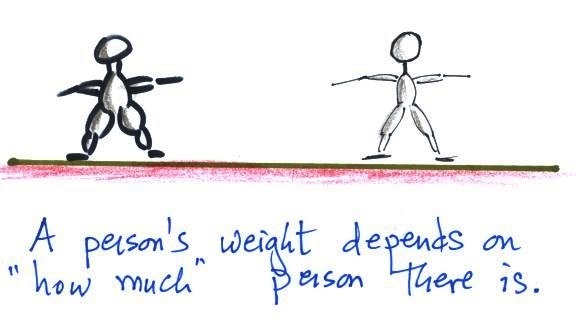
This is a good place to start because this is
something we are pretty familiar with. We
can feel weight and we routinely measure weight.
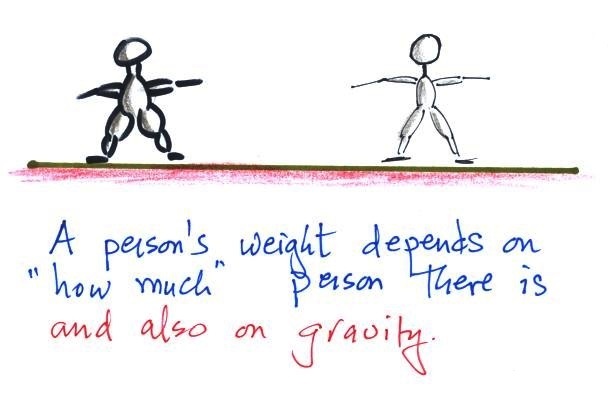
A person's weight also depends
on something else.
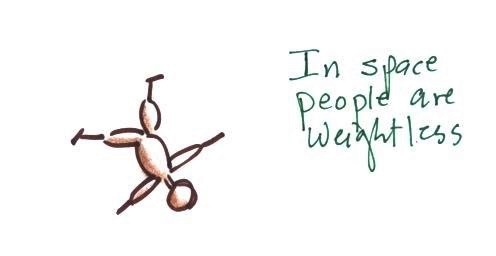
In outer space away from
the pull of the earth's gravity people are weightless.
Weight depends on the person and on the pull of gravity.
We
measure weight all the
time. What units
do we use?
Usually pounds, but
sometimes ounces or
maybe tons. A
student will sometimes
mention Newtons, those
are metric units of
weight (force).
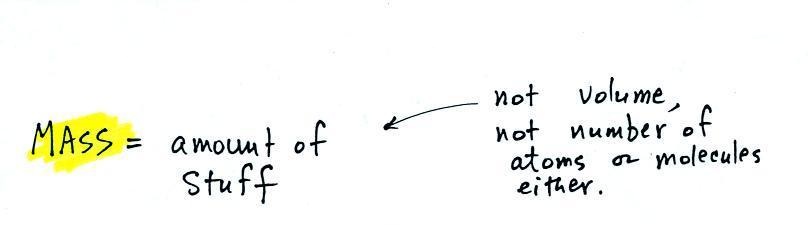
2. mass
Rather than just saying the
amount of something it is probably better to use the
word mass
It would be possible to have equal volumes of
different materials, with the same total number of atoms or
molecules, and still have different masses.
Grams (g) and kilograms (kg) are commonly used units of
mass (1 kg is 1000 g).
3. gravitational
acceleration
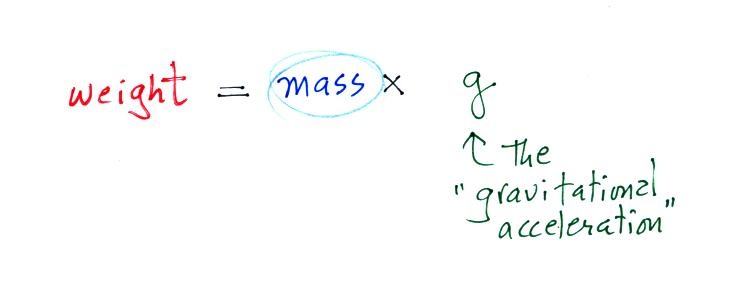
On the surface of the earth, weight is
mass times a constant, g, known as the
gravitational acceleration. The value of g
is what tells us about the strength of gravity on the earth;
it is determined by the size and mass of the earth. On
another planet the value of g would be
different. If you click here
you'll find a little (actually a lot) more information about
Newton's Law of Universal Gravitation. You'll see how
the value of g is determined and why it is called
the gravitational acceleration. These aren't details
you need to worry about but they're there just in case
you're curious.
Here's a question to test your understanding.
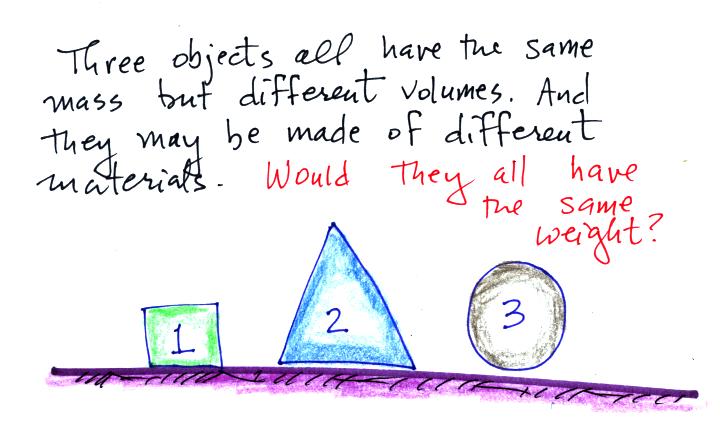
The masses are all the same. On the earth's surface the
masses would all be multiplied by the same value of g.
The weights would all be equal. If
all 3 objects had a mass of 1 kg, they'd all have a weight of 2.2
pounds. That's why we can use
kilograms and pounds interchangeably.
The following figure show a situation where two
objects with the same mass would have different weights.
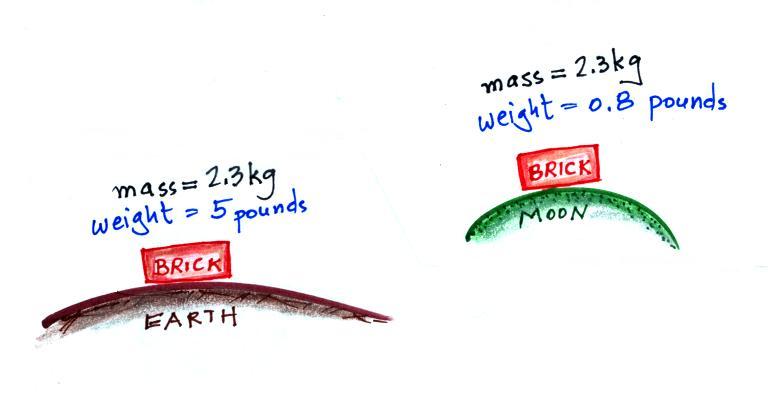
On the earth a brick has a mass of about
2.3 kg and weighs 5 pounds. If you were to travel to the
moon the mass of the brick wouldn't change (it's the same
brick, the same amount of stuff). Gravity on the moon is
weaker (about 6 times weaker) than on the earth because the
moon is smaller, the value of g on the moon is
different than on the earth. The brick would only weigh
0.8 pounds on the moon. The brick would
weigh almost 12 pounds on the surface on Jupiter where
gravity is stronger than on the earth. On the moon,
a brick would have the same mass, the same volume, the
same density, but a different weight as(than) it would on
the earth.
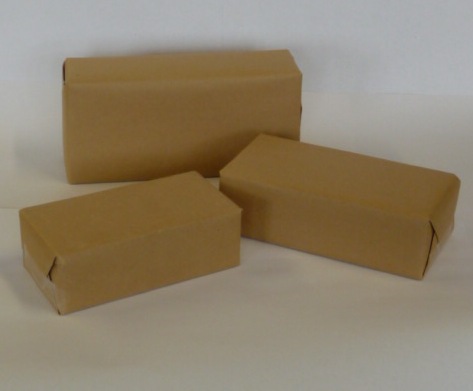
The three objects below
won't be passed around class (one of them is pretty
heavy). The three objects all have about
the same volumes. One is a piece of wood,
another a brick, and the third is something
else.
The
easiest way to determine which is which is to lift each
one. One of them weighed about 1 pound (wood), the 2nd
about 5 pounds (a brick) and the last one was 15 pounds (a
block of lead).
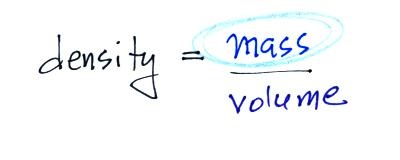
The point of all this was to get you thinking about
density. Here we had three objects of about
the same size with very different weights. Different
weights means the objects have different masses (since weight
depends on mass). The three different masses, were
squeezed into roughly the same volume producing objects of
very different densities.
4. density
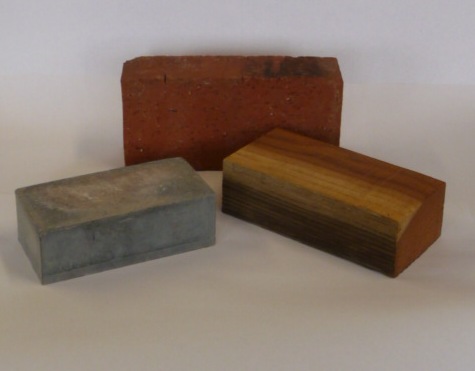
The brick is in the back, the lead
on the left, and the piece of wood (redwood) on the right.
The wood is less dense than water (see the table below) and
will float when thrown in water. The brick and the lead
are denser than water and would sink in water.
We'll be more concerned with air in this
class than wood, brick, or lead.
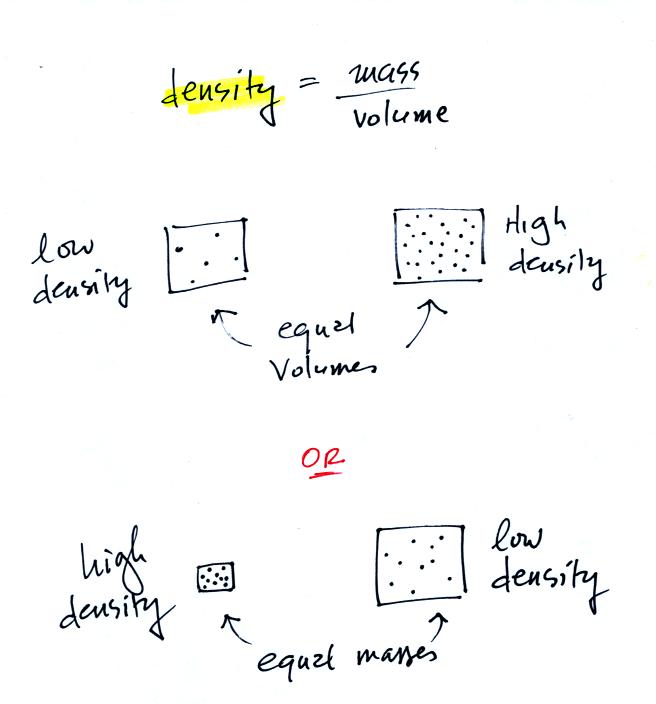
In the first example
below we have two equal volumes of air but the amount in
each is different (the dots represent air
molecules).
The amounts of air (the masses) in the second example are the
same but the volumes are different. The left example
with air squeezed into a smaller volume has the higher
density.
material
|
density g/cc
|
air
|
0.001
|
redwood
|
0.45
|
water
|
1.0
|
iron
|
7.9
|
lead
|
11.3
|
mercury
|
13.6
|
gold
|
19.3
|
platinum
|
21.4
|
iridium
|
22.4
|
osmium
|
22.6
|
g/cc = grams per cubic centimeter
cubic centimeters are units of volume - one cubic
centimeter is about the size of a sugar cube
1 cubic centimeter is also 1 milliliter (mL)
I would sure like to get my hands on a brick-size
piece of iridium or osmium just to be able to feel how
heavy it would be - it's about 2 times denser than
lead.
Here's a more subtle concept. What if we were in outer
space with the three wrapped blocks of lead, wood, and
brick? They'd be weightless.
Could we tell them apart then? They would still have very
different densities and masses but we wouldn't be able to feel how
heavy they were.
5.
inertia
I think the following illustration will
help you to understand inertia.
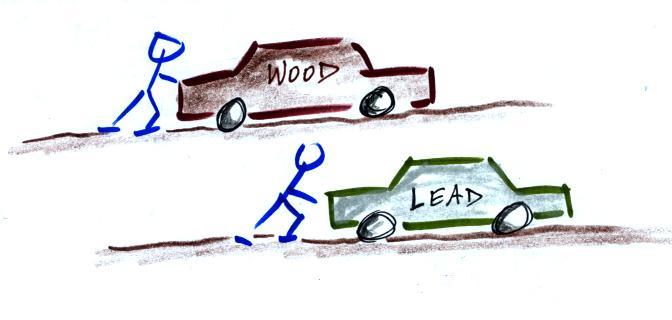
Two stopped cars. They are the same size except
one is made of wood and the other of lead. Which
would be hardest to get moving (a stopped car resists
being put into motion). It would take considerable
force to get the lead car going. Once the cars are
moving they resist a change in that motion. The
lead car would be much harder to slow down and stop.
This is the way you could try to distinguish
between blocks of lead, wood, and brick in outer space.
Give them each a push. The wood would begin moving more
rapidly than the block of lead even if both are given
the same strength push.
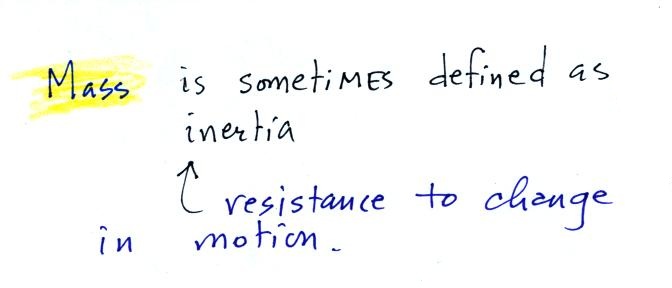
I usually
don't mention in class that this concept of
inertia comes from Newton's 2nd law of motion
F = m a
force = mass x acceleration
We can rewrite the equation
a = F/m
This shows cause and effect more clearly. If you exert a
force (cause) on an object it will accelerate (effect).
Acceleration can be a change in speed or a change in direction (or
both). Because the mass is in the denominator, the
acceleration will be less when mass (inertia) is large.