Here are several examples of conversions
between MST and UT that weren't done in class
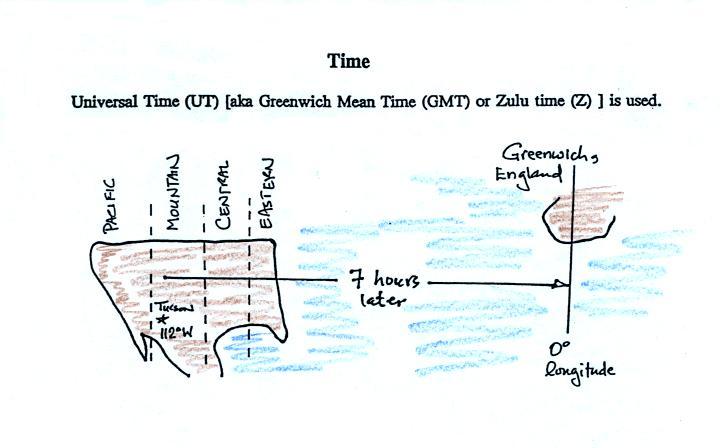
to convert from MST (Mountain Standard Time) to UT
(Universal Time)
10:20 am MST:
add the 7 hour
time zone correction ---> 10:20 + 7:00 = 17:20
UT (5:20 pm in Greenwich)
2:45 pm MST :
first convert to
the 24 hour clock by adding 12 hours 2:45 pm MST +
12:00 = 14:45 MST
add the 7 hour
time zone correction ---> 14:45 + 7:00 = 21:45 UT
(7:45 pm in England)
7:45 pm MST:
convert to the
24 hour clock by adding 12 hours 7:45 pm MST + 12:00 =
19:45 MST
add the 7 hour time zone correction ---> 19:45 + 7:00 =
26:45 UT
since this is greater than 24:00 (past midnight) we'll
subtract 24 hours 26:45 UT - 24:00 = 02:45 am the
next day
to convert from UT to MST
15Z:
subtract the 7
hour time zone correction ---> 15:00 - 7:00 = 8:00 am MST
this is the example we worked in class
02Z:
if we subtract
the 7 hour time zone correction we will get a negative
number.
So we will first add 24:00 to 02:00 UT then subtract 7 hours
02:00 + 24:00 = 26:00
26:00 - 7:00 = 19:00 MST on the previous day
2 hours past midnight in Greenwich is 7 pm the previous day
in Tucson
Finally I had several videos that I wasn't
able to show in class last week.
You did see a short video last week
documenting Auguste Piccard's voyage into the stratosphere (he
and his assistant Paul Kipfer were the first two people to do
so). They reached an altitude of about 16 km.
You might have heard about Felix
Baumgartner and the Red Bull Stratos balloon (or
seen the GoPro commercial during a recent Super
Bowl). On Oct. 14, 2012 he reached an altitude of
nearly 128,000 feet (39 km or 24 miles) and then
jumped. He reached a speed of 843 MPH on the way
down (Mach 1.25 or 1.25 times the speed of sound) and the
jump lasted about 10 minutes (Wikipedia
has an interesting report on the jump).
Here's the short
video (1:25) shown in class. It shows portions
of his jump. If you have time you should really
watch the longer
version (9:32). Baumgartner
began to spin during the descent but was able get out of
it. He came very close to blacking out.
I'm not sure whether there was a way his parachute could have
been deployed if he had gone unconscious. I also don't
know what happened to the balloon that he jumped from.
A very short segment of a second video was shown mainly for
the picture showing what would happen to a polystyrene head if
it were exposed to 5000 psi (the pressure at a depth of 10,000
feet). Auguste Piccard and his son Jacques traveled down
to about 10,000 feet depth in the ocean in a trial run of the
Bathyscaph Trieste. Jacques would later travel with Lt.
Don Walsh of the US Navy to the bottom of the Mariana Trench
(35,800 feet deep).
Here's a National
Geographic video describing film director James
Cameron's much more recent solo dive to the Challenger
Deep in the Mariana Trench on Mar. 12, 2012
(2:16). (note mention of the 16,000
psi pressure on the submersible at the bottom of the
ocean)
Bertrand
Piccard, Jacques' son (Auguste's grandson) was
part of the first two man team to circle the globe
non-stop in the Breitling Orbiter 3 balloon (Mar. 20,
1999). Brian Jones was the second team member
(source
of the left image above,
source
of the right image
). I
showed a pretty good video
summary of their trip (6:00) that I wasn't able to find
online. Here are three alternate videos of the event: short
summary (1:40),
longer
summary (6:15 with music only, no commentary)
and a full
documentary (54:06).
In the tape shown in class, another
team, Andy Elsen and Colin Prescot in the Cable and Wireless
Balloon, launched Feb. 17, 1999 from a location in Spain
and got out to a 10 day lead. Bertrand Piccard and Brian
Jones launched Mar. 1, 1999 from Switzerland. The Cable
and Wireless balloon was forced down in the sea off the coast
of Japan. The balloon "iced up." It became coated
with ice and was so heavy that it couldn't be flown.
Both teams were forced to fly around China because the Chinese
government wouldn't allow them into Chinese airspace.
Answers to questions about coding and decoding surface
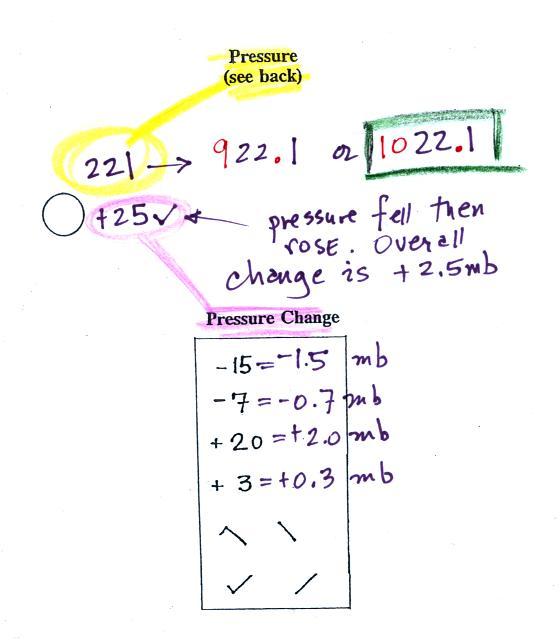
weather map pressure data embedded in today's notes:
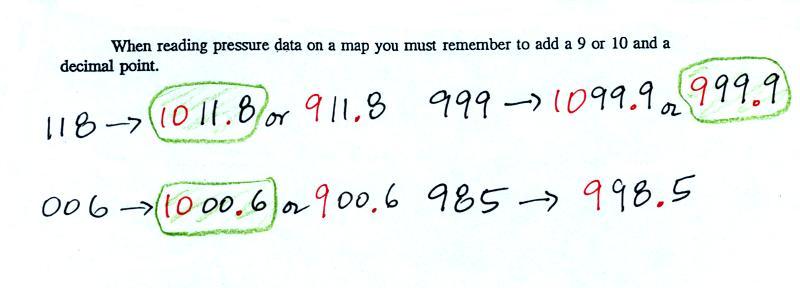
Coding pressures (you must remove the leading 9 or 10 and the
decimal point.
1035.6 mb ---> 356
990.1 mb ---> 901
1000 mb = 1000.0 mb ---> 000
Decoding pressures (you must add a 9 or a 10 and a decimal
point) and pick the value closest to 1000 mb.
422 ---> 942.2
mb or 1042.2 mb ---> 1042.2 mb
800 ---> 980.0 mb or 1080.0 mb ---> 980.0 mb
990 ---> 999.0 mb or 1099.0 mb ---> 999.0 mb