Quite a few people have already
finished and turned in the Optional
Assignment
that is due next Tuesday. Be sure to have the assignment done
before
coming to class next week if you're planning on turning it in then.
Here's
a
summary of what we've learned so far about air pollutants.
| carbon monoxide |
sulfur dioxide |
particulate
matter |
(tropospheric) ozone |
| 1. colorless, odorless 2. primary pollutant 3. incomplete combustion 4. winter morning pollutant (temperature inversions) |
1. 1st recognized air
pollutant 2. key ingredient in London type smog 3. acid rain (with a demonstration) |
1. health hazard 2. affects visibility |
x.
ozone introduction 1. secondary pollutant 2. summer afternoon pollutant 3. key ingredient in Los Angeles-type smog |
We'll
cover
the
items
highlighted
in red today (and actually I forgot all about the ozone
introduction), the items in green next Tuesday (we'll
probably have time on Tuesday to start some newer material also).
Sulfur dioxide is one of the pollutants that can react with water in clouds to form acid rain (some of the oxides of nitrogen can react with water to form nitric acid). The formation and effects of acid rain are discussed on p. 12 in the photocopied Class Notes.
Sulfur dioxide is one of the pollutants that can react with water in clouds to form acid rain (some of the oxides of nitrogen can react with water to form nitric acid). The formation and effects of acid rain are discussed on p. 12 in the photocopied Class Notes.
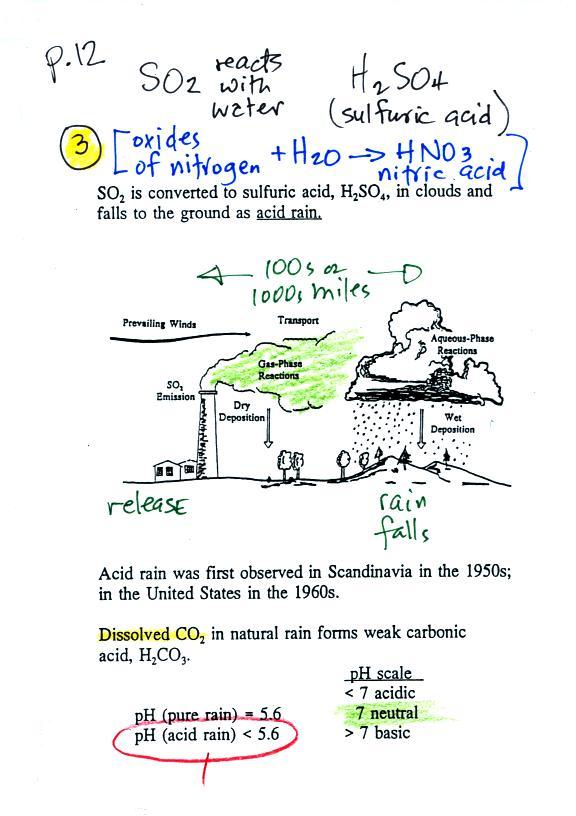
Acid rain is often a problem in
regions that are
100s even 1000s of miles from the source of the sulfur dioxide that
forms the acid rain. Acid rain in Canada could come from sources
in the US, acid rain in Scandinavia came from
industrialized areas in other parts of Europe.
Note at the bottom of the figure above that natural "pristine" rain has a pH less than 7 and is slightly acidic. This is because the rain contains dissolved carbon dioxide gas. The acid rain demonstration done in class today should make this point clearer.
Note at the bottom of the figure above that natural "pristine" rain has a pH less than 7 and is slightly acidic. This is because the rain contains dissolved carbon dioxide gas. The acid rain demonstration done in class today should make this point clearer.

Some of the problems associated
with acid rain. Click on
this acid
rain
demonstration
link for a detailed description of the demonstration done in class.
The next pollutant that we will cover is Particulate Matter (PM) - small solid particles or drops of liquid (but not gas) that remain suspended in the air (particulates are sometimes referred to as aerosols). The designations PM10 and PM25 refer to particles with diameters less than 10 micrometers and 2.5 micrometers, respectively. A micrometer is one millionth of a meter. The drawing below might give you some idea of what a 1 micrometer particle would look like (actually it would probably be too small to be seen without magnification).
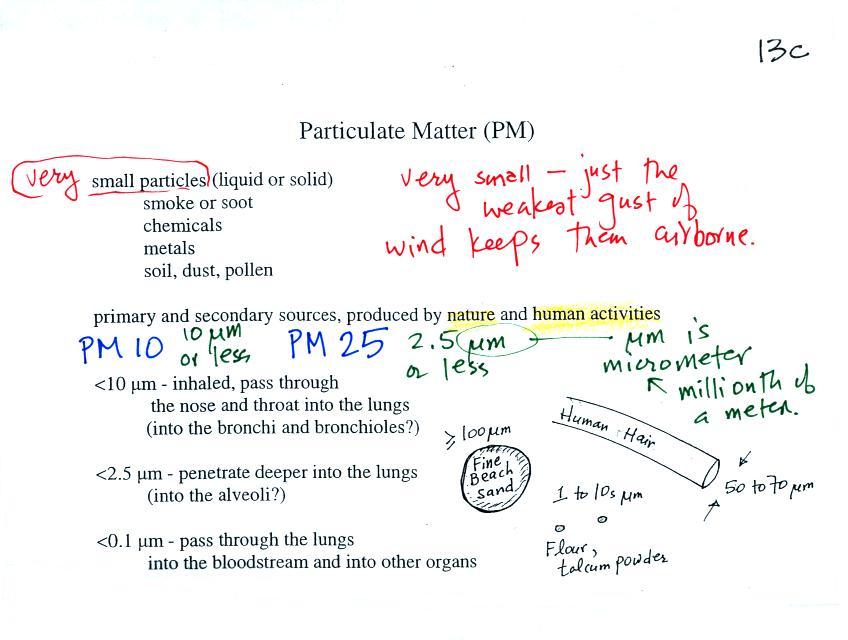
Particulate matter can be produced
naturally (wind blown dust,
clouds above volcanic eruptions, smoke from lightning-caused forest and
brush fires). Human activities also produce particulates.
Gases sometimes react in the atmosphere to make small drops or
particles (we'll see this happen in the demonstration planned for
Friday).
One of the main concerns with particulate pollution is that the small particles might be a health hazard.
One of the main concerns with particulate pollution is that the small particles might be a health hazard.
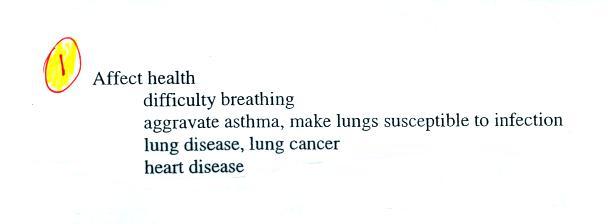
Particles with dimensions of 10
micrometers and less can be
inhaled
into the lungs (larger particles get caught in the nasal
passages). These
inhaled particles may be poisonous, might cause cancer, damage lung
tissue, or aggravate existing
repiratory diseases. The smallest particles can pass through the
lungs and get into the blood stream (just as oxygen does) and damage
other organs in the body.
The figure below identifies some of the parts of the human lung mentioned in the figure above.
The figure below identifies some of the parts of the human lung mentioned in the figure above.
 Crossectional view of the
human lungs
from: http://en.wikipedia.org/wiki/Lung |
 1 - trachea
from http://en.wikipedia.org/wiki/Image:Illu_quiz_lung05.jpg2 - mainstem bronchus 3 - lobar bronchus 4 - segmental bronchi
5 - bronchiole6 - alveolar duct 7 - alveolus |
Note the
PM10 annual National
Ambient Air Quality Standard (NAAQS) value of 50 micrograms/cubic meter
at
the bottom of p. 13c in the photocopied ClassNotes (above).

The following list (p. 13d in the
ClassNotes) shows that there are
several cities around the world
where PM concentrations are 2 or 3 times higher than the NAAQS
value.

There was some concern
during
the summer 2008 Olympic Games
in Beijing that the polluted air would keep athletes from performing at
their peak.
Chinese authorities restricted transportation and
industrial activities before and during the games in an attempt to
reduce pollutant concentrations. Rainy weather during the games
may have done the greatest amount of good.
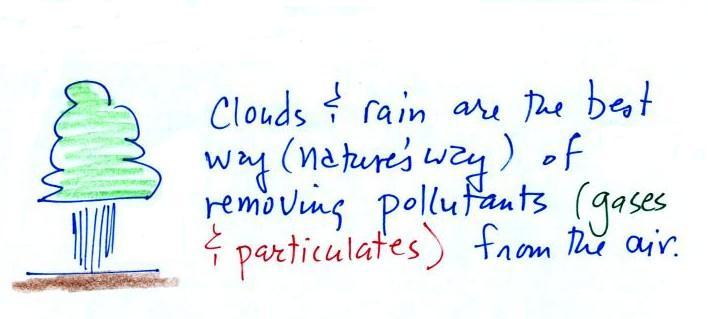
This
figure
wasn't shown or mentioned in class. Clouds and
precipitation are the
best way of cleaning pollutants from the air. We'll see later in
the semester that cloud droplets form on small particles in the air
called condensation nuclei. The cloud droplets then form
raindrops and fall to the ground carrying the particles with them.
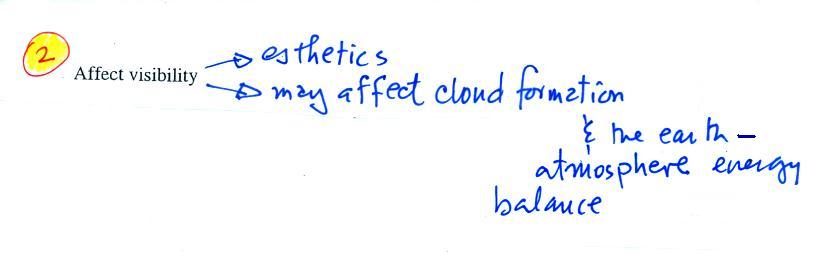
The second main concern with particulates is the effect they may have on visibility (esthetics should actually be spelled aesthetics - i.e. qualities that might make something appear beautiful or not).
The second main concern with particulates is the effect they may have on visibility (esthetics should actually be spelled aesthetics - i.e. qualities that might make something appear beautiful or not).
This could be seen last weekend.

This is what the sky in
Tucson looked like last Sunday (the
camera is operated by the Computer Science Dept. and is located on the
Gould Simpson Bldg.). There was a lot of dust in the air and the
sky appeared very hazy. The dust stirred up by
thunderstorm winds west of Tucson on Saturday.

By Monday
the air was cleaner and the visibility was much
better.
Now we will try to understand how
particulates affect
visibility. We need to first learn a little bit more about
scattering. The figures below are hopefully a little clearer than
the ones drawn in class.

The picture
above shows rays of sunlight streaming in from the
upper left. Sunlight is white light which means it is a mixture
of all the colors. I'll be using yellow to represent white light
in this and the following figures. If you were to look back along
one of the rays of light coming from the sun, you'd see the sun (of
course you shouldn't do this).
What would you see if you looked away from the sun.
What would you see if you looked away from the sun.

You might
see a cloud. The cloud droplets or ice crystals scatter
and reflect sunlight. All of the colors in the beam of sunlight
are scattered equally, so the scattered light is white. That's
why clouds are (usually) white.
What do you see if you look at the sky away from the sun and there aren't any clouds in the sky. You see blue sky.
What do you see if you look at the sky away from the sun and there aren't any clouds in the sky. You see blue sky.

Air
molecules also scatter light. But because they are so small
(smaller than the wavelength of visible light) they scatter the shorter
wavelengths (violet, blue, green) in greater amounts that the longer
wavelengths (red, orange, yellow). Violet has the shortest
wavelength and is scattered the most. However there isn't as much
violet in sunlight as there is blue and green. There's a lot of
green light in sunlight (more than any other color as a matter of fact)
but it isn't scattered as readily as blue. So the end result is
that we see blue light coming from the sky.
The response of our eyes also plays a role. Here's a little more explanation of why the sky appears blue.
What happens when you add particles to the air?
The response of our eyes also plays a role. Here's a little more explanation of why the sky appears blue.
What happens when you add particles to the air?
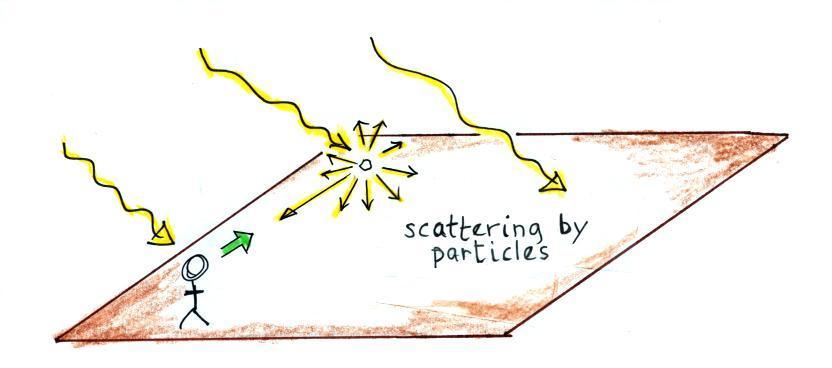
Particles
are relatively large (compared to air molecules) which means
they scatter all of the colors in sunlight in equal amounts. The
scattered light from particles is white.
OK now let's look at how the appearance of some nearby mountains might change as more and more particles are added to the air. We're going to try to understand why increasing amounts of particles can reduce visibility.
OK now let's look at how the appearance of some nearby mountains might change as more and more particles are added to the air. We're going to try to understand why increasing amounts of particles can reduce visibility.

In this first picture we start out with clean air. When we look at a mountain we see the light that is reflected off the soil and trees on the mountain (shown at left above). I've colored this reflected light green and brown. When you look at the mountain it's green and brown (right figure above).

Now we start to add some particles to the air. The scattered light from the particles will be white (colored yellow above). Now when you look at the mountain you see reflected green and brown light and also some white light scattered by the particles. The figure at right above attempts to represent this additional white light.

More particles, more scattered
light, and more white light being mixed in with the brown and green
reflected light.

Now there are even more
particles. Now the
white light from scattering from particles begings to dominate.
Eventually it becomes difficult to even make out the mountain because
of all the scattered light. Of course there was considerable
artistic license used in this explanation.
Here are a couple of analogous situations that might help understand how/why light scattered by particles in the air reduce visibility.
Driving with a dirty windshield at night. Light from oncoming traffic is scattered by dirt on the wind shield producing glare. It is hard to see the other car and even harder to see a pedestrian or a bicycle on the side of the road because of all the glare and extraneous light.
Trying to understand a student in the back of the room asking a question if lots of students in the middle and front of the room are also talking. The students voice from the back of the room is "drowned out" by all the noise coming from the rest of the front (note I'm not implying there has been a lot of noise in the classroom, quite the opposite so far this semester)
Here are a couple of analogous situations that might help understand how/why light scattered by particles in the air reduce visibility.
Driving with a dirty windshield at night. Light from oncoming traffic is scattered by dirt on the wind shield producing glare. It is hard to see the other car and even harder to see a pedestrian or a bicycle on the side of the road because of all the glare and extraneous light.
Trying to understand a student in the back of the room asking a question if lots of students in the middle and front of the room are also talking. The students voice from the back of the room is "drowned out" by all the noise coming from the rest of the front (note I'm not implying there has been a lot of noise in the classroom, quite the opposite so far this semester)
One last thing (and I'm really
starting to beat this concept to
death), not
covered in class
on Thursday.
You might think that when the air is clean that visibility might be unlimited. That isn't the case. Scattering of sunlight by air molecules alone puts a limit on visibility. The following figure tries to explain why this is so.
You might think that when the air is clean that visibility might be unlimited. That isn't the case. Scattering of sunlight by air molecules alone puts a limit on visibility. The following figure tries to explain why this is so.

The nearby mountain appears green
and brown.
You are
mostly seeing sunlight reflected off the mountain.
As the mountain gets further away you start seeing increasing amounts of blue light (sunlight scattered by air molecules in between you and the mountain) being added to the brown and green reflected light. This is because there is more air between you and the mountain. The mountain at medium range now appears brown, green, and blue. As the mountain gets even further away the amount of this blue light from the sky increases. The most distant mountain in the picture above is now blue. Eventually the mountain gets so far away that you only see blue light from the sky and none of the light reflected by the mountain itself. The mountain has faded from view.
As the mountain gets further away you start seeing increasing amounts of blue light (sunlight scattered by air molecules in between you and the mountain) being added to the brown and green reflected light. This is because there is more air between you and the mountain. The mountain at medium range now appears brown, green, and blue. As the mountain gets even further away the amount of this blue light from the sky increases. The most distant mountain in the picture above is now blue. Eventually the mountain gets so far away that you only see blue light from the sky and none of the light reflected by the mountain itself. The mountain has faded from view.