10 things you should probably
know about lightning
1. What is dry lightning?
2. How is electrical charge produced in the cold wet environment inside
a thunderstorm.
3. What is the most common type of lightning, what is the rarest form?
6:31)
4. Leaders, return strokes???
wtf?
Here's a sketch
of
one of the best photographs ever taken of an upward connecting
discharge.
You can see the actual photograph on the photographers
homepage. There were at least 3 upward discharges initiated
by the approach of the stepped leader (1, 2, and 3 in the
sketch). Streamer 1 connected to the bottom of the stepped
leader. It isn't clear where the exact junction point was.
The downward branching at Point 4 indicates that was part of the
descending stepped leader. A very faint upward discharge can be
seen at Point 3.
5. Who invented the lightning rod? Do they really work?
6. What produces thunder? Can you have lightning
without thunder, thunder without lightning?
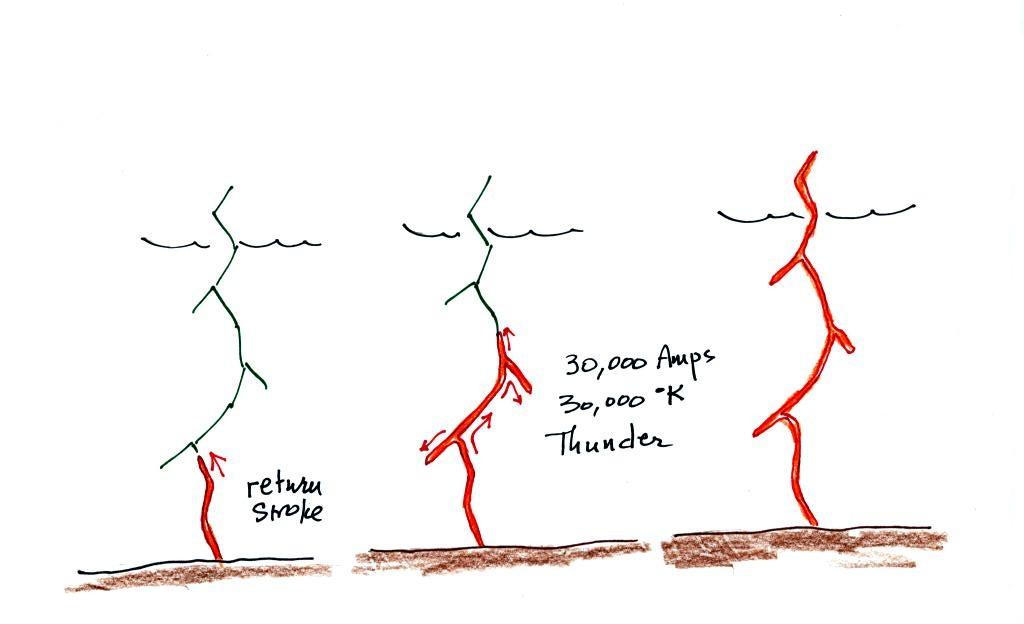
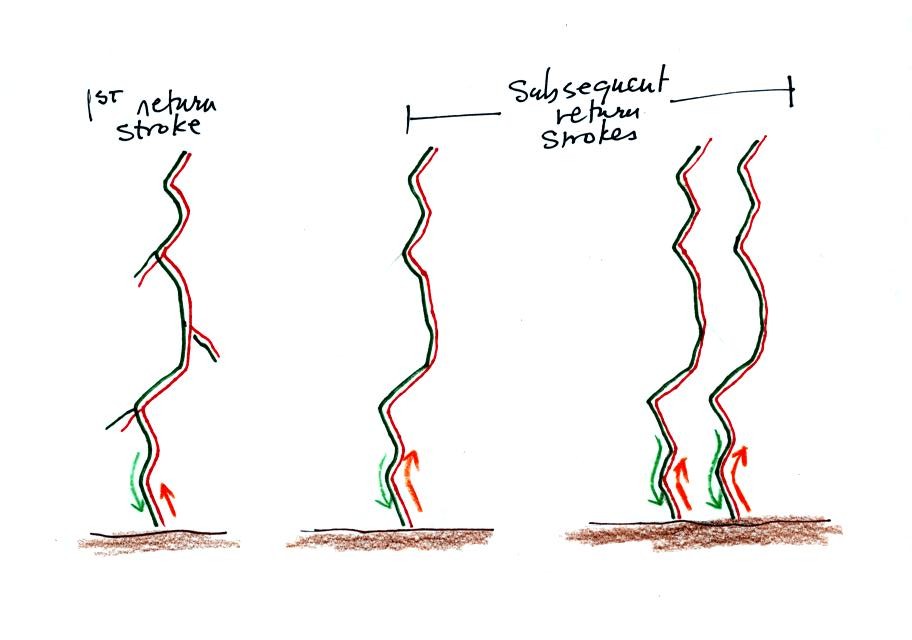
The figure below shows what we've learned so far in
simplified form
A normal
still photograph would
capture the
separate
return strokes
superimposed on each other. If you bumped or moved the camera
during the photograph the separate return strokes would be spread out
on the image.
The image above shows a multiple stroke flash
consisting of
4
separate
return strokes. There is enough time between separate return
strokes (around 1/10 th
second) that your eye can
separate the individual flashes of light.
When lightning appears
to flicker you are seeing the separate return strokes in a multiple
stroke flash. The whole flash usually lasts 0.5 to 1 second.
Scientists are able to take closeup photographs and make
measurements
of lightning currents using triggered lightning. Triggered
lightning can also be used to test the operation of lightning
protection devices. There are also some good videos of the
experiments on YouTube.
7. A metal car offers pretty good protection during a lightning
storm.
8. Is it safe to use a phone during a lightning storm?
9. How can you estimate
the distance to a lightning strike?
The latest lightning safety recommendation
is
the
30/30 Rule.
The 30/30 rule
People should seek shelter if the delay between
a lightning flash and its
thunder is 30 seconds or less.
People should remain under cover until
30 minutes after the final clap
of thunder.
10. Could lightning be used as a (green) energy source?
The
following
information
won't
be on this week's quiz
We spent a few minutes looking at some unusual upper
atmospheric phenomena that are sometimes produced by lightning.
The figure (source:
Wikipedia) below gives you an idea of where sprites, elves,
and blue jets are found and sort of what they look like. They're
very faint and don't last very long so they difficult to see.
You find some good actual pictures of sprites (mainly) at this sky-fire.tv
website. A
site maintained by the New Mexico Institute of Mining and
Technology (NM Tech) also has some good photographs, video, and more
information about these phenomena.