Tuesday Aug. 30, 2011
click here to
download today's notes in a more printer friendly format
Four
songs
from Julia
Lee
before class this morning ("Gotta Gimme What'cha
Got", "Don't Come
Too Soon", "Ain't It A Crime", and "Snatch and Grab It"
)
The 1st Optional
Assignment of the semester was handed out in
class today. It's due at the start of class next Tuesday.
You
don't have to do this assignment but can earn up to 0.3 extra credit
points if you do. But you
should finish the assignment before coming to class, don't let me find
you
furiously trying to finish the assignment before class next
Tuesday.
You can always turn in assignments ahead of time (several students had
completed the assignment by the end of class this morning).
Now we're ready to start a section on air pollutants. We'll
spend today and Thursday on this topic.
We listed
the 5 most abundant gases in the atmosphere at the beginning of
class.
Several more important trace gases were added to the
list in
class. Trace gases are gases found in low
concentrations in the air (and often the concentrations are
variable).
Low concentrations doesn't mean they aren't
important, however.
Water vapor, carbon dioxide,
methane, nitrous oxide (N2O
=
laughing
gas),
chlorofluorocarbons,
and
ozone
are
all
greenhouse
gases.
Increasing
atmospheric concentrations of these gases are responsible
for the current concern over climate change and global warming.
We'll
discuss this topic and learn more about how the
greenhouse effect actually works later in the course.
Carbon monoxide, nitric oxide, nitrogen dioxide, ozone, and sulfur
dioxide are some of the major air pollutants. We'll cover some of
these in more detail today and Thursday.
Ozone has sort of a Dr. Jeckyl and Mr. Hyde personality
(i) Ozone in the
stratosphere (a layer of the atmosphere between 10 and 50
km altitude) is beneficial because it absorbs dangerous high energy
ultraviolet
(UV) light coming from the sun. Without the protection of the
ozone layer, life as we know it would not exist on the surface of the
earth. Chlorofluorocarbons are of concern because they destroy
stratospheric ozone.
(ii) In the
troposphere (the bottom 10 kilometers or so of the atmosphere &
where we live) ozone is
a
pollutant and is one of the main ingredients in photochemical smog.
(iii) Ozone is also a greenhouse gas.
I like lists. Here are lists of the major causes of death in
the US and worldwide.
Air
Pollution (both indoors and outdoors) is a serious health hazard in the
US and around the
world. Click here
to download a copy of the statistics shown below.
Keep in mind that many of these
numbers are difficult to measure
and some may contain a great deal of uncertainty. The row that is
highlighted, toxic agents, contains estimates of deaths caused by
indoor and outdoor air pollution, water pollution, and exposure to
materials such as asbestos and lead both in the home and at the work
place. It is estimated that 60% of the deaths are due to exposure
to particulate matter, something that we will examine in a little more
detail later this week.
Air pollution is also a serious hazard
worldwide. Interestingly indoor air pollution is, in many places,
a more serious threat than outdoor air pollution. I'm not sure
how the researchers determine that 150,000 people are killed by climate
change every year.
The Blacksmith
Institute listed the Top 10 polluted places in the world in a
2007 report. The report has received a lot of worldwide
attention. If you go to this
address (click on 2007 at the top left edge of the page) you can
view the report online or download and print a
copy of the report. This is just in case you are interested.
We'll start our coverage of air pollution with a section on carbon
monoxide. You'll find
additional information on carbon monoxide and other air pollutants at
the Pima
County Department of
Environmental Quality website and also at the US Environmental
Protection Agency
website.
We will mostly be talking about
carbon
monoxide found outdoors, where it would rarely reach fatal
concentrations. CO is a serious hazard indoors also where it
can (and does) build up to deadly concentrations. (
several people were almost killed in Tucson last December)
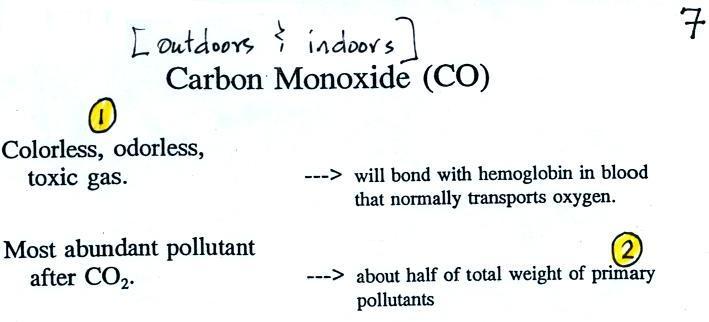
Carbon monoxide is insidious, you can't smell it or see it
and it can kill you (Point 1).
Once
inhaled,
carbon
monoxide
molecules
bond
strongly
to
the
hemoglobin
molecules
in
blood
and
interfere
with
the
transport
of
oxygen
throughout
your
body.
The
article
above
mentions that the CO poisoning victims
were put inside a hyperbaric (high pressure) chamber filled with pure
oxygen. This must force oxygen into the blood and displace the
carbon monoxide.
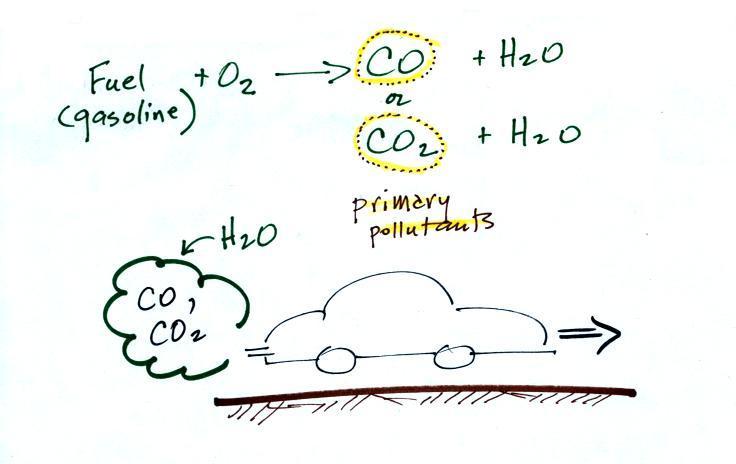
CO is a primary pollutant (Point 2
above). That means it goes
directly from a source into the air, CO is
emitted directly from an automobile tailpipe into the atmosphere for
example. The difference between
primary and secondary pollutants is probably explained
best in a series of pictures.
In addition to carbon monoxide, nitric oxide (NO) and sulfur
dioxide (SO2), are also primary
pollutants. They all go
directly from a source (automobile tailpipe or factory chimney) into
the atmosphere. Ozone is a
secondary pollutant (and here we are referring to tropospheric ozone,
not stratospheric ozone). It doesn't come directly from an
automobile tailpipe. It shows up in the atmosphere only
after a
primary pollutant has undergone a series of reactions.
Point 3
explains that CO is produced by incomplete
combustion of fossil
fuel (insufficient oxygen). Complete combustion would produce
carbon dioxide,
CO2. Cars and trucks
produce most of the CO in Tucson air.
Vehicles must now
be fitted with a catalytic
converter that will change CO into CO2
(and also NO into N2
and
O2
and hydrocarbons into H2O
and CO2).
In
Pima
County
vehicles
must
also
pass
an
emissions
test
every
year
and
special
formulations
of
gasoline
(oxygenated fuels) are used
during the winter months to try to reduce CO emissions.
In the atmosphere CO concentrations peak on winter
mornings (Point 4). The
reason for this is that surface radiation inversion layers are
most likely to form on cold winter mornings.
In an inversion layer (Point 5)
air temperature increases with increasing altitude which is just the
opposite
of what we are used to. This produces stable atmospheric
conditions which means there is little up or down air motion.
There is very little vertical
mixing in a stable air
layer.

In the left figure above, notice how temperature increases from 40
F to 50 F in the thin air layer next to the ground (it then decreases
with altitude above that). This is the stable inversion
layer. When CO is emitted into the thin
stable layer, the CO
remains in the layer and doesn't mix with cleaner air above. CO
concentrations build.
In the afternoon, the ground warms, and the atmosphere becomes
more
unstable. Temperatures decrease with increasing altitude in the
right figure all the way from the ground to the top of the picture
above. CO emitted
into air at the surface mixes with cleaner air above. The CO
concentrations are more dilute.
Thunderstorms
contain strong up
(updraft) and down (downdraft) air motions. Thunderstorms are a
sure indication of unstable
atmospheric conditions.
Let's imagine that the average carbon monoxide concentration in Tucson
air yesterday was 3 ppm. Is this a high and unhealthy value or
was the air quality OK? We need some more information to be able
to answer this question. We
need to know what an acceptable concentration level for carbon monoxide
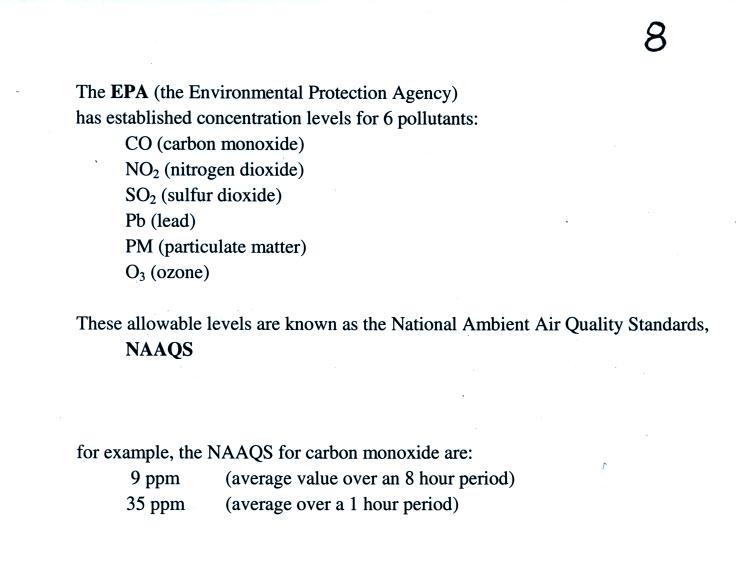
is. The EPA has done just that ( a neater version of the top of
p. 8 in the photocopied ClassNotes is shown below)
The six main pollutants are listed above (there are many more that the
EPA keeps track of).
The concentration of lead in air has decreased
significantly since lead was removed from gasoline (the
following quote is from a
Wikipedia
article
on
gasoline: "In the US,standards to phase out
leaded gasoline were first implemented in 1973 ..... In 1995, leaded
fuel accounted for only 0.6% of total gasoline sales ...... From 1
January 1996, the Clean Air Act banned the sale of leaded fuel
for use in on-road vehicles. Possession and use of leaded gasoline in a
regular on-road vehicle now carries a maximum $10,000 fine in the US.")
In Tucson,
carbon monoxide, ozone, and particulate matter are of primary concern
and daily measurements are reported in the city newspaper. Rather
than report the actual measured values, an Air Quality Index value is
reported instead. The AQI is the ratio of the
measured to accepted
concentrations multiplied by 100%.
If we plug in the 3 ppm value mentioned above for carbon monoxide,
the AQI value would be
The air quality in this case would be good. Air becomes
unhealthy when the
AQI value exceeds 100%. The units "ppm", by the way,
stands for "parts per million." A CO concentration of 3 ppm would
mean that in 1 million air molecules 3 of them would be carbon monoxide.
This information is found on the bottom of p. 8 in the photocopied
ClassNotes. Current
Air
Quality
Index
values
for
Tucson
are
available online.
There was a question from a student at about this point
about
chlorofluorocarbons. CFCs are largely non-toxic. They
probably don't
belong in the same group as poisonous air pollutants like CO. CFC
molecules are of concern because they are very stable and unreactive
compounds. Because of that
they can
make their way up into the stratosphere where they deplete
stratospheric ozone. That's the main source of concern. A
ban on the use of CFCs as
a propellant in aerosol cans was put into place in the US in
1978. International agreements since then such as the 1987
Montreal Protocol have sought to drastically reduce and eventually
eliminate CFC production.
Carbon monoxide is a serious
hazard indoors where is can build to much higher levels than would ever
be found outdoors. This next link is to a newspaper article
describing an
incident at Virginia Tech (that occurred near the beginning of the
school year in 2007). Carbon
monoxide
from a malfunctioning hot water heater sickened 23 Virginia Tech
students in an apartment complex. The CO concentration is
thought to have reached 500 ppm. You can get an idea of what
kinds of health effects concentrations this high could cause from the
figure. on p. 9 in the photocopied ClassNotes.
The 400
ppm line in the ClassNotes approaches the level where CO would cause
coma and
death. At Virginia Tech several students were found unconscious
and one or two had stopped breathing but they were revived.
Carbon monoxide
alarms are relatively inexpensive (~$50) and available at most
hardware
stores. They will monitor CO concentrations indoors and warn you
when
concentrations reach hazardous levels. Indoors CO is
produced by gas furnaces and water heaters that are
either operating improperly or aren't being adequately vented
to the outdoors. A few hundred people are killed indoors by
carbon
monoxide every
year in the United States. You can learn
more about carbon monoxide hazards and risk prevention at the Consumer Product
Safety Commission web page.
This was a
good point for a demonstration, one that was once voted
the prettiest demonstration of the semester.
You are able to see a lot of things in the atmosphere (clouds,
fog, haze, even the blue sky) because of scattering of light. I'm
going to try to make a cloud of smog in class later this week.
The
individual droplets making up the smog cloud are too small to be seen
by
the
naked eye. But you will be able to see that they're there because
the droplets scatter light. So we took some time for a
demonstration that tried to show you
exactly what light scattering is.
In the first part of the demonstration a narrow beam of intense
red
laser light was shined from one side of the classroom to the
other.
Looking down on the situation in the figure above. Neither
the students or the instructor could see the beam of light.
Nobody could see the beam because there weren't any rays of light
pointing from the laser beam toward the students or toward the
instructor.
The instructor would have been
able
to see the beam if he had stood at the end of the beam of laser light
and looked back along the beam of light toward the laser. That
wouldn't have been a smart thing to do, though, because the beam was
strong
enough to possibly damage his eyes (there's a warning on the
side of the laser).
Everybody was able to see a bright red spot where the laser beam struck
the wall.

This is because when the intense beam of
laser light
hits the wall it
is scattered (splattered is a
more descriptive term). The original beam is broken up into a
myriad of weaker rays
of light that are sent out in all directions. There is a ray of
light
sent in the direction of every student in the class. They see the
light because they are looking back in the direction the ray came
from. It is safe to look at this light because the original
intense beam is split up into many much weaker beams.
Next we clapped some erasers together so that some small
particles of chalk dust fell into the laser beam.

Now instead
of a single spot on the wall, students
saws lots of
points of light coming from different positions along a straight
segment of the laser
beam. Each of these points of light was a particle of chalk, and
each piece of chalk dust was intercepting laser light and sending light
out in all directions. Each student saw a ray of light coming
from
each of the chalk particles.
We use chalk because it is white, it will scatter rather
than absorb visible light. What would you have seen if black
particles
of soot had been dropped into the laser beam?
In the last part of the demonstration we made a cloud by
pouring some
liquid nitrogen into a cup of water. The cloud droplets are much
smaller than the chalk particles but are much more numerous. They
make very good scatterers.

The laser beam is visible in the left 2/3 rds of the picture
because it is passing through cloud and light is being scattered toward
the camera. There wasn't any cloud on the right 1/3rd of the
picture so you can't see the laser beam over near Point 1.
There's something else going on in this picture also. We're
not just seeing the narrow beam of laser light but some of the cloud
outside the laser beam is also visible.
Up to this point we've just considered single scattering. A beam
of light encounters a cloud droplet or a particle of chalk and gets
redirected and then travels all the way to your eye or to a
camera. That's what's happening at Point 2. You just see
the narrow laser beam. But sometimes the scattered ray of light
runs into
something else and gets scattered a 2nd or a 3rd time. This is
called multiple
scattering. And that is what is illuminating the cloud alongside
the beam of laser light at Point 3. Light is first scattered by a
cloud droplet in the beam. As it leaves the beam it runs into
another droplet and gets scattered again. So now it looks like it
is coming from the cloud surrounding the laser beam rather than from
the beam itself.
Here's a comment that wasn't mentioned in
class
Air molecules are able
to scatter light too, just like cloud droplets. Air molecules are
much smaller than cloud droplets and don't scatter much light.
That's why you couldn't see the laser beam as it was traveling from one
side of the classroom to the other through the air. Outdoors we
are able to see sunlight scattered by air molecules. This
is true
for a couple of reasons. The sunlight is much stronger than the
laser beam and its shining through a lot more air.
Sunlight is
white light which means it's made up of a mixture of violet, blue,
green, yellow, orange, and red
light. Air molecules have an unusual property: they scatter the
shorter wavelengths (violet, blue, green) much more readily than the
longer wavelength colors in sunlight (yellow, orange, and red).
When you look away from the sun and look at the sky, the blue color
that you see are the shorter wavelengths in sunlight that are being
scattered by air molecules.
We'll come back to the topic of light scattering later this week or
early next week. when we
cover particulate matter and its effect on visibility.
We had a little time to start a
short section on sulfur dioxide, the
2nd air pollutant we will be concerned with.
The following information is on p. 11 in the photocopied ClassNotes.
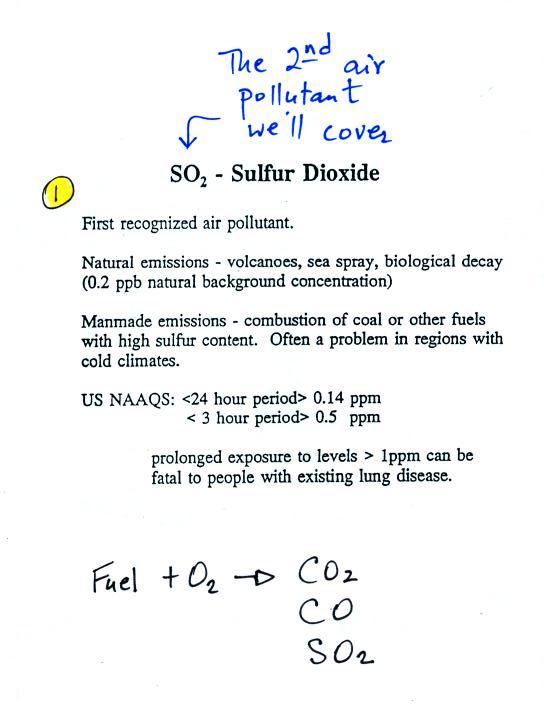
Sulfur dioxide is produced by the
combustion of sulfur
containing
fuels such as coal. Combustion of fuel also produces carbon
dioxide and carbon monoxide. People probably first became aware
of sulfur dioxide because it has an unpleasant smell.
Carbon
dioxide and carbon monoxide are odorless. That is why sulfur
dioxide was the first pollutant people became aware of.
Volcanoes are a natural source of sulfur dioxide.
Some
of the photographs below come from articles published in 2002 on the
50th anniversary of the event.
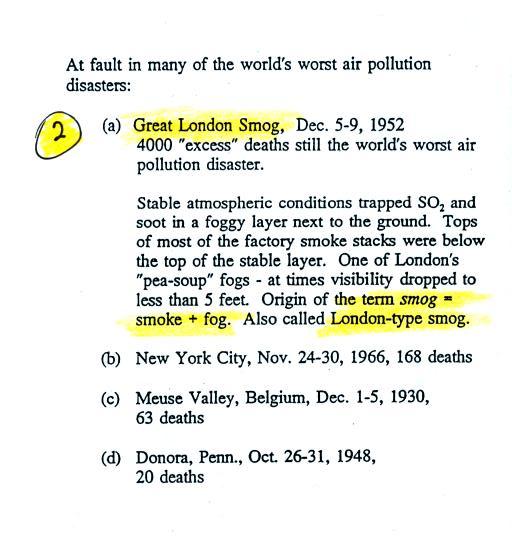
The sulfur dioxide
didn't
kill people directly. Rather it would aggravate
an existing
condition of some kind. The SO2 probably
also made people susceptible
to bacterial
infections such as pneumonia. Here's
a
link that discusses the event and its health effects in more
detail.
London type smog which contains sulfur dioxide and is
most
common
during the winter is very different from photochemical or Los Angeles
type smog, something we will be learning about later this week.
Los
Angeles type smog contains ozone and is most
common in the summer.
Some other air pollution disasters also involved high SO2
concentrations. One of the deadliest events in the US occurred in
1948 in Donora, Pennsylvania.

"This eerie
photograph was taken at noon
on Oct.
29, 1948 in Donora, PA as deadly smog enveloped the town. 20 people
were asphyxiated and more than 7,000 became seriously ill during this
horrible event." The photograph below shows some of the mills
that were operating in Donora at the time. The factories were not
only emitted pollutants into the air but probably also discharging
pollutants into the river.
from: http://oceanservice.noaa.gov/education/kits/pollution/02history.html
from: http://www.eoearth.org/article/Donora,_Pennsylvania
"When
Smoke
Ran
Like Water," a
book
about air pollution is among the books that you can check out, read,
and report on to fulfill part of the writing requirements in this class
(instead of doing an experiment report). The
author, Devra Davis, lived in Donora Pennsylvania at the time of the
1948 air pollution episode.